
Every Village Needs a Temple: Why Do We Need Monks and Followers?
Venerable Thich Chan Quang shares insights on the role of the temple, the monk, and the followers in the spiritual life of Vietnamese people, along with a call to practice to find true happiness.
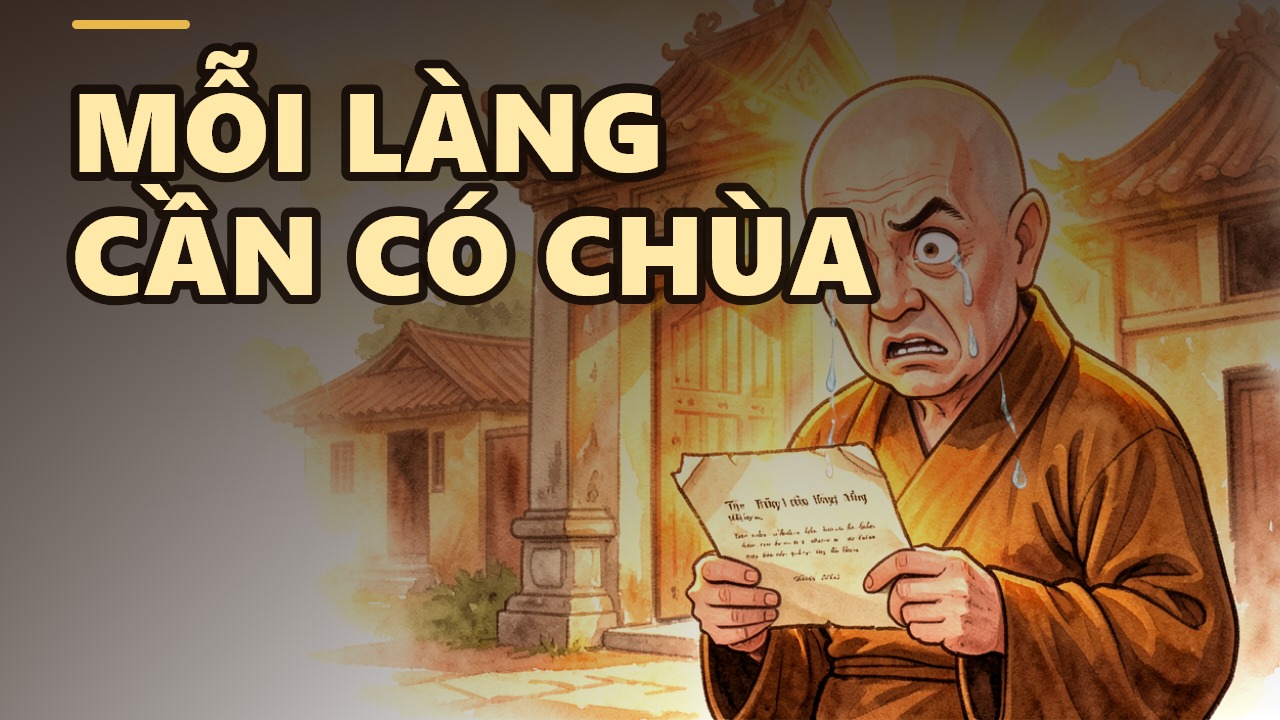
Have you ever paused in a peaceful village, heard the temple bell ring, and wondered: What creates happiness for a community? Could it be that when a temple stands, supported by a true monk and devoted followers, that place becomes exceptionally serene?
A Call from Over a Century Ago
Venerable Thich Chan Quang begins with a historical story about Vice Scholar Nguyen Sinh Sac – the father of President Ho Chi Minh. He once sent a letter to Nghe An province, urging his people to develop Buddhism to preserve the nation. But the letter was intercepted by French secret police, and nearly one hundred years later it was found. The Venerable emphasizes: "A nation must still have a soul to live. Our Dharma walks hand in hand with the nation."
The Vice Scholar's vision was truly clear-sighted: when Buddhism develops powerfully and the people possess firm spiritual faith, the nation will stand firm against all hostile forces.
The Temple, the Monk, and the Followers: The Trio of a Happy Village
According to the Venerable, every village should possess three things: a temple, a truly practicing monk, and devoted followers. The temple is the place of worship of the Buddha, the spiritual anchor for the village people; but to realize its value, a monk is needed to teach and guide; and followers are needed to preserve and spread this spirit. He says: "The temple is the point of worship for the Buddha, where we direct our hearts, where we ignite the spiritual life of our village."
However, in many places only the old temple foundation remains, with no monk and no followers. In some places there is a monk but no temple. The Venerable speaks of devoted leaders who have advocated for temple reconstruction, and of true monks who have inspired the people's faith so that temples can be built. This is a joyful development.
Why Is There a Lack of Those Who Ordain?
Every village with a temple, every temple with a monk – this is the dream, but the reality is very difficult due to a lack of those who leave home to ordain. People fear abandoning worldly pleasures: fine clothes, cars, and romantic freedom. Life in the temple sounds austere, with strict precepts. The Venerable acknowledges this, but then points out: "What we think are the pleasures of this world are merely the edge of an abyss behind them. The world has little joy, much suffering, and even more danger."
He also tells of people who, after marrying and having children, finally understand the suffering hidden behind what seemed like happiness. And when they enter the path, they discover the opposite truth: a life of pure monastic practice is true happiness.
Practicing to Experience True Happiness
The Venerable offers a very ordinary example: when others praise us, we are happy; when criticized, we are sad. Our mind changes with praise and blame, becoming unsettled. A practitioner learns to stand firm before such things, maintaining inner peace. He asks: "Between a life where our mind shifts with praise and blame, and a life of tranquility before all things, which do we choose? This is the life of a practitioner who finds it far more fulfilling."
But one must practice to see this. The Venerable encourages: "Enter the path, try practicing, and you will understand why some people leave the world behind to choose a life of purity."
Happiness does not lie in fleeting, short-lived pleasures. Happiness is when our mind is calm and unmoved. Try sitting quietly for a moment, chanting a sutra once, hearing a Dharma word, and you will understand why monks choose this path. And who knows, in some village, you might add a bit of faith, helping to make the path of "every village, one temple" a reality.
AI-assisted translation from the Vietnamese original.
Read in Vietnamese →