
No One Can Surpass Him, Yet Anyone Can Equal Him: The Message Behind the Buddha’s Title of "Unsurpassed Teacher"
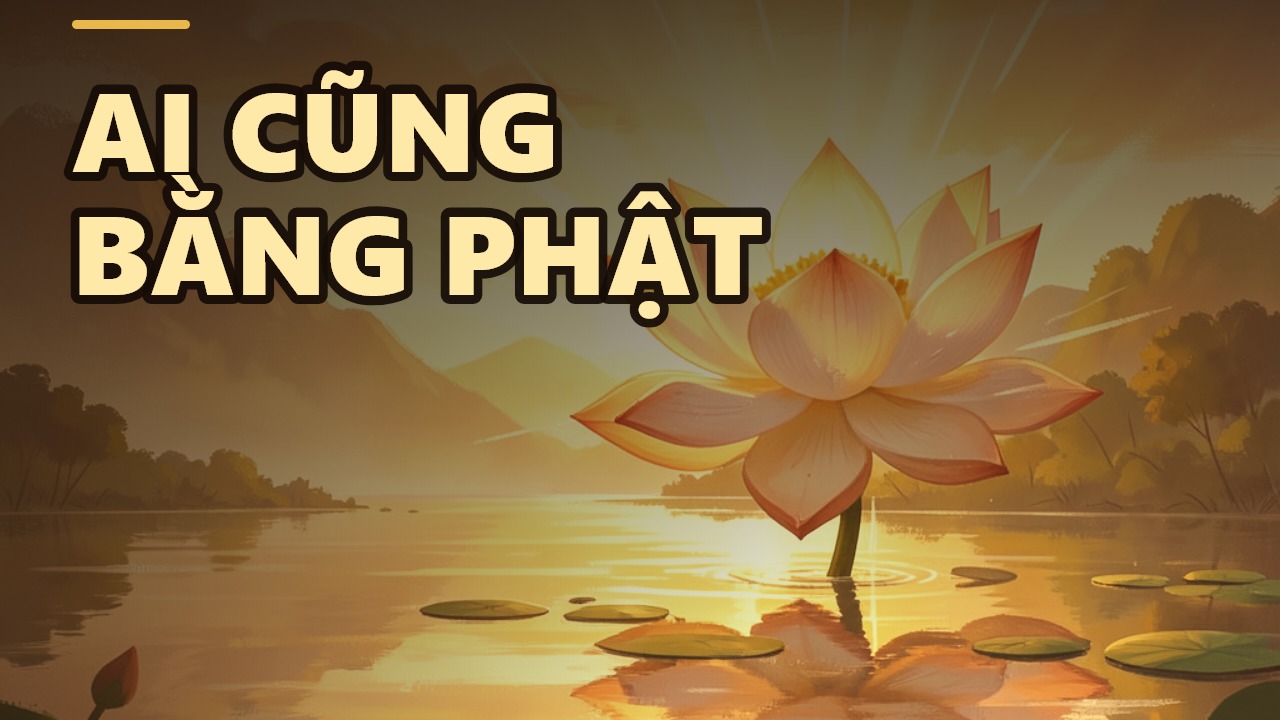
The ten titles of the Buddha do not merely honor an enlightened being; they reveal a path open to all of us. This article explores their profound meaning and invites us into action.
Have you ever wondered why the Buddha is called the "Unsurpassed Teacher"? Does this mean He is the highest deity, with no equal? In a dharma talk on the Lotus Sutra, Venerable Thich Chan Quang clarified a surprising point. This title does not imply exclusivity. Instead, it signifies a destination that every one of us can reach. Let us explore this together.
## World-Knower: Omniscient Understanding of the Three Realms
World-Knower refers to understanding the world. However, according to Venerable Chan Quang, the world is not just our current life filled with worries. It encompasses three realms: the realm of desire, the realm of form, and the formless realm, stretching from hell to the highest heavens. We only understand our own realm, often remaining confused by issues like why some nations are wealthy while others are poor, or why epidemics arise. Only the Buddha fully perceives the conditions (dependent origination) behind all phenomena.
"In the problems of sentient beings, there is logic and reason... but no other being can understand them as completely as the Buddha."
This reminds us that every phenomenon has natural causes. For example, when a nation disregards immigrants, such discriminatory thoughts lead to karmic consequences of decline. Conversely, people living ethically help their country flourish. The Buddha’s understanding is not mere knowledge. It is seeing clearly the connection between cause and effect (karmic law) across all realms.
## Unsurpassed Teacher: No One Can Surpass Him, Yet Anyone Can Equal Him
This is the most distinctive aspect of Buddhism. In many religions, God is the highest being whom no one can become. But the Buddha, though supreme, opens a path for us to reach that absolute state. Venerable Chan Quang explains:
"What does 'highest' mean? It means no one can equal me, right? No one can match me. But the word 'unsurpassed' means no one can be better than me, yet anyone can equal me."
Thus, "Unsurpassed Teacher" is not a monopoly. It is an absolute peak that everyone can touch. We may feel small like grains of sand, but we can become vast deserts or boundless oceans. The more we understand this, the more we revere the Buddha, for He showed the path for all beings to evolve.
## Tamer of Men: Transforming Souls Through Compassion
Tamer of Men describes one who has the power to transform sentient beings. In reality, transforming a person is difficult. A teacher may instruct students, but if the student lacks the right conditions (dependent origination), they will not listen even if spoken to. Yet the Buddha possesses immense spiritual power. He does not need to speak much. His mere presence is enough to change another’s life.
"He did not speak in words, but simply sat quietly, looking down. Without even looking at us, just seeing the Buddha’s appearance made us want to leave home and follow Him immediately."
Through the power of compassion and great realization, the Buddha’s radiance shines not only in the human realm but also illuminates invisible realms. Many invisible beings seek Him out to be moved and to shift their karma. This demonstrates miraculous teaching through a pure soul, requiring no empty words.
## Teacher of Gods and Humans: Keeping Us From Falling Into Lower Realms
This title highlights the Buddha’s role as the teacher of both gods and humans. Why? Because His teachings prevent sentient beings from falling into the three lower realms: hell, hungry ghosts, and animals. By practicing even a part of these teachings, we secure a human rebirth. If we practice well, we may be born in heavenly realms.
"The teachings He proclaimed, if practiced by sentient beings, ensure they first avoid falling into the three evil paths of hell, hungry ghosts, and animals, and certainly attain a human body."
Venerable Chan Quang shares a story of an elderly couple who lived ethically, teaching their children generosity and kindness. When they passed away, they departed peacefully and were reborn in heaven. This proves the protection offered by the Buddha's teachings (Dharma). Therefore, whenever we visit a temple to hear a dharma talk, it is due to conditions (dependent origination) planted over many lifetimes. We have been disciples of the Buddha since past lives, and today we continue learning the path.
## Blessed One: The Peak of Enlightenment and Practice
Finally, the title Blessed One confirms that all nobility stems from enlightenment. Enlightenment is not just theory; it is action. Venerable Chan Quang emphasizes that good thoughts alone are insufficient. We must act to make goodness our nature.
"When thoughts turn into actions, they become our true good nature and carry over from this life to future lives."
Many intellectuals speak beautifully but never act. Meanwhile, uneducated people who constantly help others truly embody the teachings. Let us practice starting with small acts: making offerings, yielding, and helping. Only then does enlightenment imprint itself on our mind/heart, bringing us closer to the unsurpassed peak.
The ten titles of the Buddha are not just for honoring Him. They are mirrors showing us the way. As the teacher said, each of us can become an unsurpassed teacher if we cultivate and transform ourselves. Begin today with practical actions. Do not just think; do. When the mind/heart is purified, the path to enlightenment naturally unfolds.
AI-assisted translation from the Vietnamese original.
Read in Vietnamese →