
Ascetic Practice and Solitary Dwelling: Understanding Correctly to Practice Correctly
Venerable Thích Chân Quang helps us understand solitary dwelling and ascetic practice in Buddhism: they are a measure of spiritual strength, not a doctrine. What matters is living in community, cooperating, and understanding precepts as means.
Have you ever wondered: must a practitioner necessarily live in solitude and austerity in order to practice correctly? Or can one live amid everyday life, still cultivating the path, while accomplishing great works of the Dharma? Today, let us listen to the sharing of Venerable Thích Chân Quang to gain a clearer view of the path of genuine practice.
1. Living in community – the foundation of all great Dharma works
In his New Year dharma talk, Venerable Thích Chân Quang opened with a very practical observation: to accomplish great works of the Dharma, we need the contribution of many people. But first, each person must have the ability to cooperate. And to cooperate, the essential prerequisite is knowing how to live in community, living harmoniously with others.
"To accomplish great Dharma works, many people must join hands and contribute. And to join hands and contribute together, each person must have the ability to cooperate."
The Venerable emphasized: when we begin a task, we may be assigned to mop the floor while another sweeps the walls, yet we must still support one another. That is the spirit of cooperation, the way of life of a disciple of the Buddha. If someone only likes living alone, without relating to anyone, it will be difficult to create great things for the Dharma and for sentient beings.
2. Solitary dwelling and ascetic practice: a measure of spiritual strength, not a doctrine
This is not to deny the value of solitary dwelling and ascetic practice. In the scriptures, the Buddha once praised Mahākāśyapa, who lived ascetically in the mountains and forests, wearing ragged robes. He was a model for the monastic community. But Venerable Chân Quang gently reminds us:
"Solitary dwelling and ascetic practice are a measure of spiritual strength, but they are not the doctrine of Buddhism."
That is, such practices can help train the mind, but if we absolutize them, practitioners easily fall into self-imposed bondage, straying from the engaged, other-centered spirit of the Buddha's teachings. A person who only cares about their own austerities, living in isolation, cannot contribute to the flourishing of the Dharma and the benefit of sentient beings.
3. The precepts: a means, not an absolute
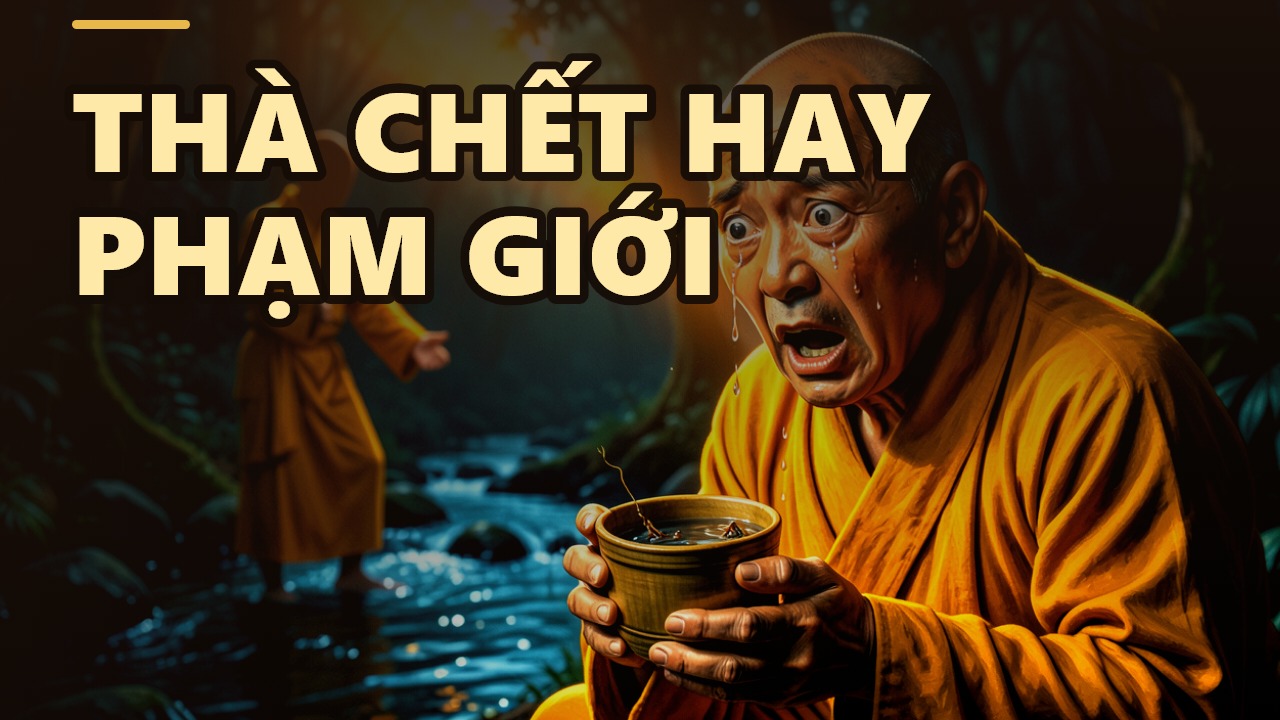
Speaking of the story of two monks who came upon muddy water teeming with organisms — one drank it to survive, the other would rather die than break the precepts — Venerable Chân Quang said we need to understand the true nature of the precepts.
"The precepts are one angle, one means of expressing the Buddha's teachings and principles, but they are not the whole."
He gave an example: the Buddha established the precepts only after thirteen years of teaching the Dharma, when problems arose; before that, practitioners followed the teachings and guarded their own body and mind. Thus, the teachings are the root. The precepts are a means, not something so rigid that one needlessly harms one's own life. What matters is to see further: in complex situations, we need wisdom to weigh good and evil and choose what is right. The Venerable also gave the example of two dogs fighting: one must quickly intervene, perhaps somewhat forcefully, to prevent bloodshed. To outsiders this looks like harm, but in truth it is compassion.
"Do not imagine that the value of the precepts is absolute, to the point of preferring death over breaking them."
4. How to correctly understand "Do not pursue the past, do not long for the future"?
This verse is easily misunderstood as a denial of all memory and planning. Venerable Chân Quang explains: it is simply a warning against letting the past fill us with regret and resentment, or letting a fanciful future sweep us away. We still need to use past experience to live better, and to plan for the future in a realistic way.
"Not pursuing the past means not taking the past to breed regret, not generating feelings of regret. Not longing for the future means simply not indulging in fanciful dreams."
He gave an example: if we have one million in our pocket and plan to buy food, make offerings at the temple, and help the poor — that is wisdom, that is morality. But sitting and dreaming of winning the lottery and then buying a car, buying land, acquiring this and that — that is mere delusion.
5. What to remember in order to practice correctly?
Maintain solitary dwelling and ascetic practice in reasonable measure, but do not regard them as the ultimate goal.
Keep the precepts with wisdom, flexibly according to circumstances, in harmony with the teachings.
Live harmoniously and cooperate with the community; fulfill your duties and support others.
Do not let the past or the future cause suffering or vain daydreams.
Through the sharing of Venerable Thích Chân Quang, we realize that the Buddha's teachings do not encourage extreme austerities or escape from the world. What matters is practicing with awareness in every relationship, knowing how to cooperate, knowing how to live joyfully with the community, and using wisdom to understand the teachings correctly. Let us begin with simple things today: live well with those around us, fulfill our duties, and always keep a heart of compassion and a clear, wise mind. That is the path that leads us to true peace and happiness.
AI-assisted translation from the Vietnamese original.
Read in Vietnamese →