
When the Deepest Pain Unexpectedly Leads to Enlightenment
The story of a monk who was melancholy for twenty thousand years, yet through diligent effort attained the path in a single moment. A lesson on the psychology of repetition, cause and effect (karmic law), and practicing without limits of time.
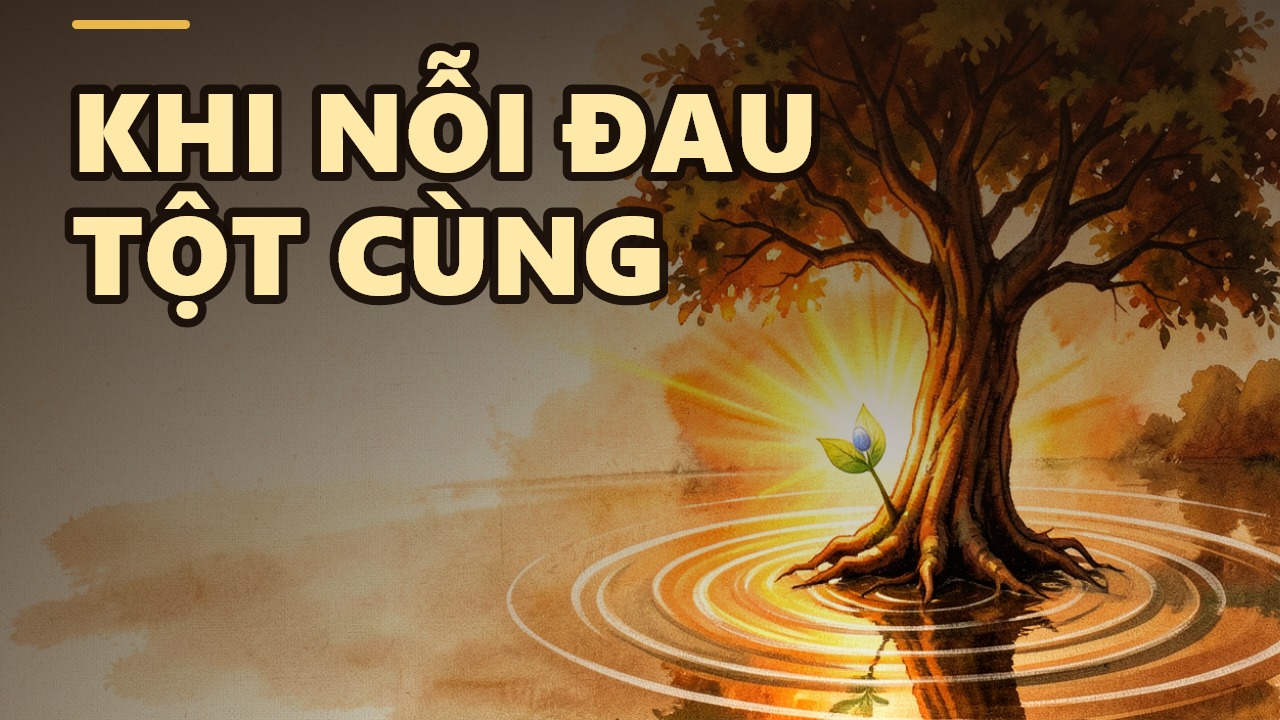
Have you ever felt a nameless sadness, a deep discouragement with no clear cause? Even when life on the outside seems stable, do you find yourself sinking into an indescribable gloom? This was exactly the state of mind of the monk Sapadasa in a story taught by Thay Thich Chan Quang from the Dhammapada. And the miracle is that in the very midst of that deepest pain, the monk attained enlightenment.
1. The Story of a Sadness Without Cause
Sapadasa was a monk who practiced the Dharma correctly and kept the precepts strictly. Yet his heart was always filled with sadness and weariness, and at times he even wanted to end his life. No one understood why, because he practiced so well. Once, he volunteered to release a poisonous snake, but in truth he wanted to reach his hand out so the snake would bite him. The snake did not bite. Then one day, when his head was to be shaved, he asked for the razor, hid in the forest, and intended to cut his own throat. But as he placed the razor against his neck, in that moment of looking back over his life of practice, he suddenly entered deep meditative concentration and attained the fruit of an Arahant.
The Buddha said that time is not the important factor, because Sapadasa had already been meditating for twenty thousand years. Now that the fruit had ripened, the moment he placed the razor to his neck, he attained the path.
This story shows us that the deepest pain can become the greatest turning point. But what matters is what we have accumulated through the years. If we live with diligent effort and perseverance, then even in suffering, no effort of practice is ever wasted.
2. Our Psychology Can Repeat Itself from Life to Life
Thay Chan Quang emphasizes that human psychology tends to repeat itself across lifetimes. If in a past life you were a generous, noble-hearted person, in the next life you will tend toward generosity. If in a past life you were selfish, in the next life you will easily be pulled along by selfish tendencies. The Buddha gave the example that an ant struggling to drag a piece of bread across the floor may be the result of a selfish person whose selfishness was never resolved over many lifetimes.
A person selfish for a thousand past lives, whose selfish psychology was never resolved, who never met a wise spiritual friend to advise them — that selfish tendency repeats itself life after life, and they keep creating the karma of selfishness, which pushes that person further and further down... Today we look at the floor and see an ant dragging a piece of bread, struggling along with such difficulty.
Therefore, we must observe our own mind closely. If we see negative tendencies such as timidity, selfishness, or melancholy, we should kneel before the Buddha in repentance and make the vow to transform them. Do not let them become karmic forces that push us deeper down.
3. The Cause and Effect of Psychology: What You Sow, You Reap
There is a story about a man who went to the river intending to take his own life. Standing on the bridge, he looked back on his life and saw that everyone had betrayed him, and so he grew even more despondent. Suddenly, a mother holding her child jumped into the river. He forgot his own pain and rushed down to save mother and child. After rescuing them, he suddenly felt that life was not so unbearable after all. This is cause and effect (karmic law): when we want others to live, we lose our own thought of suicide.
The cause and effect here is that because he wanted the other person to live, what happened to him? The thought of suicide vanished at once — the thought of death disappeared immediately.
Thay Chan Quang also teaches that suicide for personal reasons is a negative psychology that must be uprooted. Only those who die for a great and righteous cause receive great blessings from merit. Otherwise, when we die for personal reasons, we will suffer far more than we did while alive. So let us learn to live for others — that is the way to uproot negative psychology.
4. Do Not Set Time Limits on Your Practice
Hearing about twenty thousand years of meditative concentration may seem far too long to us. But Thay Chan Quang teaches that time is only relative. What matters is an unlimited aspiration. If we set limits on our practice, thinking something like "I must attain the path in this one lifetime," we may unknowingly fall into a mistaken program. If one lifetime is not enough, we may give up in the next.
If anyone asks me how long I plan to practice before attaining the path, I will say: I vow to strive with diligent effort for two hundred thousand years. With diligent effort — not two hundred thousand years of laziness.
Sow the seed of the unlimited so you may reap the fruit of the unlimited. Do not let your small ego be confined by numbers. Prepare your spirit to practice steadily and perseveringly through countless lifetimes. Then enlightenment will come naturally, like warm sunlight falling upon a heart that has long been waiting.
5. Living One Day Fully in the True Dharma
The Buddha taught: "One who lives a hundred years in laziness without diligent effort is not worth as much as one who lives a single day wholeheartedly in the true Dharma." This is a verse from the Dhammapada, and the story above is its illustration. To live a hundred years without diligent effort, without mindfulness, without awakening, is for life to pass by in meaninglessness. In contrast, even a single day lived with the aspiration for enlightenment, with faith and perseverance, can create immeasurable merit.
One who lives a hundred years in laziness without diligent effort is not worth as much as one who lives a single day wholeheartedly in the true Dharma.
So whatever sadness you may be carrying, do not let it sweep you away. Each day, live fully with a heart of diligent effort, love, and letting go. Kneel before the Buddha in repentance and make your vow. Believe that one day lived wholeheartedly in the true Dharma is worth more than a hundred years of delusion. And perhaps, in the very depths of your deepest pain, you will find the opportunity to awaken.
AI-assisted translation from the Vietnamese original.
Read in Vietnamese →