
When the Demon King Starved the Buddha: A Lesson on the Mind of Non-Possession
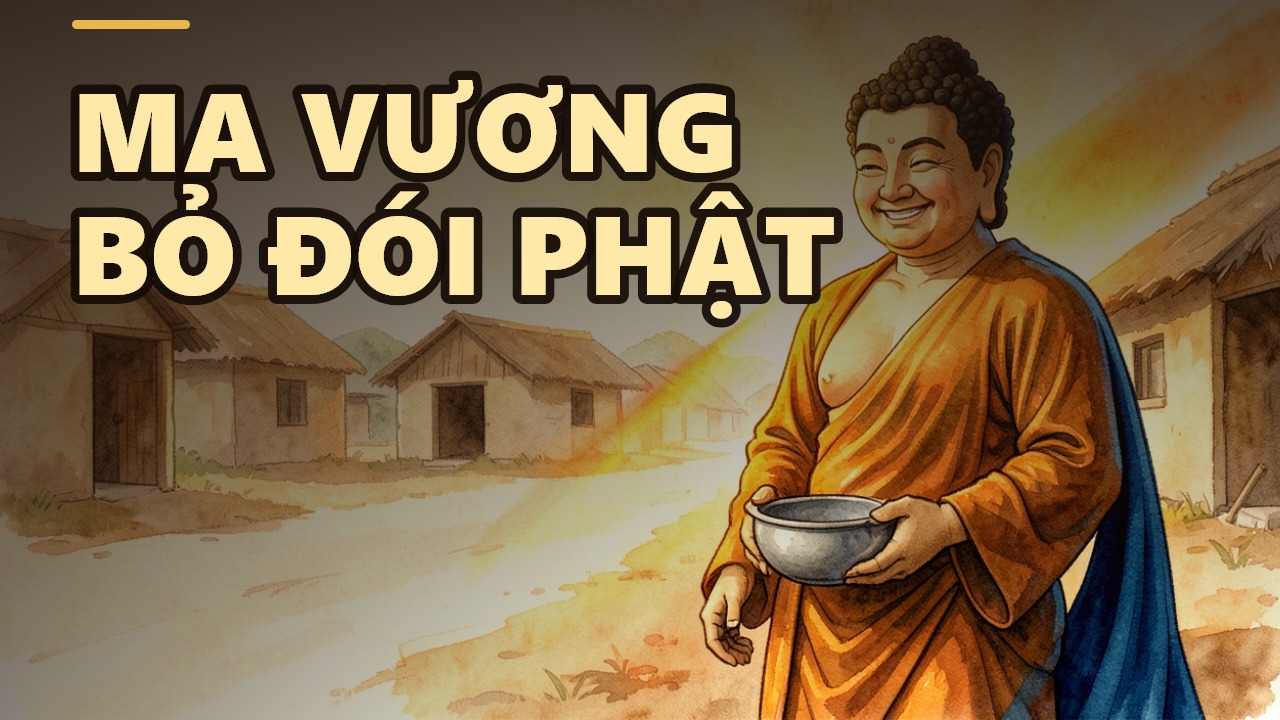
The Buddha was influenced by the demon king so that the villagers would not make offerings to him, yet he remained at peace thanks to a mind that saw nothing as "mine." This lesson helps us recognize the power of demons and the path of awakening.
Have you ever suddenly felt hatred toward someone you once cherished, without knowing why? Perhaps that was not your own emotion, but the power of the demon king at work. In the Dhammapada, teaching story number fifty-six opens for us a surprising view of the supreme power of the demon king, and how the Buddha conquered it not with supernatural powers but with a liberated mind.
The Buddha Was Starved by the Demon King
One day, the Buddha went to a Brahmin village on his alms round, because he knew that some young women there had the conditions to attain realization. The demon king seized the opportunity and influenced the villagers' minds, so that not one of them would offer even a spoonful of rice. The Buddha walked through the entire village, and his bowl came back empty. As he left the village, the demon king appeared to taunt him, inviting him to return so he could be mocked. The Buddha calmly walked back in and met a group of young women returning from their bath. They suddenly felt a heart of reverence and bowed to the Buddha. He taught them, and the women attained the fruit of Stream-Entry right there.
The Buddha said: "The Tathagata lives without ever seeing anything as mine, without seeing anything as self. Therefore the Tathagata's mind is always at peace, always joyful, like the heavenly beings in the celestial realms."
The Power of Demons: Controlling Human Minds
The demon king can influence the human mind, causing people to act against their own good nature. The villagers had a long tradition of supporting monastics, yet they were suppressed by a mind that the demon had aroused. What is striking is that the demon does not appear in visible form; it invades and makes people believe these are their own thoughts. Today, in the form of "living demons" — those who specialize in destroying the Dharma — they use cunning schemes to undermine the faith of Buddhists. They whisper, slander, and sow division, causing many people to abandon their teachers and the path without realizing they have been exploited by demons.
We think we hate on our own, but in truth the demon has already struck.
Understanding and Seeing: The Gap Between the Ordinary and the Noble
The young women attained Stream-Entry not because they understood the doctrine, but because they clearly saw the truth of it. Truth is not something found in books. An ordinary person studies the Buddha's teachings, understands, remembers, and applies them, yet still remains in darkness. A noble one looks at things with eyes free of prejudice, seeing their true nature. It is like a blind person who, no matter how carefully the color yellow is explained — like the oriole bird, like sunlight, like gold — will never see it. One who attains realization is the same; they need not say anything, but they see the truth before their eyes. Once they see, their faith cannot be shaken by anyone.
Why Do Demons Fear Our Practice?
The demon king is a being of power who wants to control sentient beings. When a person practices and gradually escapes the bonds of afflictions (kleshas), the demon loses its power. That is why the demon does not want anyone to attain enlightenment. It will watch and wait, destroying our resolve with unreasonable pretexts. Sometimes we see a long-time practitioner suddenly abandon their teacher and the path over some trivial matter. That is the demon striking at the mind. We need to stay alert and recognize this so we do not fall into the trap.
All of us who come to the Buddha's teachings (Dharma), all of us who practice, are declaring war on the demon.
Buddha and Demon: Two Different Paths
In the story, the demon used supernatural powers to manipulate people's minds. The Buddha did not use supernatural powers to force anyone's respect. The Buddha used only his teachings, letting listeners reflect for themselves and accept through their own awakening. This is the dividing line between a true teacher and a false one. A true teacher opens up wisdom and does not use tricks and deception. Those who wish to practice must rely on the true Dharma in order to attain genuine diligence and true liberation.
What Should We Do to Escape the Demon's Net?
Facing the influence of demons, we should not fall into confusion, but must hold firm to our spiritual resolve. Practice mindfulness, recite the Buddha's name, and chant the sutras so that body and mind remain safe. Like the story of the woman who bought a house haunted by a restless spirit — thanks to regularly listening to dharma talks, making food offerings, and praying for the departed, her home became peaceful and warm. And when a feeling of hatred toward your teacher or fellow practitioners suddenly arises in your heart, remember that it may be the demon's whispering. Place your mind in the true Dharma and trust in the Buddha, and no demon's net can entangle your feet.
In the storm of ignorance, spiritual resolve is a lamp. We need not fear demons; we need only fear losing our own wakefulness. Each morning when we rise, let us recite the Buddha's name and keep the mind at peace. And when we face challenges, let us remember that the Buddha conquered the demon king not with power, but with non-possession and contentment. We can do the same.
AI-assisted translation from the Vietnamese original.
Read in Vietnamese →