
When Technology 4.0 Knocks at the Door: Does the Temple Still Have a Place?
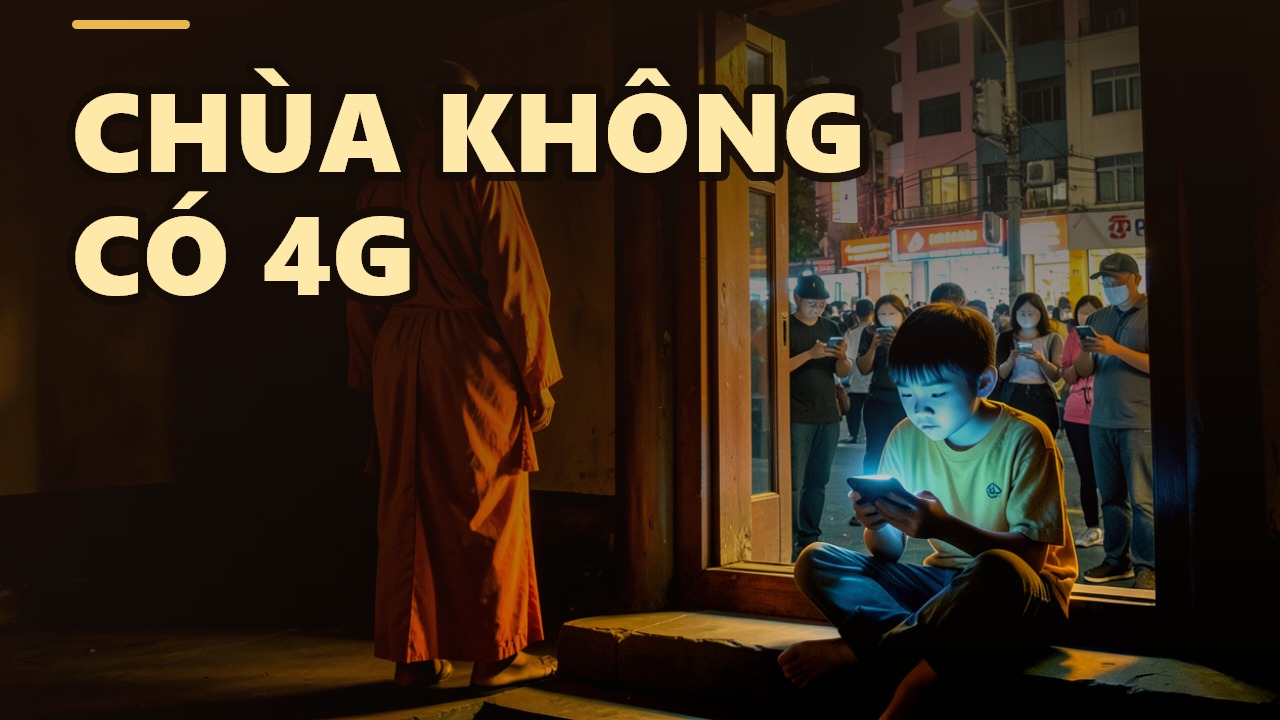
Technology 4.0 is transforming our lives, but it also poses great challenges for Buddhism. Thầy Thích Chân Quang points out the risks and opportunities, while affirming the unchanging value of the Buddha's teachings.
During a family meal, I heard my nephew, an eighth grader, say: "Grandma, I don't want to go to the temple. The temple doesn't have 4G." That innocent remark startled me. Is the temple gradually losing its appeal to the younger generation? And as the world enters the fourth industrial revolution, will spiritual values remain intact?
In a special dharma talk, Thầy Thích Chân Quang shared on "The Challenge of Technology 4.0 to Buddhism." This is not only a lesson for monastics, but for all of us living in the digital age.
Understanding Technology 4.0 Correctly: From the Steam Revolution to Artificial Intelligence
Thầy Chân Quang began with the foundational concepts. Technology 1.0 was when humans created the steam engine, "the machine that could move by itself" — that was amplified physical strength. With technology 2.0, electrification brought energy into every corner of life, from light bulbs to kitchen stoves.
Technology 3.0 was the arrival of computers, when machines began "thinking and calculating on behalf of humans." And technology 4.0 — artificial intelligence — goes even further: it creates, it writes books, it composes music, it controls things remotely, and there are even temples abroad that have built "robot monks" to teach the Dharma.
"Technology 4.0 strikes into the temple and can break the temple, can even erase the temple altogether."
If we do not understand and do not grasp it, we ourselves will be left behind.
How Does Technology 4.0 "Break" the Temple?
Thầy recounted that in the old days, in the countryside without electricity, the temple was the most crowded place because there was nothing else for entertainment. But today, with the internet, with Facebook, with games, people seek everything online. Thầy put it this way: "Eyes lifted to the screen. Time spent on Facebook, time spent on other things, on virtual life, is greater than ever."
The consequence is that the temple grows emptier. Thầy shared how you can tell whether a temple is crowded just by looking at its gate — by seeing whether flies are buzzing around, because "there is nothing to eat there, so even the flies don't bother to come" — a very worldly image that speaks of desolation. Thầy said:
"The flow of life moves forward, the era moves forward, the world moves forward, so everyone is compelled to move forward. But if the temple refuses to move forward, it means the temple remains behind everyone."
People abandon the temple not because they have lost faith, but because the temple no longer walks alongside them in modern life.
Why Has the Temple Emptied of People?
Thầy analyzed the cause: the temple has not kept pace with the times. He gave examples: a Buddhist wants to contact the monk by phone, but the monk has no phone; wants to transfer an offering electronically, but the temple has no bank account. People enjoy modern music, yet the temple chants sutras in old melodies. People value nutritious eating, yet the temple still serves plain rice and vegetables. Thầy concluded:
"People and the temple no longer walk together. What does that mean? It means no one comes to the temple anymore. And the temple grows empty. Emptier and emptier."
But not everyone places the blame on the temple. Thầy raised the question: "Whose fault is it?" He said that it is precisely the stubborn refusal to progress with the times that is the "culprit" driving the temple and people apart.
Has the Temple Become Merely a Service for Rituals?
One heartbreaking reality is that in the 4.0 era, many people only need the monk when someone dies, when rituals are required. Thầy said:
"The temple survives only on that alone; everything else is gone. That is how dangerous it has become."
People do not need to understand what the monk is chanting; they only need him to be present so the funeral is "properly traditional." In this way, the temple's role is reduced to a mere service, losing its meaning of education and spiritual nourishment.
There Are Things Technology Cannot Replace
Amid this bleak picture, Thầy Chân Quang reminded us of an important truth: no matter how far technology advances, some things can never be replaced. These are eating and drinking, sleeping and resting, studying, caring for one's health, and above all, cultivating virtue. Thầy said:
"Cultivating virtue is something you must do yourself in order to have virtue; no machine can cultivate it on your behalf."
This is the unshakable standing ground of Buddhism. Technology can replace many things, but it cannot replace human awakening, it cannot replace compassion, it cannot replace inner peace and joy.
Eating and sleeping — the body must do these itself. Learning — knowledge must be accumulated by the person. Caring for health — no machine can make you healthy in your place. Cultivating virtue — only one's own practice can bring it.
A Lesson for Each of Us
In the 4.0 era, we cannot reject technology, but we also cannot lose our essence. The temple needs to change in order to walk alongside the world, while still preserving its core values. And as Buddhists, let us learn to use technology wisely, so that technology serves our practice and the spreading of the Buddha's teachings (Dharma), rather than pulling us away from the path to enlightenment.
Technology 4.0 is a challenge, but it is also an opportunity. Let us embrace it with wisdom and a heart of compassion.
AI-assisted translation from the Vietnamese original.
Read in Vietnamese →