
When a Bodhisattva Helps You, What Are They Calculating?
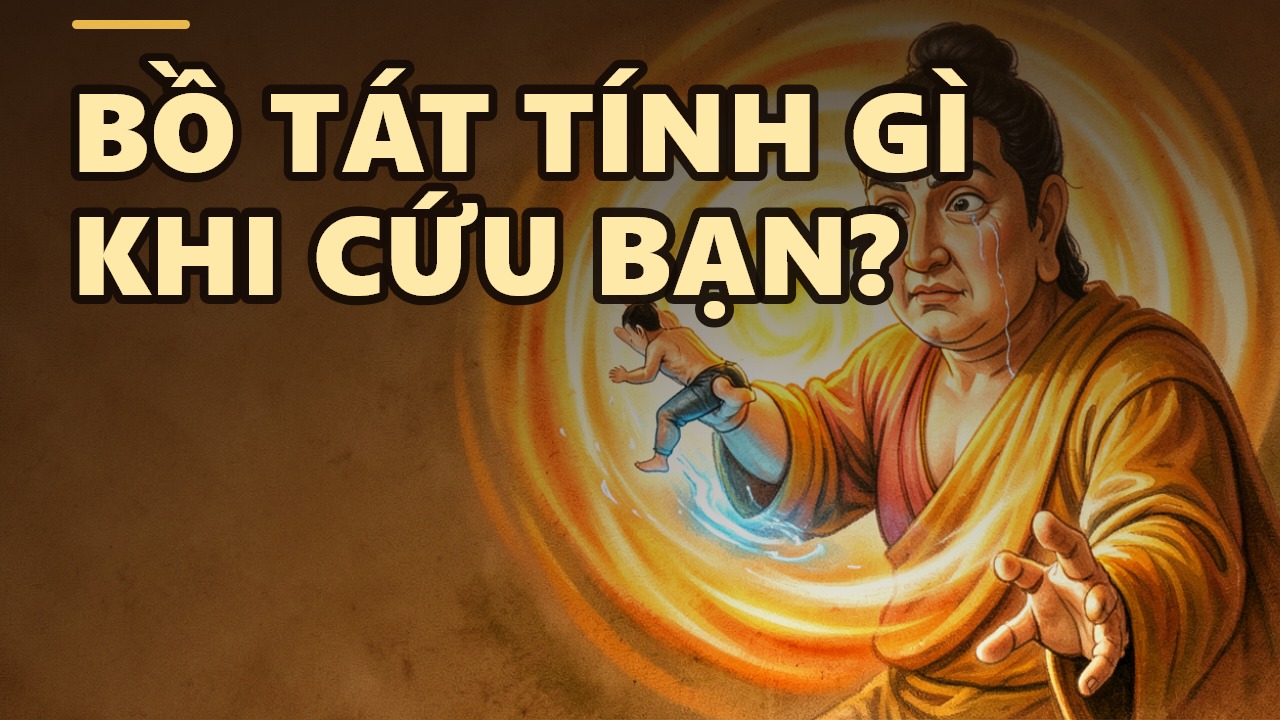
Discover how bodhisattvas apply the profound law of cause and effect (karmic law) in teaching sentient beings. This is a touching and wise dharma talk by Venerable Thich Chan Quang.
Have you ever wondered: "If the Buddha possesses infinite supernatural powers, why does He not simply save all sentient beings from suffering with ease?" This question may seem like a mere curiosity, but it opens a very deep door into the law of cause and effect (karmic law). In this dharma talk, we gain a different perspective: whether they are bodhisattvas or Buddhas, when helping sentient beings, they must also calculate on the scale of cause and effect (karmic law). This does not diminish their power; rather, it reveals the magnificent wisdom of an enlightened being.
### Bodhisattvas Use Supernatural Powers But Still Must Follow Cause and Effect
Imagine a person struggling in a swirling current, facing death at any moment. In desperation, they chant the Buddha's name. Suddenly, a current pushes them to shore. This is the Buddha's supernatural power, but it is not an independent miracle. Venerable Thich Chan Quang explains that in Buddhism, everything must rely on the law of cause and effect (karmic law). Even if a bodhisattva uses supernatural powers, they always calculate based on this law and never depart from it.
This means that when saving someone, the Buddha must consider that person's merit, their spiritual heart, and the karma they must repay. Such help does not erase all karmic debt. Instead, it creates a new equation: the saved person must practice and generate more merit to balance the scales. It is like converting a loan into an opportunity for cultivation, rather than receiving a free gift.
### The Law of Cause and Effect Is the Foundation of the Universe
We often understand cause and effect (karmic law) simply as reaping what we sow. However, according to the teacher, the depth of this law is not simple. He states that the law of cause and effect (karmic law) is the universe, and the universe is the law of cause and effect (karmic law). Why is this so? This vast universe is formed from various fields: gravitational fields, electromagnetic fields, and spiritual fields. Yet above all, there is one absolute field governing all operations—the field of cause and effect (karmic law). Understanding this, we will never act recklessly, because reckless action sows disaster. For a bodhisattva, adjusting cause and effect (karmic law) to help sentient beings is an expression of wisdom, not arbitrary power.
### Loving Children Without Understanding Cause and Effect Can Turn Love Into Disaster
In life, many parents wish for their children's happiness and spare no expense to provide for them. But without understanding the law of cause and effect (karmic law), they inadvertently burn up their children's blessings from merit. The teacher shares that some people constantly take their children on trips here and there, only to find that by age eighteen, the child has no remaining blessings, becoming ignorant and unemployed. He emphasizes that loving a child without calculating based on the law of cause and effect (karmic law) can ruin them completely.
Conversely, parents with a bodhisattva's heart know how to teach their children to create blessings from a young age—learning to love others, help, and give generously. This is the greatest gift parents can leave behind: not wealth, but a heart that trusts in cause and effect (karmic law), allowing the child to walk forward on their own feet, supported by blessings from merit.
### Do Not Hate Evil People, Lest You Become One
There is a profound lesson here. When we see someone engaged in bad professions, we often despise and hate them. But the teacher teaches that such a person was not necessarily evil from the start. Perhaps in a past life, they hated evil people too much and spoke derogatory words, so in this life, they fall into circumstances where they appear evil for a time to learn deeply. Therefore, the teacher reminds us: We should hate evil deeds, but do not hate evil people.
When we understand cause and effect (karmic law) deeply, we no longer blame anyone. We see that everything has a cause. A murderer may be repaying vengeance from a previous life, or nurturing hatred over time. Looking through the eyes of a bodhisattva, we do not condemn them; we only see a human being in pain. From there, instead of distancing ourselves, we can seek ways to help them transform.
### Seven Levels on the Path Home
The teacher teaches that on the journey toward the path, there are many levels from low to high. We can reflect on ourselves to know where we stand. First is knowing the path: encountering the Buddha's teachings (Dharma) and learning the doctrines. Second is cherishing the path: having affection for the Buddha's teachings (Dharma), willing to visit temples and listen to lectures. Third is studying the path: diligently seeking to understand the doctrines deeply. Fourth is practicing the path: beginning to live according to moral principles, avoiding sins, creating merit, and cultivating meditative concentration. Fifth is transforming the path: living the moral principles through one's own life and spreading them to others. Sixth is protecting the path: consciously guarding the Buddha's teachings (Dharma) against misunderstandings and destruction. As we ascend each level, our hearts and lives change profoundly. Especially from the level of transforming the path, we no longer maintain a mediocre attitude but become true propagators of the Dharma in daily life.
### Transforming the Path: When Faith Becomes Practice
One of the best ways to transform the path is to live correctly according to moral principles and let others see this in you. The teacher tells a story of a family arguing over an elderly parent's assets. The child who understood the Dharma advised them by never speaking about the assets, focusing only on how to make the parents happy while alive and after passing. The teacher says that when we live correctly according to moral principles, our thoughts align with them, compelling our speech to match those principles. This begins to influence those around us. Thus, transforming the path is not just writing sutras or giving dharma talks; it is a way of living. When we live kindly, with compassion, and without greed, people naturally find it strange, then curious, and finally trusting. At that moment, moral principles permeate hearts without needing lengthy lectures.
The dharma talk by Venerable Thich Chan Quang opens a practical door for each of us. Do not stop at merely knowing or cherishing the path. Move forward by studying, practicing, transforming, and protecting the path. Each small step every day—a gentle word, a compassionate action, an understanding glance—is applying the law of cause and effect (karmic law) in life. Remember that this universe operates according to an absolute order: cause and effect (karmic law). By living in harmony with this law, we achieve happiness for ourselves and become bodhisattvas gently and profoundly teaching sentient beings.
AI-assisted translation from the Vietnamese original.
Read in Vietnamese →