
When You Think You Are Right, That Is Ignorance
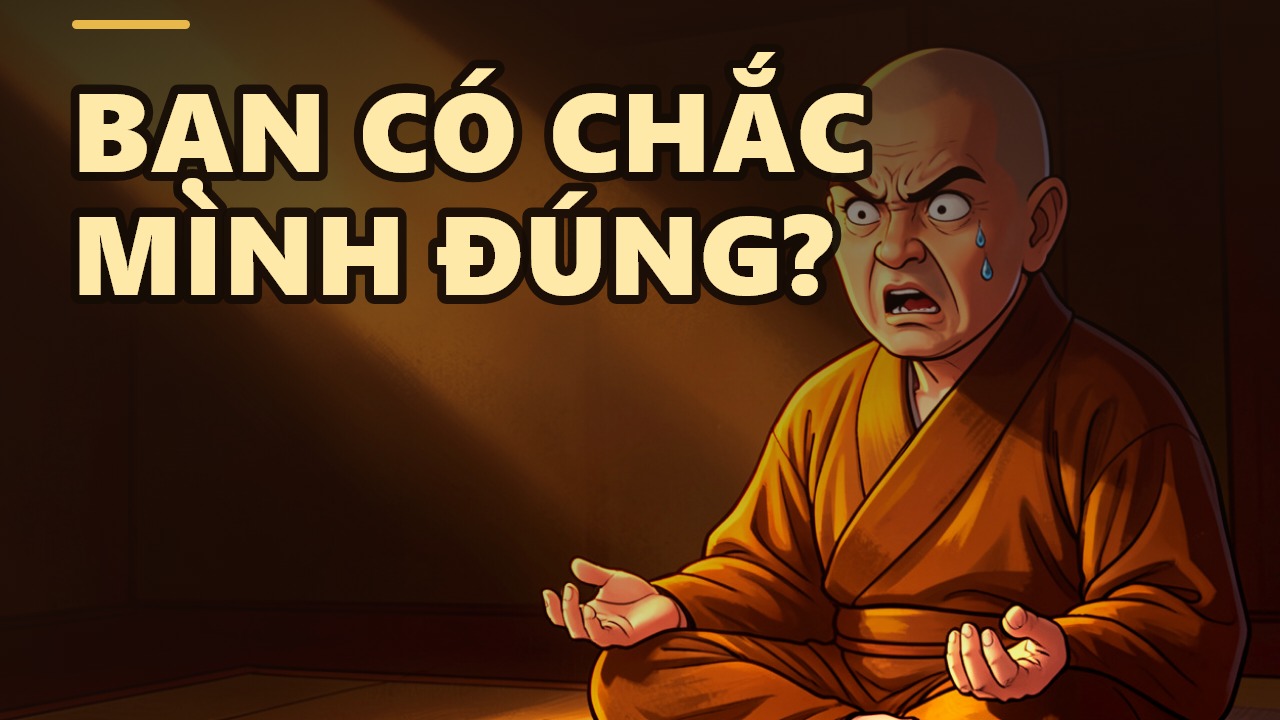
**SUMMARY:** Ignorance is not just foolishness, but a subtle misunderstanding that makes us believe we are right, thereby destroying our path of goodness and practice. Let us look within ourselves to feel startled and reconsider.
Amidst the busy flow of life today, have you ever wondered, “Why do I keep stumbling?” Then you search for ways to blame circumstances or others. But there is a deep, silent reason that even you fail to recognize. That is ignorance—a profoundly dangerous misunderstanding of oneself.
**Ignorance Is Not Just Foolishness**
Hearing the words “ignorance,” many think of someone incompetent or dull-witted. But Venerable Thích Chân Quang teaches this profoundly: “Ignorance is a type of misunderstanding, a mistaken view.” It is not simply confusion, but our skewed perceptions and erroneous interpretations.
“Ignorance is a type of misunderstanding, a mistaken view.”
Because of misunderstanding, upon seeing a beautiful girl, you hastily conclude she must have had plastic surgery or used rice water to become pretty. The Venerable smiles: “You are so ignorant. A beautiful face comes from merit, from that person regularly honoring the Buddha, arranging flowers, and praising others.” Or when seeing someone sitting silently with a frowning face, we quickly blame them for being unfriendly. But in reality, they might have a stomachache and haven’t found a restroom. Such misunderstandings in daily life represent a shallow level of ignorance.
**The Deeper Ignorance: When We Think We Are Right**
The most dangerous level, according to Venerable Chân Quang, is “the misunderstanding about what is right and wrong, good and bad within ourselves.” The psychology of “I’ve done well enough, I’m good enough” exists within each of us. This is the armor of ignorance, sealing shut the path of goodness.
“In the depths of our hearts, we all think: Ah, what I’ve done is fine, how I live is fine, how I treated that person is fine. We are all possessed by this psychology. But I must say that thought is mistaken; it is not yet enough, because there is always a more correct way, a better way.”
Have you ever witnessed siblings fighting over a plot of land left by their parents? Everyone claims they are fair, that they have the right, but deep down lies greed. “We keep being fooled; we deceive ourselves, while in the depths of our hearts, we still think we are right.”
**Practice Is Not Just Chanting Sutras or Reciting the Buddha’s Name**
Many people take pride in daily chanting the Lotus Sutra or reciting Tantric mantras, believing this will ensure their rebirth in a Buddha-land. But Venerable Thích Chân Quang points out that this too is a type of ignorance, an illusion about one’s own practice. Chanting sutras is good, but if it stops there, it is not enough. Some say, “I build roads, bridges, and cook for the hospital—who has more merit than me?”
“The sutras state clearly, and many rely on this to become complacent, certain of a Buddha-land. But chanting the Buddha’s name, reciting sutras—these involve only the mouth, only the name. One must cultivate the mind to become a Buddha.”
The Venerable tells of a Zen master from the North: “At many temples now, everyone chants the Buddha’s name, but claiming to become a Buddha through mere verbal practice is a lie. One must cultivate the mind.” You and I might feel startled and ask ourselves, “What am I truly practicing? Am I relying only on my mouth, on names, and forgetting that a Buddha arises from a pure mind?”
**Do Not Cling to Names, Cling to the Mind**
In the sutras, the Buddha taught that he has no fixed name. He is nameless, formless. And there is a very interesting story about the Zen Master Dongshan:
“My disciples are famous in this world. Now, is there anyone who can destroy my reputation?” A monk knelt and said, “I request the Master’s dharma name.” The Master nodded, “I have lost the sound of my mind.”
The Zen Master realized that names are merely conventional designations, just symbols like ABC. We cling to the name “Chân Quang,” so when someone praises us, we feel happy, and when someone criticizes us, we feel sad. But if we do not cling to names, if we can let go of our perception of ourselves, then we can see our truly pure mind. Only a mind of compassion and wisdom is the path to following the Buddha.
**From Startlement to Practice**
You and I should reflect once more. Are the thoughts “I am right,” “I am good” truly born of a mind of complete compassion and wisdom? The path of learning Buddhism is a path of continuously recognizing our own delusions in order to let go and return to our true heart. Whenever the mind of greed arises, stop and observe it. This is how we do not let ignorance blind us as we enter the new year.
Venerable Thích Chân Quang advises: “We think we are right, but letting go is what is truly right.” A person who knows to yield a plot of land to a younger sibling, who accepts disadvantage yet lives in peace, is one who truly understands ignorance. You do not need to realize the fruit of an Arhat to know this. Start with one small thing: open your heart, listen to opposing viewpoints, and examine yourself again.
Correcting all mistakes is not easy. But once you understand what ignorance is, you will see there is much more to let go of, much more to learn, and we begin to see ourselves in the light of the Dharma. Wishing you a new year filled with clarity, compassion, and wisdom.
AI-assisted translation from the Vietnamese original.
Read in Vietnamese →