
Gentle as Grass, Small as a Fig – Why Do Practitioners Feel Smaller the More They Practice?
A dharma talk by Master Thích Chân Quang opens a profound perspective: the more humble a practitioner becomes, the more they mature. Yet gentleness does not mean weakness – we must keep a resilient heart to protect what is right.
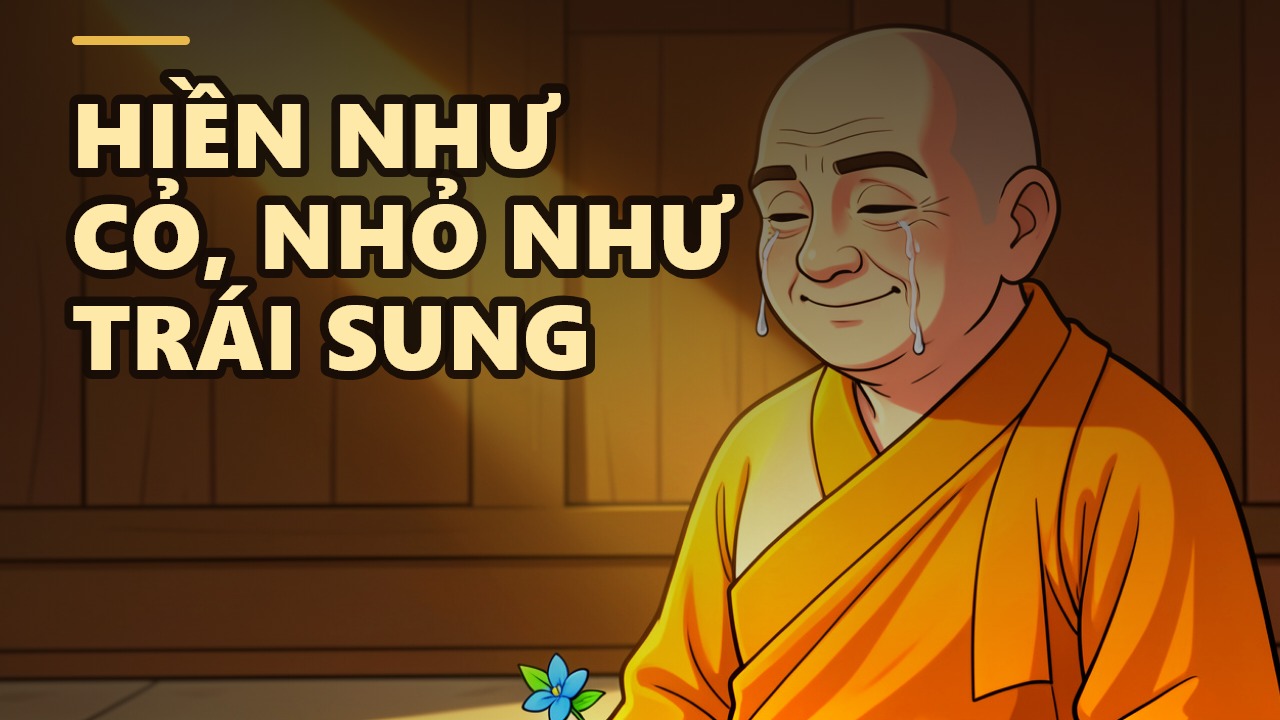
Imagine you have just stepped into a temple, your heart full of joy, when an elderly woman points at you and says, "Young man, please sweep up that pile of trash for me." How would you react? If you are a wealthy Buddhist, accustomed to being respected by others, would you be willing to do it gladly, or would a small sense of wounded pride rise up inside you? Master Thích Chân Quang taught that in that very moment, we are testing the depth of our practice. A deeply cultivated person finds happiness in seeing themselves as small, and that is the first step toward liberation.
"Always see yourself as small. Never see yourself as doing something great or grandiose. If you can keep this heart, then you can walk the path steadily." – Venerable Thích Chân Quang
Seeing Yourself as Small Is Wisdom
In life, we chase after power, status, and wealth in order to feel "bigger" than others. But when we begin to practice, we realize that the feeling of being superior is a burden of the ego – the root of suffering (dukkha). A true practitioner always nurtures the aspiration to see themselves as small as a blade of grass, as dust and earth. This is not weakness, but wisdom that far surpasses ordinary understanding.
Master Chân Quang compares the practitioner to a blade of grass: when the wind blows, it bends; when someone steps on it, it lies still; but when they pass, it slowly rises again. That gentleness and suppleness allow practitioners to pass through every trial without breaking. And the more we keep the heart of smallness, the more our blessings from merit continuously grow, lifting us to higher positions without letting us fall.
"The smaller you become, the greater you grow. A person who always sees themselves as small – their merit will gradually carry them to greater and greater places." – Venerable Thích Chân Quang
But as blessings from merit increase, so does the respect of others. At that point, the resolve to see oneself as small becomes a great challenge. The Master recounted that when a practitioner becomes famous and is revered by Buddhists, without sufficient wisdom, they will begin to see themselves as great, and from there their merit gradually diminishes and they fall. For this very reason, keeping a humble heart – seeing oneself as mere dust in this world – is "an immense, continuous effort," not something easily done.
Gentle but Not Weak
Master Chân Quang emphasized the third part of his teaching: "Gentle as grass, small as a fig, but heroic as a warrior general." If we have only gentleness and smallness, we easily fall into weakness, staying silent in the face of wrongdoing. That is a great mistake, especially for monastics. The Master told the story of the ten thousand monks at the ancient Nalanda University who were killed without any resistance, causing Buddhism in India to be nearly wiped out. Had they stood up to protect themselves and protect the Buddha's teachings (Dharma), history would have turned out differently.
"Gentle, but never weak. Not weak means not merely enduring. It means that when you see wrongdoing, you cannot turn away. You must do something, say something, take some action, so that in this world, little by little, wrongdoing diminishes." – Venerable Thích Chân Quang
So how can we be both gentle and resilient? The Master taught that these two hearts must combine like the two wings of a bird beating together to rise into flight. When we see someone doing wrong, we firmly stop it, but the way we express ourselves must be skillful and gentle, never rude. We do not slam the table or argue to win and satisfy our wounded pride; instead, we rely on love to help the person change.
Love Is Poison When Used Wrongly
In the Buddha's teachings (Dharma), compassion is a deep and vast love, but if it becomes mere indulgence, it turns into poison. Master Chân Quang gave the example of parents who love a wayward child, chasing after them without teaching them, causing the child to fall further. That is the kind of love that indulges – loving in order to please – and it easily leads that person to ruin.
"When you love someone, you must help them become better." – Venerable Thích Chân Quang
A practitioner does not belong to themselves – this body belongs to the Buddha, a precious asset for serving all sentient beings. Therefore, practitioners must all the more take care of their health and stand firm in saying no to wrongdoing, so they can continue to bring benefit to the world. The strictness within compassion is the greatest love, guiding people toward goodness, not love driven by fleeting emotion.
Practicing Today
To walk the path of practice steadily, each of us should learn to live like a blade of grass – simple and humble, yet possessing tremendous vitality. Before every opportunity to serve, to be given a task, see it as an opportunity to discover yourself. And when you encounter wrongdoing, have the courage to speak the truth, but with a gentle and skillful attitude. Thanks to these two wings of the heart beating together, the bird of liberation will slowly soar higher, flying on until it reaches the boundless and infinite.
When you are reborn in a future life into a wealthy and powerful family, may you still remember this teaching: see yourself as small as dust and earth, gentle as grass, yet resilient as a warrior general protecting the true Dharma.
AI-assisted translation from the Vietnamese original.
Read in Vietnamese →