
The Fire Has Gone Out! – Lessons from Master Guishan for Modern Practitioners
Have you ever been asked a question that left you speechless, one that haunted you for the rest of your life? In the kitchen, Zen Master Guishan picked up a handful of rice and asked his disciple Xiangyan: “Thousands upon thousands of grains arise from this single seed. But where did this single seed come from?” Xiangyan was stunned and could not answer. Guishan laughed heartily and walked away. That very question drove Xiangyan to leave his teacher. He lived in despair until one day, hearing the sound of a pebble striking a bamboo stalk, he suddenly awakened.
Today, let us revisit the *Guishan Jingce* (Admonitions of Guishan), a text that every monastic must study. However, we do not study it merely to memorize words, but to become teachers ourselves, passing wisdom on to future generations. This is especially vital in our digital age, when practitioners face temptations that did not exist in Guishan’s time.
### Strict Teachings from a True Practitioner
This text was written by Zen Master Guishan, whose dharma name was Lingyou. He was a renowned great master in ancient China. The word “Jingce” means strict admonition or warning. Although the text is short, if he were alive today, he would likely have written ten times as much. In his era, there were no smartphones, no Facebook, and no internet, so he did not scold those distractions. Yet, we must grasp the spirit of his warnings and apply them to our current reality.
As Venerable Thich Chan Quang teaches, “When we study today, we learn the spirit of these admonitions to apply them to the present age.” When teaching disciples, we must be flexible and expansive to fit actual conditions. For instance, Guishan once criticized monks who gathered closely to gossip after meals. Today, we also contend with phones, computers, and social media. If we cannot master these tools, the six sense faculties become six thieves. Add a seventh faculty—the mind attached to technology—and they become seven thieves. How can one remain a true practitioner then? These are critical topics that require careful discussion and instruction.
### Is There Still Fire? A Question of Enlightenment
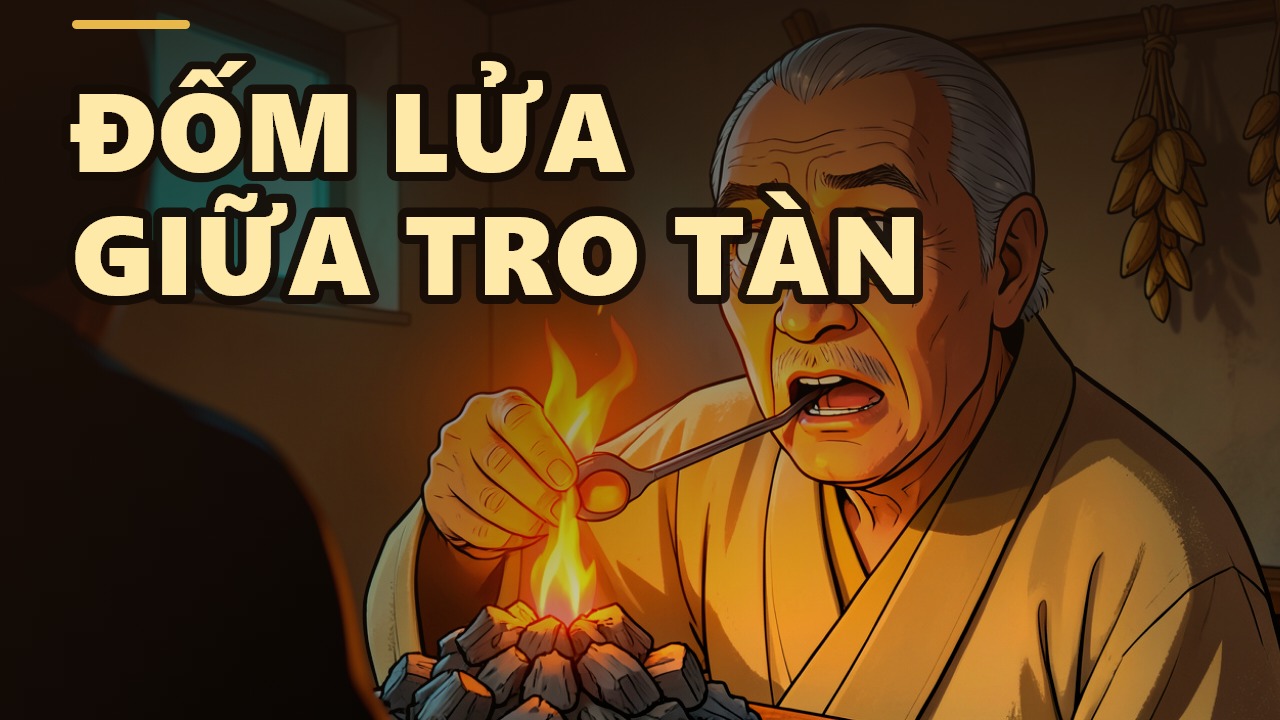
Once, Master Baizhang asked his attendant Guishan, “Is there still fire?” Guishan first replied, “Yes,” and took a cold stick of wood, blowing on it repeatedly. Baizhang criticized him, saying, “Like a worm boring into tree bark, you make marks but produce no meaning.” This was mere intellectual understanding, not complete realization.
Later, faced with the same question, Guishan answered, “The fire has gone out.” Baizhang stepped down, dug through the ashes, and picked up a tiny spark, asking, “You said the fire was out. What is this?” At that moment, Guishan attained great enlightenment. That spark symbolizes the flame of enlightenment, which always smolders within. We need only look closely for it to burst into light. But if we merely blow air to show off our views, we are like the worm in the bark, producing no true insight.
Venerable Chan Quang notes, “Zen lies here. Picking up a stick and blowing three times presents an idea, but it does not reach the truth.” Therefore, practice is not found in beautiful words or clever concepts, but in direct experience. Only when we touch the “spark” within ourselves can we claim true realization.
### Zen is the Core of Buddhism
Venerable Thich Chan Quang recounts the words of a monk at Khanh Son Pagoda in Soc Trang, a Pure Land practitioner who highly valued Zen. He stated: “A practitioner who does not know Zen cannot truly be called a practitioner.” He added, “Within Buddhist teachings, and within any practitioner, there must always be the essence of Zen.” Finally, he affirmed, “If one practices correctly, the realization is the same for all.”
This shows that whether one comes from the Zen school or the Pure Land tradition, if one correctly practices morality, meditative concentration, and wisdom, the resulting attainment is identical. Among many monks from different lineages, one can see their realization of Zen in their eyes, demeanor, and speech. The flavor of Zen is not exclusive to one school; it is the shared taste of the Buddha's teachings. Thus, the spirit of the *Guishan Jingce* should permeate every aspect of our practice.
### Guiding Disciples to Awaken Themselves
Xiangyan, a wise disciple of Guishan, was asked about the origin of the “single grain of rice” and begged his teacher for an explanation. Guishan refused, saying, “If I teach you now, you will curse me later.” Hearing this, Xiangyan felt deep sorrow. He left his teacher to seek another place, living as though he had lost all hope. But when he heard the pebble strike the bamboo, he awakened. Only then did he understand that his teacher’s kindness was as vast as that of his parents. Had Guishan explained it earlier, Xiangyan would never have attained the Way.
The lesson for those preparing to teach is clear: do not hand disciples ready-made answers. Instead, provoke inquiry so they may discover the truth themselves. Guidance given at the right moment helps disciples shine brightly, while premature instruction creates only intellectual views, not genuine enlightenment.
### New Temptations and Maintaining Mindfulness
In our time, phones, the internet, and social media add new layers to what requires “strict admonition.” If we are not careful, practitioners get swept into virtual worlds. Every thought races forward, and each fleeting moment dissolves into endless concerns. Venerable Chan Quang reminds us: “The six senses are already six thieves; we are nearly dead. Now, adding a seventh thief means we are completely ruined.”
We cannot entirely avoid technology, as it is useful and embedded in daily life. However, practitioners must use it with a mind of mastery. Therefore, teachers must address this issue as a specific topic for instruction. Do not dismiss it as unimportant, for it has become crucial to spiritual life.
Modern practitioners need awareness. Use technology to support learning and connect with teachers and friends, but maintain a pure mind. Do not let devices become thieves of your time.
### Let Your Own Flame Burn Brightly
In this life, each of us needs a flame to warm our hearts. Do not let it go out. Learn from Guishan and practice daily, so that when someone asks, “Is there still fire?” you can answer with your very life. This is how we study—not just for ourselves, but to teach future generations.
Begin today. Take a minute to pause. Breathe with mindfulness. Recite a sutra with reverence. Little by little, the flame will burn brightly forever.
AI-assisted translation from the Vietnamese original.
Read in Vietnamese →