
A Grain of Sand Contains the Universe: The Meaning of the Buddha’s Enlightenment
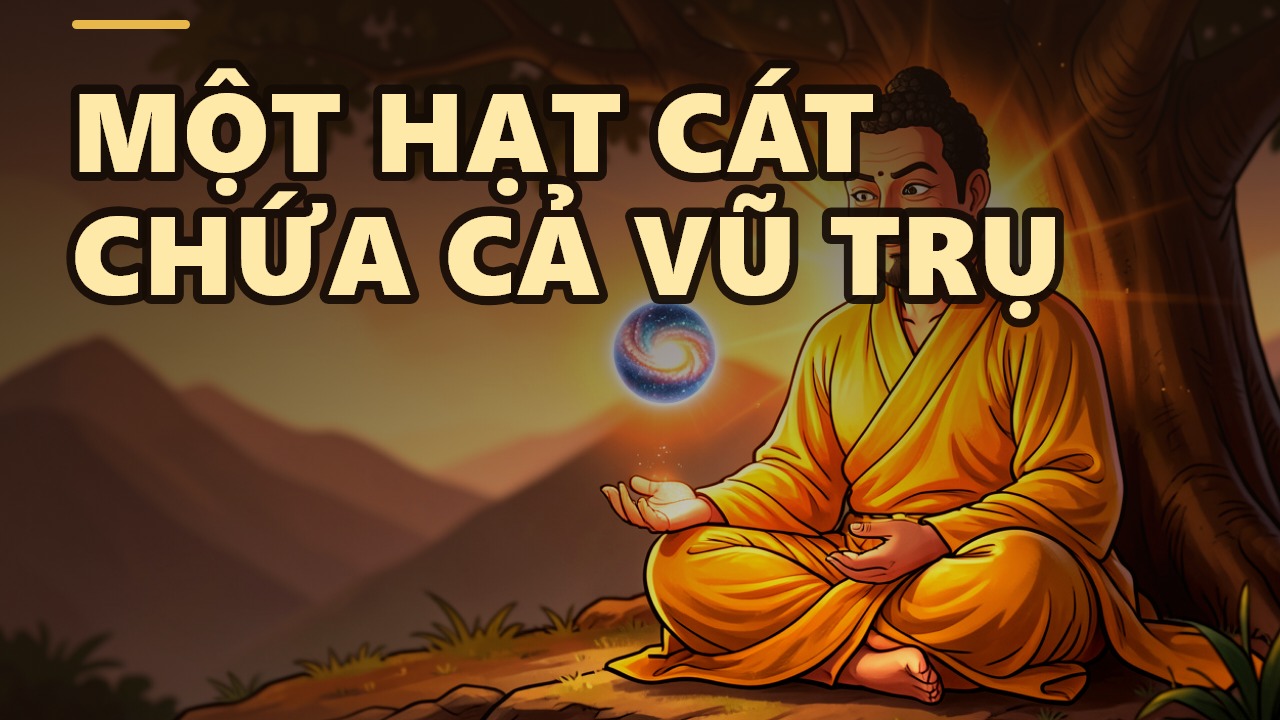
Discover the profound meaning of enlightenment through the teachings of Venerable Thich Chan Quang. He reveals the greatest dream the Buddha offered to humanity, the wisdom of cause and effect (karmic law), and the practice of mindfulness in every small action. Did you know that a tiny grain of sand can contain an entire boundless universe? This is not merely poetry, but a truth the Buddha realized and shared with the world. Let us listen to these teachings to understand the true significance of the day of his enlightenment.
### The Limited Knowledge of Ordinary Beings
We often trust our eyes and ears, yet these senses frequently deceive us. Venerable Thich Chan Quang shares a story about a woman holding a baby. Everyone assumed she was the mother, but in reality, she was simply carrying someone else’s child. As the teacher noted, when we see something, we immediately make incorrect assumptions. Without hearing or seeing, we claim not to know. The understanding of ordinary beings depends entirely on their senses, which are limited by space, time, and physical laws. However, other realms exist, such as spiritual dimensions where spirits or deities can see through walls or perceive past and future events. Beyond even these lies a realm where a single speck of dust contains the entire cosmos. This is the realm of enlightenment.
### Attaining Enlightenment: Entering the Realm Where Dust Holds the Universe
The teacher explains that when the Buddha attained enlightenment, he entered a completely new dimension, transcending all human thought and logic. In Buddhism, this represents the ultimate realization known as nirvana. It cannot be described or reasoned about; it can only be directly experienced and seen. As quoted from the teachings, this is the place of supreme realization for the Buddha and the Arhats. This event marked an extraordinary leap in the spiritual history of humanity, leaving behind a vast, sublime, and magnificent treasury of doctrine.
### The Buddha Gave Us the Greatest Dream
Human beings naturally tend to imitate others when they witness extraordinary feats. If one person jumps onto a haystack, the whole village may try to copy them. When children see a magician, they become fascinated and wish to learn those tricks. Similarly, when we see a human being attain enlightenment, we gain faith that we too can become awakened. Venerable Thich Chan Quang states that the Buddha gave us a dream greater than any other desire in life. All worldly ambitions seem small compared to the aspiration to become an enlightened being. This very dream has awakened countless generations of practitioners, inspiring each person to commit themselves to the path of enlightenment.
### Buddhist Wisdom Is Not Blind Faith
While many religions demand belief without questioning, the Buddha taught us to doubt and examine carefully to open up wisdom. The teacher emphasizes that anyone who clearly understands the law of cause and effect (karmic law) is considered wise in Buddhism. However, understanding karmic law is not just a simple matter of reaping what you sow. It requires deeper insight. For instance, if you help someone, whom are you helping? You must take responsibility for where the money you give ends up. Giving money to someone who uses it to buy a knife for evil deeds does not generate merit. The deeper our understanding of karmic law, the greater our wisdom becomes.
### Choosing Small Actions to Nurture Great Wisdom
Wisdom also lies in recognizing whether each of our actions and thoughts leads toward non-self (anatta) or reinforces ego-clinging. When we see someone else win the lottery, what arises in our mind? If we feel jealousy, we remain trapped in ego-clinging. If we rejoice for them, we move toward non-self (anatta). This requires constant mindfulness. The teacher instructs us never to do even the smallest bad deed, like a grain of sand, and to always perform even the smallest good deed. This is the conduct of a holy being.
### Signs of Practice: Knowing the Day of Your Departure
When we live in this way, we gain a certain assurance: knowing the day of our death beforehand. The teacher clarifies that if throughout our lives we fear even the smallest wrongdoings and never refuse even the tiniest acts of kindness, then we will possess the ability to know when we will pass away. This is the inevitable result of sustained mindfulness.
Let us begin today with small actions. Every dropped candy wrapper, every word spoken, and every thought arising are opportunities for us to walk the Buddha’s path. Do not wait until you achieve enlightenment. Simply take gentle steps forward, bringing joy to others. It is within these humble moments that we find true happiness and the genuine meaning of human life.
AI-assisted translation from the Vietnamese original.
Read in Vietnamese →