
The Root and Branch of Practice: From Cause and Effect (Karmic Law) to the Depths of Meditative Concentration
A dharma talk by Venerable Thích Chân Quang on the memorial day of Elder Thích Thông Lạc, offering a lesson on the root and branch of practice: cause and effect (karmic law), virtue, blessings from merit, and deep meditative concentration.
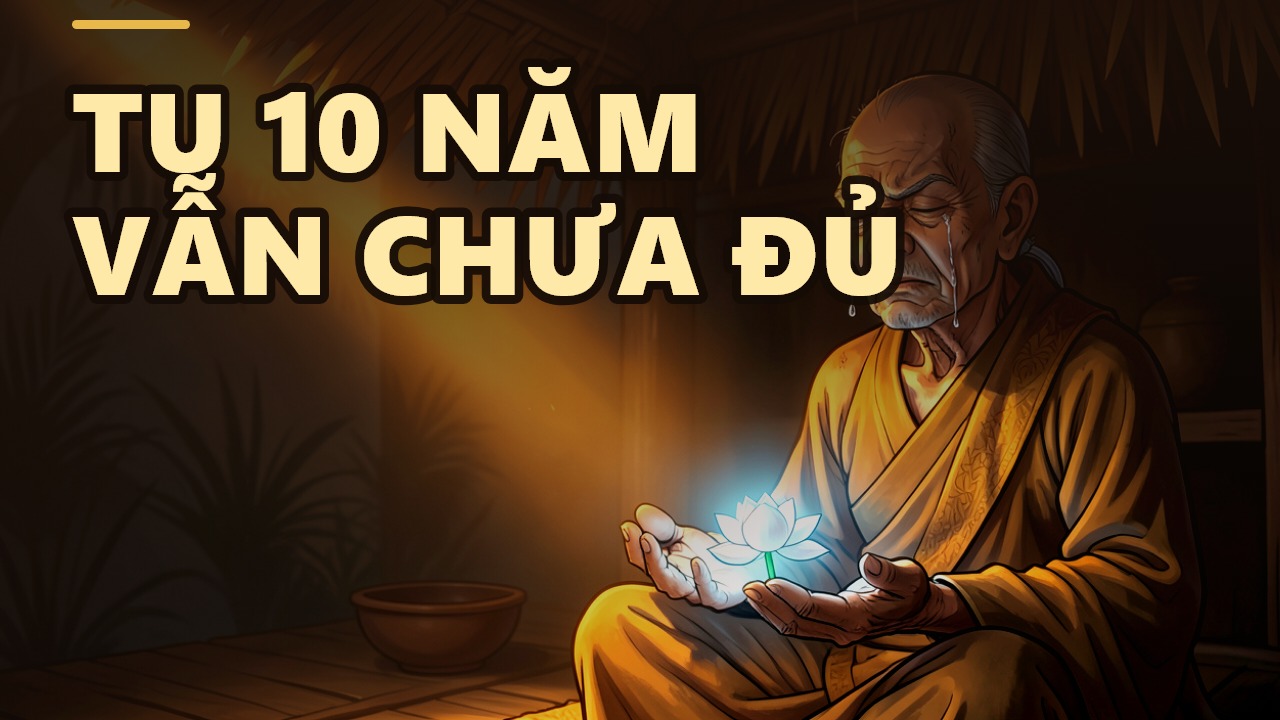
In a remote forest stood a small hut roofed with leaves. A teacher sat there for ten years, supported only by his elderly mother who brought him rice and his younger sister who toiled to care for him. People say that after ten years in seclusion, the teacher attained the Dharma. But have you ever asked yourself: why do some people practice such austere discipline yet attain no realization? And what truly brings about the attainment of a master? Today, on the memorial day of Elder Thích Thông Lạc, Venerable Thích Chân Quang invites us to look back at the root and branch of the path of practice — to understand that no seed ever sprouts without roots.
The Root and the Branch: Nothing Comes Naturally
Sitting before that simple leaf-roofed hut, where Elder Thích Thông Lạc had spent a decade in seclusion, Thầy Chân Quang recalled the early years. He recounted that when he first came here, he asked his grand-teacher about everything — from the teachings, to cause and effect (karmic law), to past lives. The old master always answered patiently and gently, never once giving way to anger. It was thanks to this that Thầy Chân Quang gradually came to understand:
Practice has its root and its branch — realization is not something anyone can attain easily.
It is not that ten years of seclusion alone brings enlightenment; it is the accumulation of many lifetimes of practice. The Buddha himself passed through countless lifetimes as a bodhisattva. So today, as we sit here in remembrance of a great teacher, let us also look at ourselves — do we have roots yet? And where do our roots lie?
The First Step: Understanding Cause and Effect (Karmic Law)
According to the Elder's teaching, the first step of every path of practice is understanding cause and effect (karmic law). The Buddha, in his time, also taught cause and effect before speaking of the Four Noble Truths. Through understanding cause and effect, we learn to fear wrongdoing and to cherish goodness. This is not merely an intellectual matter — it transforms both our conduct and our heart. Thầy Chân Quang shared:
Once we understand cause and effect, we begin to fear wrongdoing and to treasure blessings. When we know that the fruit of our actions will come back to us, we become afraid at once. If I want to scold someone now, I think: if I utter these harsh words, will I become a dog in the future? And then I dare not speak them.
Only after knowing cause and effect do we dare to cut through our stinginess and practice generosity. For beginners, giving away money earned by the sweat of their brow is a battle with themselves. But it is precisely this battle that awakens compassion and helps us transform. Once we truly understand cause and effect, we no longer do evil, and we strive to do good. That is the solid foundation for the path of practice that follows.
Giving Rise to the Aspiration to Practice: From Reverence for the Noble Ones
Knowing cause and effect helps us avoid wrongdoing and do good — but where does the aspiration for liberation come from? Thầy Chân Quang says: recall the moment we met a noble one, and reverence and faith arose in our heart. That is precisely when the bodhi mind begins to sprout. Because noble ones appear in this world, we can see that the path to enlightenment is real, and we too wish to walk it. Though Elder Thích Thông Lạc spent ten years in seclusion, after emerging he lived quietly, and later went to Trường Chiếu to meet Hòa thượng Thanh Từ. His story spread, drawing many people to this humble grass hermitage to study. Monastics came one after another, and people's aspiration to practice deepened.
Thus, in practice, reverence for the noble ones is the doorway through which the bodhi mind opens. Without faith and reverence, it is difficult to arrive at right view. Let us be grateful to those who went before us — they are the models that keep us steady on the path.
With Blessings From Merit Comes Progress: Revering the Noble Ones and Loving All Beings
In his talk, Thầy Chân Quang emphasized: "Only with blessings from merit can we progress in practice." But what are these blessings? He distilled them into two things: toward the noble ones, absolute reverence; toward all beings, love and helpfulness. And this help must not stop at material support — it means helping one another to practice. For only the path of enlightenment can lead beings out of the deepest suffering. He said:
Our heart grows warm with love for humanity. Our eyes shine bright — bright with what? With seeing fully the joy and the suffering of everyone.
Each day, let our heart be truly warm, caring for others. When we see a pothole, we fill it; when we see the sick, we care for them; when we see the poor, we help them. But above all, we invite them to practice alongside us. For only practice brings lasting benefit to all.
Meditative Concentration: The Right Method and Going All the Way
The second part of the Elder's legacy is deep meditative concentration. What he left behind was not fame or fortune, but levels of meditative absorption that many have yet to touch. Thầy Chân Quang recalled that many who came to his grand-teacher had already studied elsewhere, yet when they sat with him, they felt a depth entirely different. Though gentle and simple, the old master's insight into meditation surpassed even that of the Theravada masters. For this reason, we must learn the right method and never grow complacent with the states we attain. If we achieve a little tranquility and call it realization, we will die in complacency. The teacher instructed:
Keep striving always, and let your aspiration regarding time spent practicing be boundless and infinite — never set a deadline.
In meditative concentration, the breath is the core, but it requires full attention and practice over many days and months. We must seek out qualified teachers, ask in detail, and train without ceasing. Anyone who sets a deadline like "realization within one lifetime" is not speaking truth — for this path requires boundless time.
Practicing Together, Not Alone
Finally, Thầy Chân Quang concluded: a good disciple does not merely imitate the teacher, but must develop the path further. Elder Thích Thông Lạc emphasized solitary, focused practice, while Thầy Chân Quang added the collective dimension. He said:
For practitioners, unless one has the conditions of a Solitary Buddha like the ancients, who could walk alone and succeed, all of us with lesser capacities will gradually lose our way if we practice alone. Little by little the heart drifts away, and we fall back.
Only Solitary Buddhas can walk the path alone. As for us, with our modest capacities, we need the encouragement of our brothers and sisters in the practice community. The Elder himself established a monastery so that everyone could practice together. So today, let us invite one another to return and practice together, supporting one another as we move forward.
Conclusion: A Legacy in Two Parts
In remembrance of Elder Thích Thông Lạc, let us take away two precious lessons:
Blessings from merit: revere the noble ones, love all beings, and help one another practice.
Meditative concentration: learn the right method, strive diligently, and never grow complacent.
This is the root and branch of practice — the path walked by the Buddha and all the noble ones. Today, let us vow to preserve this tradition, continually cultivating merit and continually practicing meditative contemplation. May every moment of our lives be a step forward toward enlightenment. Homage to our Original Teacher, Shakyamuni Buddha.
AI-assisted translation from the Vietnamese original.
Read in Vietnamese →