
Precepts and Attachment to Rules: The Fragile Boundary Between Practice and Clinging
This dharma talk by Venerable Thích Chân Quang helps us clearly distinguish between precepts and attachment to rules, revealing the compassion and wisdom at the heart of Buddhism, so that we avoid clinging to outward forms while forgetting the true goal of enlightenment.
Have you ever wondered why some people keep the precepts very strictly, yet make others feel uncomfortable? While there are others who keep the precepts and radiate compassion, bringing peace and joy to everyone they meet? Where does this difference lie? Today, let us listen together to the teachings of Venerable Thích Chân Quang on this fascinating topic.
Thirteen Years Without Formal Precepts
When the Buddha first established the Sangha, for the first twelve or thirteen years, he did not create a single formal precept. The monks lived in purity, making no mistakes, simply by listening to the Buddha's teachings and practicing accordingly. The Sangha in those days was deeply at peace, and many attained the fruit of Arhatship.
"During those first twelve or thirteen years, the monks lived in purity according to the teachings, without any formal precepts. That is, hearing the Buddha's words and living by the truth was enough."
This shows us that the precepts are not the final goal, but only a means. The true goal is inner purity, a mind free from greed, hatred and delusion. When the mind is already pure, keeping the precepts becomes natural, without any need for force or strain.
Two Extremes: Precepts and Attachment to Rules
In Buddhism, the precepts are sacred, but attachment to rules is considered an unwholesome dharma. So how do they differ? The precepts are guidelines established by the Buddha to prevent wrongdoing and lead toward a life of purity. Attachment to rules, on the other hand, is rigid clinging to outward forms and principles, while forgetting the spirit of compassion and wisdom.
"The very core of the precepts is an inner mind that makes no mistakes, free from greed, hatred and delusion. That is the true core of the precepts."
One who keeps the precepts in their true meaning is someone who understands their purpose, who applies them flexibly in every situation, always placing love and understanding first. One who clings to rules merely grips the letter of the law, heedless of circumstances, heedless of another's heart, making relationships dry and rigid.
The Story of the Monk and the Novice
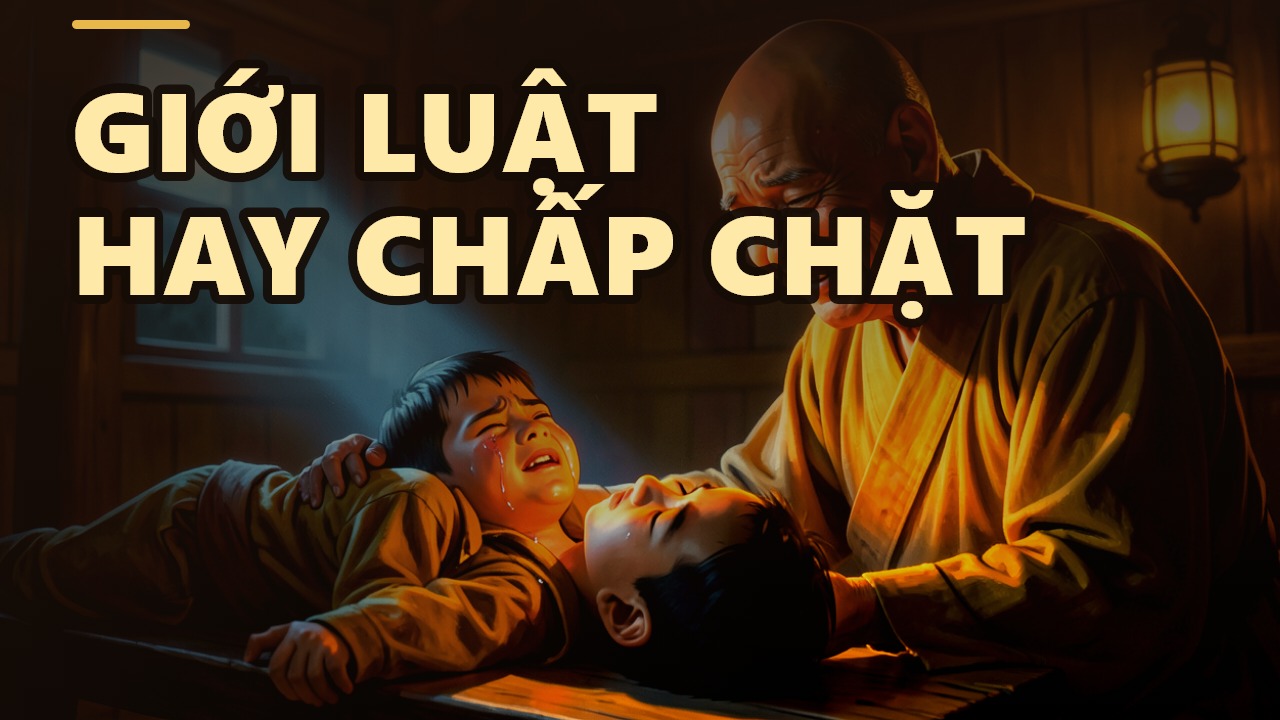
To illustrate this, Venerable Chân Quang tells a story: A monk was returning from attending to Buddhist affairs when he saw a young novice lying on a hammock, not rising to greet him. According to the precepts, one who comes later should respect one who came before, so this novice seemed to have broken a rule. But the monk was one of true understanding. He did not rush to scold, but gently asked after him. It turned out the novice had fallen and was in too much pain to stand. The monk immediately cared for him, massaging his aching body.
"Instead of the novice having to serve him, he turned around and served the novice. He took off his robe and hung it up, went to fetch a towel and water, washed him, took oil and massaged him."
If we look only at the outward form, the monk acted contrary to the precepts. But in truth, he was keeping the very spirit of the precepts: compassion, love, and mutual care. That is the true beauty of the path.
A Lesson from the Traffic Officer
The Venerable also gave the example of a traffic officer. Their purpose is to help reduce traffic accidents, not to collect fines. Fines are only a means. If an officer forgets this goal and only thinks of collecting money, people will grow resentful. But if they remember their purpose of service, they will guide, remind, and educate those who violate the rules, helping them understand and correct their mistakes.
"The precepts exist so that we do not make mistakes. Are the precepts meant for us to compete with one another, to catch each other's faults? Are they meant for us to blame and resent one another?"
In our daily lives, we too often fall into attachment to rules when we become too rigid about principles, schedules, and regulations, forgetting the higher goal: service, love, and understanding.
Attachment to Rules Is an Unwholesome Dharma
Why is attachment to rules considered unwholesome? Because it makes the mind narrow, selfish, and lacking in compassion. Those who cling to rules tend to pick at the faults of others, creating anxiety and division in the community. They turn the precepts into a weapon for criticism, rather than a means for self-cultivation.
"Anyone who clings rigidly to principles is an unwholesome person."
The Buddha taught that one who attains the fruit of Stream-entry, the first stage of awakening, has broken the fetter of attachment to rules. Such a person no longer clings rigidly to principles, but always looks to the core of the truth, to love and to liberation.
How Can We Keep the Precepts Without Falling into Attachment to Rules?
We need to understand that the precepts exist to help us live better and more purely, not to bind us. When keeping a precept, always ask yourself: Why am I keeping this precept? Is it to bring more peace and joy to my mind, to help me love others more? If keeping the precepts makes us harsh and difficult to be near, then we have gone astray.
"The precepts are not something for us to lean on in order to find fault, blame, and hate one another. The precepts are there so that we do not make mistakes."
Always remember that the precepts are only a means, while the goal is enlightenment and compassion. When we keep the precepts with a compassionate and understanding mind, they become nourishment for the soul, drawing us closer to liberation.
May each of us, whether monastic or layperson, be able to apply the Buddha's teachings in our lives, keeping the precepts with intelligence and flexibility, so that our own lives and the lives of those around us are always peaceful and happy. Let us begin today, with the smallest of things. Let us live with a compassionate mind, letting go of all clinging, to find true freedom.
AI-assisted translation from the Vietnamese original.
Read in Vietnamese →