
Precepts: A Buried Stake or a Transparent Diamond?
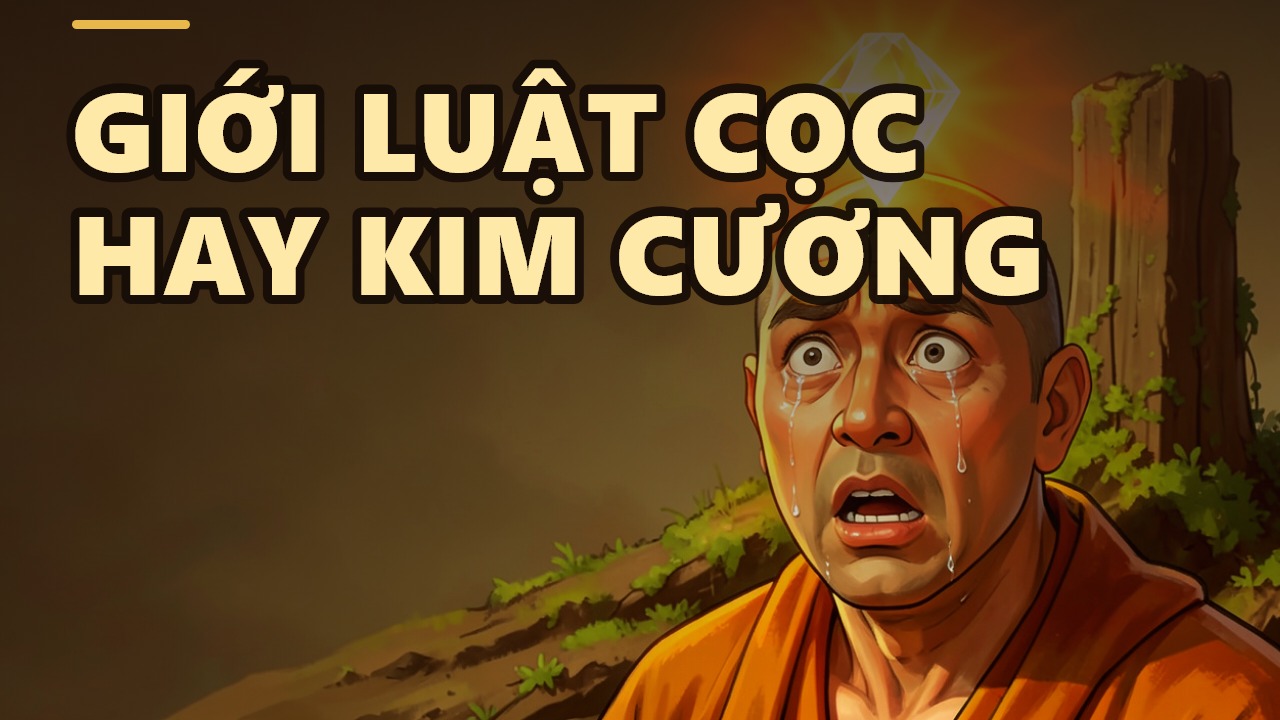
Precepts are not merely external prohibitions. Venerable Thich Chan Quang teaches that to uphold the precepts sustainably, we need wisdom, meditative concentration, and the ability to find joy in the path. Why do some people who keep the precepts strictly eventually collapse? Why do others who live lightly, seemingly without strict observance, remain steadfast? The answer lies deep within our own mind/heart.
## Precepts Are Not Just Prohibitions
When hearing about precepts, many people often think of them as harsh rules meant to bind us. However, Venerable Thich Chan Quang begins his teaching with a gentle reminder. He says that when we hear about precepts, we should listen to apply them in our practice, not to watch over monks and criticize them.
Precepts are not for scrutinizing or judging others. They are a mirror for each person to look into themselves. The teacher distinguishes between precepts, which are important prohibitions, and laws, which are detailed implementations. Yet, the key point is that external precepts must be based on internal moral conduct. If there are only prohibitions without ethics as a foundation, no one has the strength to keep them perfectly.
## The Difficulty of Precepts: Distinguishing Good from Bad
The basic definition of precepts is "not doing bad things." But is there a clear boundary between good and bad? Venerable Chan Quang warns that good and bad do not have distinct borders. Something that appears good can instantly turn bad if viewed from just a few small angles.
For example, a person keeps the precept against lying, but if they use honesty to hurt others, is it still good? Or consider those who keep precepts extremely strictly but develop hidden pride, causing their merit to be destroyed. Therefore, precepts are not simple. We must learn every aspect of them so that we can protect ourselves while also loving others.
## Willpower and Ego: Twin Brothers
To keep the precepts, we need willpower. But Venerable Chan Quang points out an interesting paradox. He states that willpower and ego are twin brothers. When a person uses willpower to keep the precepts pure for five or ten years, their ego also grows very large.
This explains why some long-time practitioners become rigid, arrogant, or angry. They think they are keeping the precepts, but they are actually nurturing their ego. The teacher uses an image: the willpower of a beginner practitioner is like a stake buried in the ground, covered in moss. In contrast, the willpower of an enlightened being is like a transparent diamond mountain. Looking at it, you see emptiness, yet nothing can shake it.
## Meditative Concentration and Wisdom Are the Foundation
Many people think they must keep the precepts first before practicing meditation. But Venerable Chan Quang believes this is a misunderstanding. During the first thirteen years, the Buddha did not establish precepts; he taught meditation, and many attained enlightenment. Only later, when some practitioners had weak meditative concentration and violated the precepts, did the Buddha issue them. Thus, precepts, meditative concentration, and wisdom form an equal circle.
He explains that precepts lead to meditative concentration, and meditative concentration leads to wisdom. But conversely, meditative concentration and wisdom enable us to keep the precepts. Without meditative concentration, we cannot look deeply into our own mind/heart. We keep the precepts through willpower, but the ego follows along. Only when we have the power of concentration can we dissolve the ego, allowing our willpower to become transparent like a diamond. Therefore, practitioners should not separate keeping the precepts from meditative concentration. Both must go hand in hand.
## Joy in the Path: The Key That Does Not Turn Away
Why do some people leave monastic life after ordaining? Venerable Chan Quang speaks frankly. He says that if we do not find joy in the path, then in three, five, or ten years, we will turn back. Everyone has an instinct for enjoyment and a desire for happiness. This is a human right, not a mistake.
But if practitioners do not find joy in the Dharma, in meditative concentration, or in brotherly love, they will be invited by the world. The teacher tells of a monk who finally left the path not because of fear, but because no one showed him a way to live happily within the teachings. Therefore, practitioners must urgently seek joy in wholesome dharmas, in the four immeasurable minds, and in moments of collected attention. Once we taste the sweetness of the path, we will feel light regarding worldly pleasures.
## Do Not Look for Demons Outside
Finally, Venerable Chan Quang reminds us of a very practical truth. He says not to imagine that keeping the precepts means fighting something outside. It is not demons lurking outside; the demon lies within our own heart.
Precepts are not a sword to cut down demons in front of us. The demon is right inside our mind/heart, in hidden demands, and in every drop of instinctive blood. Only through deep contemplation can we clearly see and transform these afflictions (kleshas).
Today, let us start with a small action. Practice meditative concentration for a few minutes, reflect on the precepts, and ask yourself, "Am I finding joy in the path?" When you find it, you will see that the precepts are no longer a burden, but a key that opens the flower of liberation.
AI-assisted translation from the Vietnamese original.
Read in Vietnamese →