
The Value of the Three Jewels: Three Priceless Treasures in Human Life
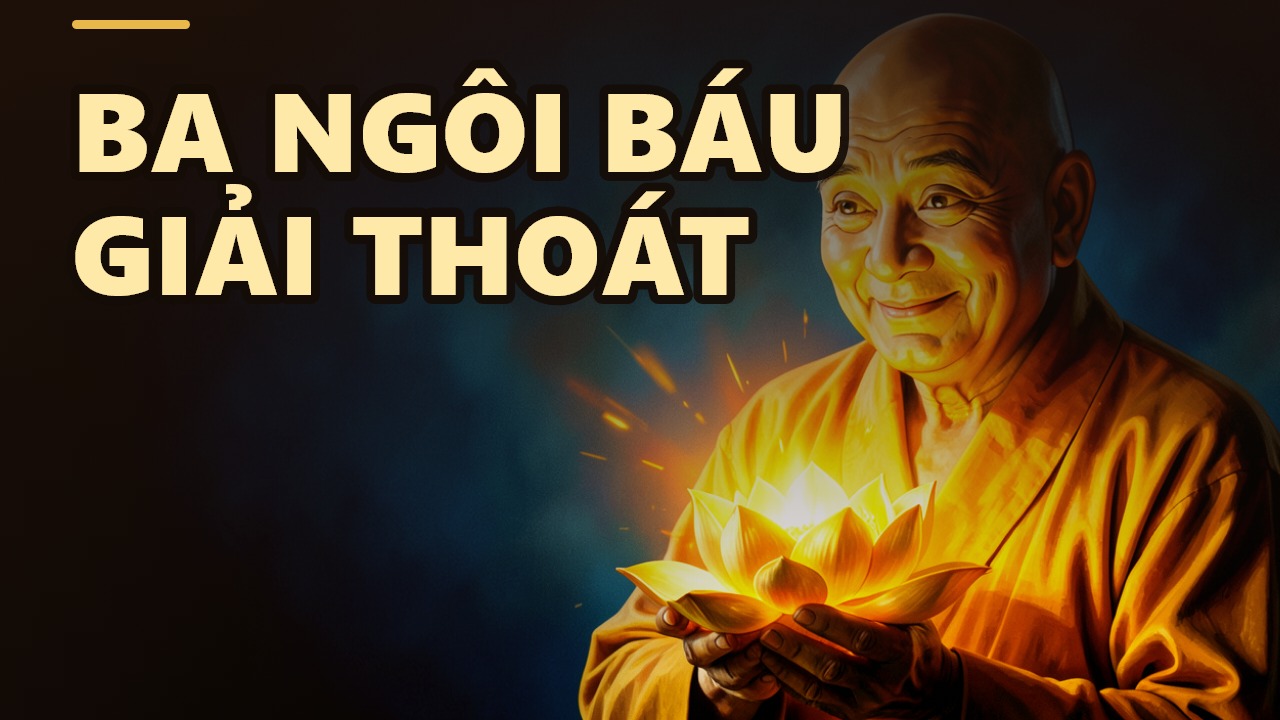
The Three Jewels – Buddha, Dharma, and Sangha – are three priceless treasures. Understanding them clearly helps us choose the right path to truth, live in peace, and attain liberation. Have you ever wondered why Buddhism is called a "treasure"? Why does a religion that does not demand blind faith still conquer even the greatest minds in humanity?
In a dharma talk at Ngu Tu Pagoda in Thanh Chuong, Venerable Thich Chan Quang began with a moving historical story. Mr. Nguyen Sinh Sac, the father of President Ho Chi Minh, wrote from the South to Nghe An province, calling on the people to follow Buddhism. The French colonialists seized that letter, but it contained a formula worth deep reflection. It stated that to gain independence for the nation, three factors were essential: first, the farmers; second, patriotism; and third, Buddhism.
Why was Buddhism so important? Because the Three Jewels are not merely spiritual supports. They are the keys to entering a life of ethics, wisdom, and liberation.
## The Three Jewels: Infinite Preciousness
Venerable Thich Chan Quang affirmed that within Buddhism lie three things of infinite value. Their preciousness is such that we could sacrifice our entire body and life, yet still find no comparison to their worth. These three are the Buddha, the supreme enlightened one; the True Dharma, the teaching of truth; and the Sangha, the community of practitioners.
Among these, the Sangha consists of those who sacrifice themselves to preserve the lamp of the True Dharma for future generations. They are present everywhere, from small pagodas to large Buddhist study centers. Their reputation lies not in power or wealth, but in their practice and boundless efforts to transform others through teaching.
## The Buddha: The Supreme Teacher
The Buddha was a human being who renounced his throne to seek and realize the ultimate truth. Throughout his life, there was never an unnecessary action, an unnecessary glance, or an unnecessary smile. He was beautiful in every fingernail, beautiful in every blink of an eye, and beautiful in every step he took.
According to the Venerable, reverence for the Buddha comes from understanding. We often go to the temple and bow to the Buddha without seeing his true beauty because we do not yet understand him. Therefore, as wisdom grows, the more we understand the Buddha, the greater our reverence becomes. When this reverence reaches its absolute peak, one immediately attains the fruit of Stream-Entry, the first stage among the Four Noble Stages of Enlightenment.
But how can we understand the Buddha? The Venerable pointed out clearly that we must practice ourselves. We must cultivate our conduct. We must engage in meditative concentration. Only by living a holy ethical life can we truly understand the Buddha and grasp what makes him so precious.
## The Buddha’s Teachings: A Treasury of Truth
The Buddha’s teachings constitute the True Dharma, the eternal truth. Intellectuals who study various religions are often overwhelmed by the precision and profundity of Buddhism when they encounter it. While one might read all the sutras in one or two years, fully understanding them takes a lifetime. The Venerable cited a specific teaching:
"When a monk walks, he knows he is walking. When he stands, he knows he is standing. When he sits, he knows he is sitting. When he lies down, he knows he is lying down. Whether bending or stretching his arms, whether stepping forward or back, he knows clearly."
We might think this is easy, but after thirty years of diligent practice, one begins to realize its profound meaning. Every small word of the Buddha contains countless treasures. The most fundamental basis of these teachings is the law of cause and effect (karmic law).
## Cause and Effect: The Foundation of Ethics and Karma Transformation
The Venerable shared a story about a disciple who worked in marine extraction. After following the Buddha's teachings (Dharma), he resolutely refused to kill any living beings. Suddenly, however, he suffered from severe gout and could not walk. When he returned to the temple, the Venerable instructed him:
"This is karma. Now, go home and do only this task for me: find potholes on broken roads and fill them in so people can pass safely. Keep filling them until your illness is gone."
He listened and diligently repaired the roads. After some time, his illness completely vanished. This is how cause and effect works. It is neither punishment nor reward, but the natural operation of the universe. When we understand cause and effect, we learn how to transform karma through our own wholesome actions.
## Buddhism and the Nation’s Destiny
Mr. Nguyen Sinh Sac saw clearly that when the country was invaded, the colonizers spread their own religion to steal the souls of our compatriots. A Vietnamese person who loses their soul will inadvertently aid the invaders. Therefore, to regain independence, one had to reclaim the soul of the Vietnamese people by revitalizing Buddhism and promoting patriotism. Buddhism has walked alongside the nation for thousands of years, so followers naturally possess a deep sense of national identity.
## Buddhism: The Path of Wisdom and the Future
In today’s era, humans live by reason. Buddhism does not accept superstition or empty faith. It is a religion of reason and wisdom. One must know everything thoroughly before choosing to follow and practice. This quality makes Buddhism considered the religion most compatible with science. The scientist Albert Einstein once said that if a future religion wishes to survive, it must encompass science. If a religion cannot explain scientific truths, people will not follow it. He added that only Buddhism could achieve this.
Just as Sun Wukong, the Great Sage Equal to Heaven, could never escape the palm of the Buddha despite his endless flying, all knowledge of science and humanity can never transcend the truth taught by the Buddha. Following Buddhism means walking a path that expands endlessly, leading toward the highest peak of sunlight.
During the dharma talk, the Venerable also spoke of King Tran Nhan Tong, known as the Emperor Who Controlled His Own Mind and Awakened to Enlightenment. When asked about the essence of the Buddha's teachings, he replied, "Using a stick to poke the moon." This is the vision of an enlightened being, seeing the universe within reach. We may not yet achieve this today, but simply by stepping through the door of Buddhism, we are already walking on the endless path of truth.
Begin by understanding and practicing the Buddha’s teachings. Live according to cause and effect, nurture patriotism, and cultivate compassion for others. The Three Jewels are not far away. They await you each day wherever you take your steps. And you yourself will become a treasure of life.
AI-assisted translation from the Vietnamese original.
Read in Vietnamese →