
The Yoke of Jasmine Flowers Offered to the Buddha: When Reverence Transcends Death
The story of a flower seller who offered eight bundles of jasmine to the Buddha, accepting the risk of losing his life, and the profound lesson about absolute reverence, cause and effect (karmic law), and the spirit of asking nothing in return.
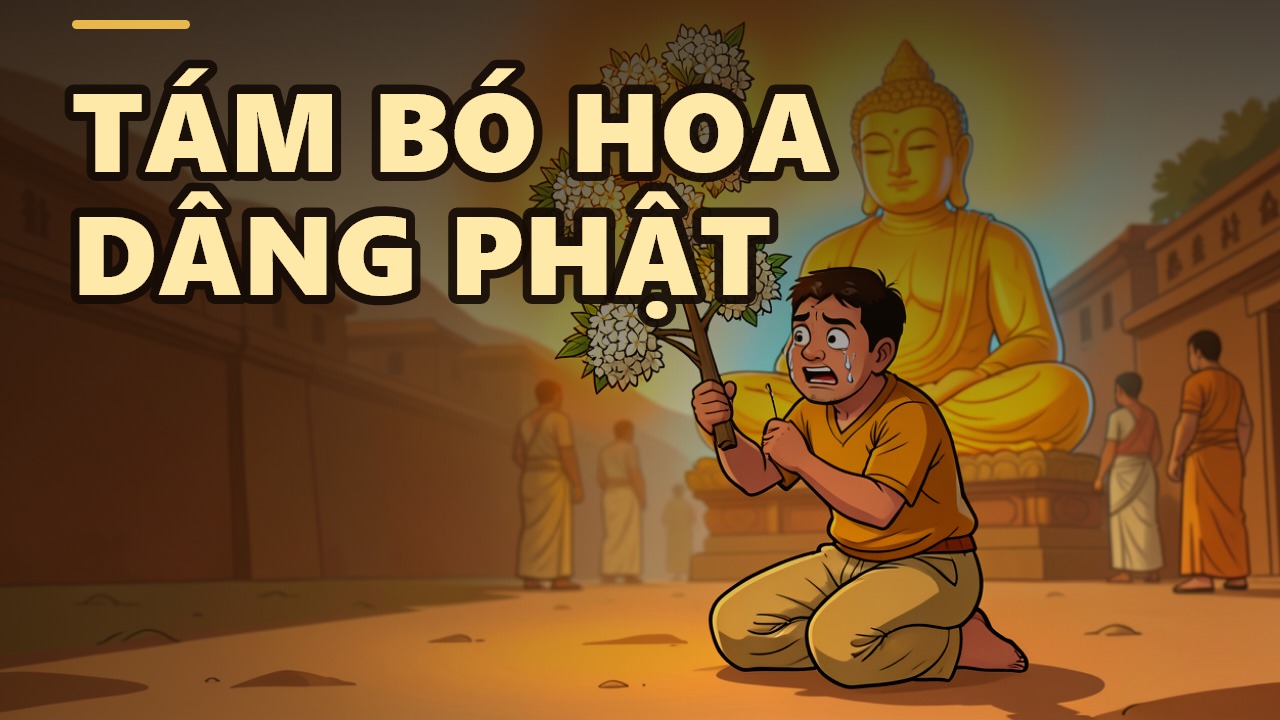
One morning, along the road leading into the city of Rajagaha, a gardener named Sumana was carrying a yoke of eight bundles of jasmine flowers to offer to the royal palace. Suddenly, upon seeing the majestic form of the Buddha, he froze in place. A sacred emotion surged within him to the very depths, making him forget everything — even his own life. He knew that if he failed to deliver the flowers to the palace, he could be convicted of breaking his contract and pay for it with his life. Yet in that moment, he felt no fear at all. He knelt down and lifted the yoke of flowers as a vow:
"I would rather accept death than fail to express what must be shown — my reverence for the Buddha."
Though brief, this story opens up so many layers of meaning about faith, cause and effect (karmic law), and liberation. Today, let us reflect together on that yoke of jasmine flowers and see ourselves within it.
When Eight Bundles of Jasmine Rose into the Sky
Sumana was not a wealthy man. He was only a poor gardener with a contract to supply flowers to the royal court. That day, as he carried his yoke of flowers along the road, he saw the Buddha and the monks walking on their alms round. Reverence welled up in his heart, and he longed to make an offering, but he had nothing in his possession except the flowers. Offering the flowers to the Buddha meant breaking his contract with the palace — an offense that could lead to execution. And yet he did not hesitate for a moment.
Then something miraculous happened: as he raised the yoke of flowers in offering, the eight bundles of jasmine rose into the sky on their own, forming a canopy of blossoms suspended around the Buddha. Everyone stood in awe, cheering. King Bimbisara, witnessing this, also knelt down, invited the Buddha to the palace, and afterward rewarded Sumana with a great deal of gold and silver. The Buddha also gave his confirmation: because of his absolute reverence, Sumana would one day become a Solitary Buddha named Jasmine.
It was only eight bundles of flowers, yet Sumana's heart was boundless. The Buddha taught:
"When one has performed wholesome karma and feels no regret, when the heart overflows with joy, the blessings from merit are truly infinite."
Emotion Drives Action, and Cause and Effect Follows Accordingly
Thay Thich Chan Quang emphasizes that everything we do begins with emotion — love, dislike, fondness, weariness. That emotion, whether gentle or intense, leads to action. And that action creates karmic results, a hundredfold, a thousandfold greater than the deed itself.
When we truly love someone, we respect them, help them, praise them; blessings from merit will come to us. When we love the wrong person, someone wicked, we become entangled in wrongdoing. Love placed rightly creates goodness; love placed wrongly leads to disaster. The same is true of hatred. But in Buddhism, we are not permitted to hate a wicked person — only to hate the wicked deed. Thay taught:
"We are only entitled to hate the evil deed, never the evil person. That is what the Buddha teaches us."
Why? Because when we hate someone, we will seek to slander and harm them. If that person is a saint, the karmic consequences are even more terrible. Instead, we should feel compassion for them and wish for their transformation. That is precisely the spirit of compassion in the Buddha's teachings (Dharma).
The Formula of Cause and Effect: The Value of the Gift × The Sincerity of the Heart × The Benefit to the Recipient
When discussing cause and effect (karmic law), Thay offered a rather "mathematical" formula: the value of the offering, multiplied by the sincerity of the giver's heart, multiplied by the benefit to the receiver, equals the karmic result. For example, a box of milk given to a sick person: the value might be three hundred, but the heart is full of love, the sick person drinks it and recovers, and then goes on to care for others — the karmic result will be immeasurable. Conversely, if that person drinks the milk and then goes off to gamble, the merit diminishes.
But it seems the formula involves many other parameters: timing, circumstances, long-term outcomes. Thay said:
"Cause and effect involves so many parameters; it is not as simple as saying that such a cause produces such a result."
Consider the story of Sumana: eight bundles of jasmine were worth very little, but his heart was at its utmost, and the benefit to the receiver was also immense — the eight bundles rose to shade the Buddha, seen by the king and all the people of the city. That is why his karmic result was great both near (the gold and silver that very day) and far (becoming a Solitary Buddha).
Do Not Risk Your Life Chasing Karmic Rewards — Live Out of Reverence
Hearing Sumana's story, some people may wish to imitate it by "risking everything to make offerings to the temple" in hopes of becoming rich. But Thay offers a humorous warning: if someone takes all the family's gold, leaves their spouse, throws themselves into temple offerings, and then buys a lottery ticket, they will not win the lottery this evening — and their family will fall apart. The reason is that the mind is different.
Sumana did not seek a karmic reward. He was even prepared to die. As for us, when we "risk everything" merely to gain benefits, that is greed for rewards, not reverence for the Buddha. Thay reminded us:
"He did not think of the reward at all. He thought only of death."
The key point is the purity of the mind/heart. A single moment of genuine, uncalculating reverence, seeking nothing, brings the greatest karmic result. Conversely, making offerings with a greedy, petitioning mind brings no blessings from merit at all — it only creates unwholesome karma.
So each day, when we bow to the Buddha, recite the Buddha's name, or make offerings, let us keep a pure mind/heart and offer our wholehearted reverence — not to "win the lottery," but simply to express our faith and gratitude. It is precisely through such a heart that the yoke of jasmine within our own minds will also rise into the sky, creating boundless blessings from merit in the same way Sumana's did.
In closing: please remember the moment when we witness something noble, a majestic form — whether a Buddha statue or a page of scripture. Let us awaken the deepest reverence from within our own hearts, letting go of all calculations of gain and loss, and feel our souls like a yoke of jasmine flowers rising into the sky, spreading their fragrance far and wide.
AI-assisted translation from the Vietnamese original.
Read in Vietnamese →