
Do Not Trust the Heart: The Buddha’s Warning on Love
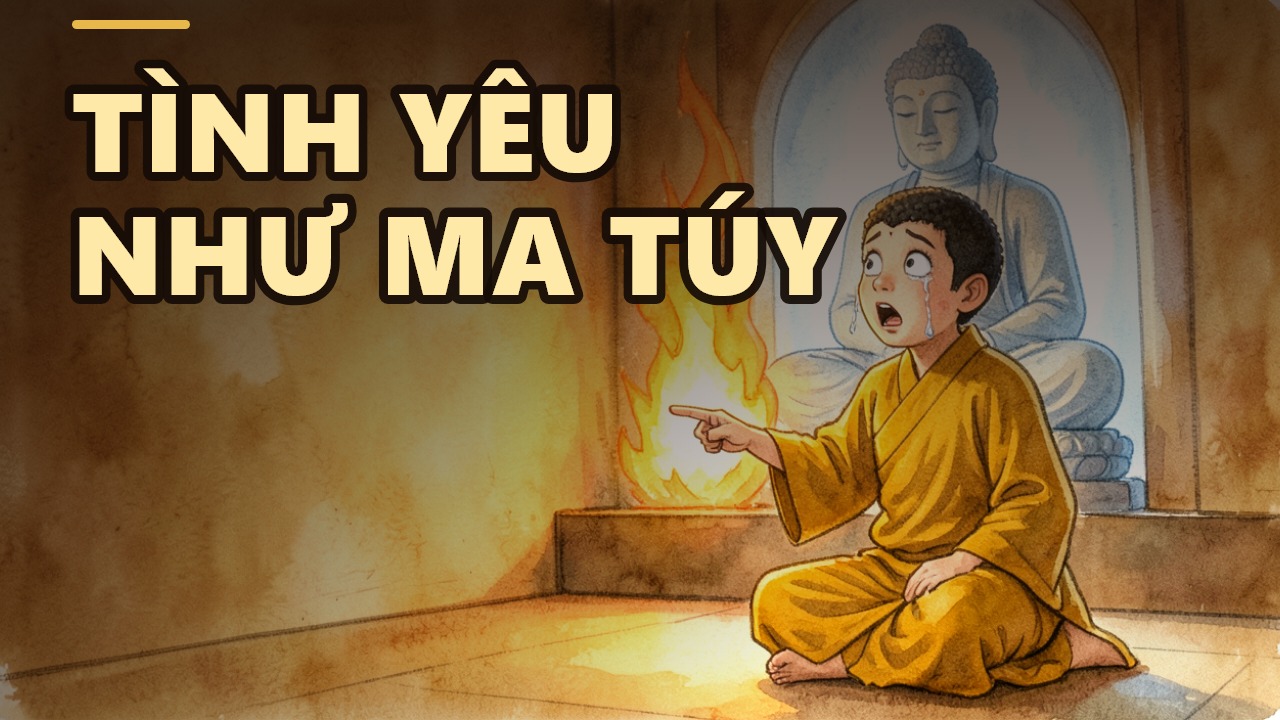
Love is a kind of addictive drug. This story recounts the journey of a young monk and the Buddha’s teaching: do not trust your mind before enlightenment, for all emotions are impermanence (anicca).
There was once a young bhikkhu who went to a woman’s house every day to collect alms. The woman said, “Please do not go elsewhere; come here only, and I will make offerings entirely to you.” So he began visiting her alone, sitting and talking, until gradually his mind became distracted. His fellow monks noticed this change and reported it to their teacher, eventually bringing him before the Buddha.
### Fire Near Gasoline Will Eventually Explode
The Buddha revealed that this woman had been the monk’s wife in a previous life. In that past existence, she had betrayed him to follow a robber, leading to his death. His current infatuation was merely a repetition of a past pattern, like a cord of craving tightening with each reunion. Master Chan Quang reminds us, “Fire near gasoline will eventually explode.” Do not be complacent about relationships that seem harmless, for they can become invisible bonds we never anticipated.
“Bad thoughts disturb the mind, while pleasures cause intoxication. The cord of craving is strong; the more it tightens, the deeper it binds. One who dwells in inner peace observes impurity with mindfulness, loosening the cord of craving and escaping the bondage of afflictions (kleshas).”
### Love Is an Intoxicant of the Mind
In his dharma talk, Master Chan Quang explained that love is similar to drugs, alcohol, or gambling—it is an addiction. Addicts often believe they can quit, but in reality, they simply seek to replace one object with another. He shared an anecdote: “A man once said, ‘I can leave my wife, but I cannot quit smoking.’ Yet in truth, when he left one wife, he immediately sought another, because love itself is a form of addiction.”
“Love is also a type of addictive drug.”
For this reason, the Buddha teaches us to contemplate impurity—to see the impermanent nature of physical forms and emotions. Once we become attached, it is not easy to escape. However, if we cultivate mindfulness, we can loosen these bonds and attain inner freedom.
### Do Not Trust the Heart: Sentimentality and Intuition Are Different
Master Chan Quang cited the story of Princess Diana, who taught her sons, “Trust your heart, and you will not make mistakes.” Yet her own life was filled with errors precisely because she trusted sentimentality. He analyzed, “The heart is always wrong. Intuition is not wrong, but sentimentality is.” We often confuse faith, intuition, and mere emotion. Therefore, until we achieve liberation, we should not trust our feelings of love or anger, as they are neither real nor accurate.
“If you have not attained the stage of an Arahant, do not trust your own mind.”
This is a precious teaching from the Buddha. When we lack sufficient wisdom and meditative concentration, we should not rush into important decisions based on inspiration. Instead, return to calmness, reflect deeply, and observe clearly to distinguish truth from illusion within your mind.
### Love Is Fragile; Do Not Stake Your Life on It
Master Chan Quang remarked, “Of one hundred people who fall in love, one hundred and one betray each other.” This statement sounds humorous yet carries profound weight. In samsara (the cycle of rebirth), we have been spouses to countless beings; each life involves brief relationships. When we meet again, we may feel moved, but such trembling does not guarantee a lasting bond. There is also the story of a bricklayer who pretended to buy two taels of gold weekly to win the daughter of a jewelry shop owner. After marriage, the truth emerged—he did not possess nearly that much gold. Love before marriage is often embellished, but it is not necessarily the truth.
Therefore, true happiness does not lie in finding a perfect partner, but in returning to practice mindfulness and escaping the vortex of sensual desire. When we understand that everything is impermanent (anicca), we no longer fear loss, nor do we drown in fleeting emotions.
Remember, the path to liberation does not involve chasing emotions or relying on others. It is a path of returning to oneself, seeing the nature of impermanence clearly, and untying the cord of craving through mindfulness. Each day, you need not be an Arahant, but you can begin by practicing awareness, observing your emotions rather than being swept away by them. Take refuge in the Buddha and dwell in inner peace—that is true freedom.
AI-assisted translation from the Vietnamese original.
Read in Vietnamese →