
How Can What Seems Right Turn Out Wrong? A Buddhist Warning
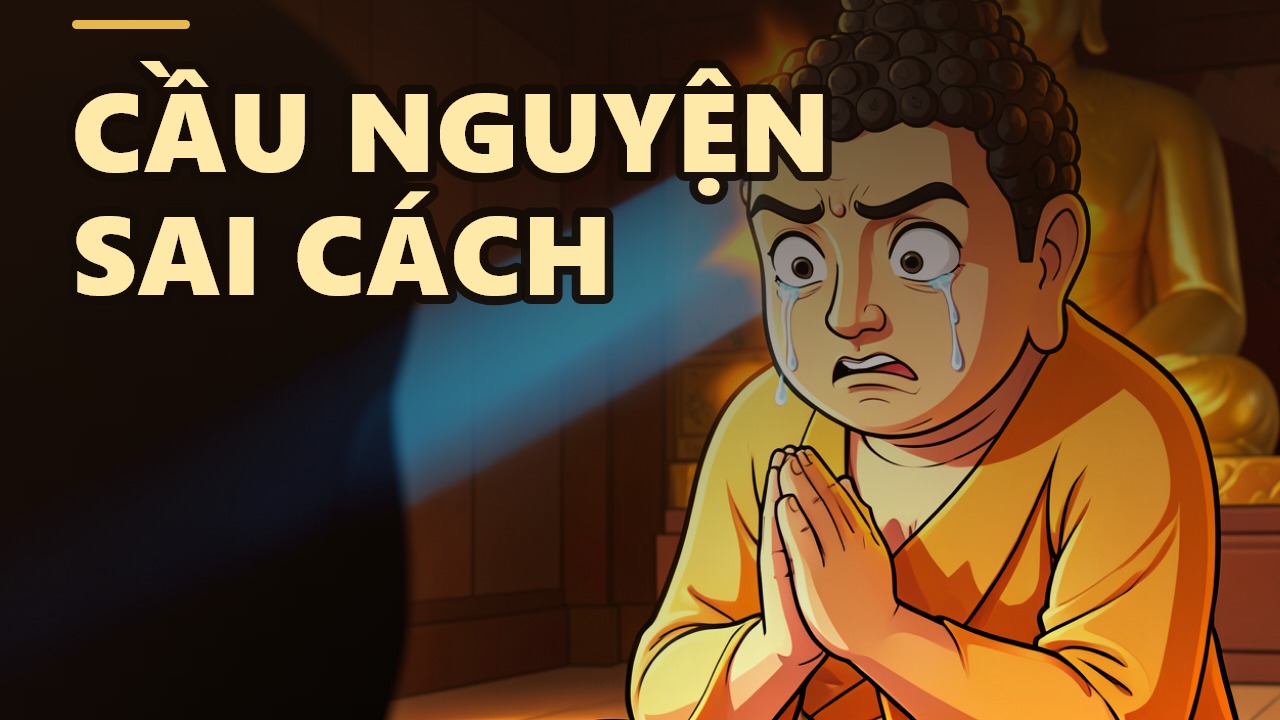
Have you ever asked yourself: Why do I practice diligently and bow to the Buddha every day, yet my life still faces many obstacles? Venerable Thich Chan Quang’s teaching helps us recognize that what seems correct in spiritual practice can sometimes be mistaken, guiding us to walk the path with stability.
### The First Step: Reverence for the Buddha
When we first approach the Dharma, the initial quality of our heart and conduct must be reverence for the Buddha. This is the foundation that allows all beautiful things to gradually unfold within our soul. By having a holy being to admire, our base desires and scattered thoughts are slowly brought under control.
If we lack a holy figure to respect, this absence becomes the primary cause of our struggles. Without reverence, instinctive negative thoughts will naturally arise and push our lives toward error. Therefore, bowing respectfully to the Buddha is the solid first step on the path of cultivation.
### The Sneaky "Self" in Prayer
However, starting correctly does not guarantee that we will remain correct forever. Many people accompany their bows to the Buddha with prayers. If these prayers are tainted by ego, we are inadvertently reinforcing our sense of self. This is where the subtle mistake lies.
For example, praying for one’s child to become diligent in practice, to attain saintly fruit, or to save all sentient beings may sound noble. Yet, if the focus remains solely on personal achievement, it is still the ego being elevated. Only when prayers are altruistic and vast, like those left by the patriarchs, are we truly moving in the right direction.
### Believing in Cause and Effect – A Good Start, But Easy to Misinterpret
Believing in cause and effect (karmic law) is the foundation of right view. For anyone approaching the Dharma, believing in cause and effect marks a good beginning. However, when we interpret cause and effect through our own limited understanding without sufficient wisdom, we easily misunderstand and fall into wrong views.
In this life, we always have responsibilities toward one another, even toward strangers. Sometimes, out of fear of karmic consequences, we avoid responsibility, saying that if others act wrongly, they should bear the results themselves. But such avoidance is irresponsible and causes us to lose merit. True understanding of cause and effect means seeing not just simple linear connections, but recognizing that we hold responsibility for all sentient beings in this world.
### Right Effort – A Long Road That Is Not Easy
On the path of cultivation, there is a crucial stage known as right effort. Many confuse right effort with right diligence. In reality, right diligence means being energetic in doing all good deeds, while right effort specifically focuses on perseverance in meditative concentration.
Right effort narrows its scope, concentrating solely on diligence within meditation. This is a very long phase, potentially lasting many lifetimes, requiring unwavering willpower. But once you have entered this path, do not become discouraged, for this is the only way to progress toward enlightenment.
### Never Think You Know Enough
Throughout the journey of practice, humility and continuous learning are essential. Do not assume that you already understand the Dharma simply because you have read many sutras. Only upon becoming an Arhat can one claim to be beyond further learning for oneself; however, the work of teaching sentient beings still requires ongoing study.
Stay alert, cautious, and humble at every step. Because what is right at the beginning never guarantees that we will remain right in subsequent steps. May this writing offer you deeper insight into your practice, inspiring you to live each day with compassion, responsibility, and wisdom.
AI-assisted translation from the Vietnamese original.
Read in Vietnamese →