
The Night the Prince Left the Palace: The True Meaning of Renunciation
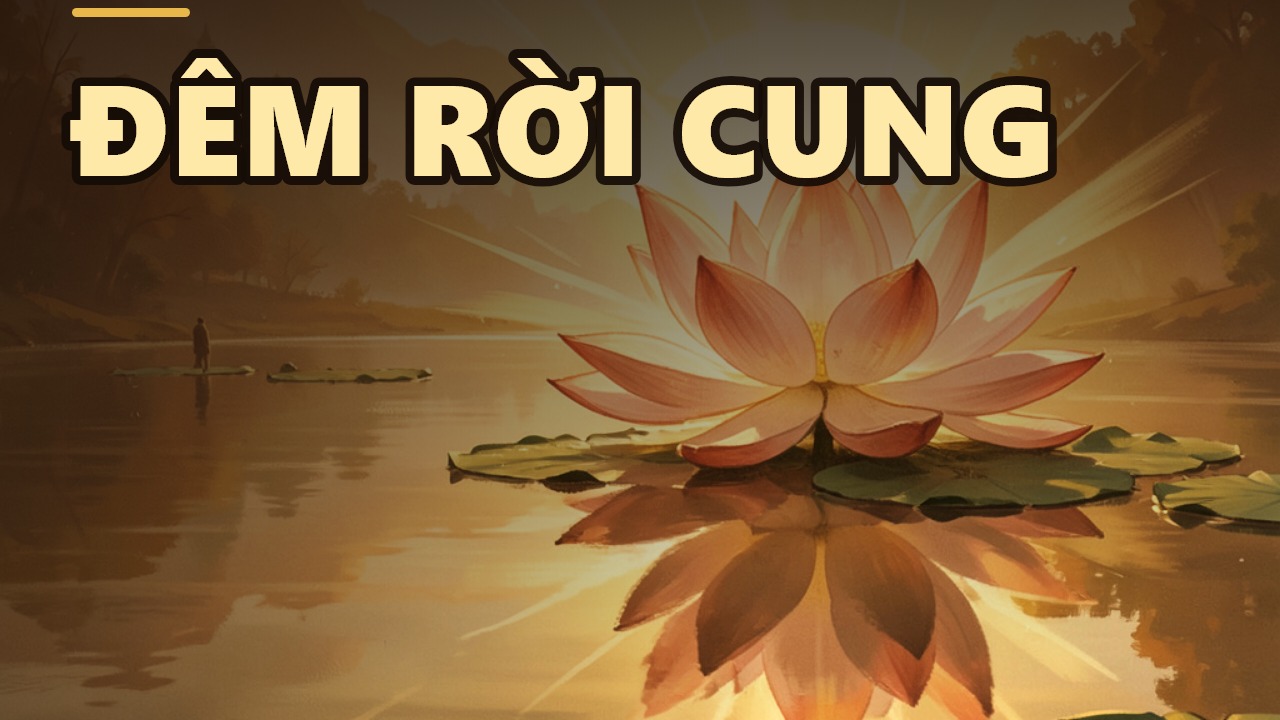
Each year, as we commemorate the Buddha’s renunciation, we recall the night the prince left the palace. True renunciation is not merely leaving behind a golden palace, but letting go of greed, hatred, delusion, fear, and desire to find peace amidst everyday life.
People often say, "To ordain is to leave everything behind." But how does one leave things behind, and what is gained? The story of Prince Siddhartha departing Kapilavastu—cutting his hair, donning the robes of a renunciate, and crossing the Anoma River—remains one of the deepest sources of inspiration for Buddhist practitioners. On this anniversary, Venerable Thích Chân Quang offers profound reflections on the meaning of renunciation, showing it is not just a prince’s story but a lesson for us all.
**The Night of Decision: When the Moon Lit the Path**
On that quiet night, the prince entered the chamber and looked upon his sleeping wife and child. He could not even see their faces clearly before he silently withdrew. When he woke his charioteer, Channa, Channa asked in surprise, "The night is dark, the world is shrouded. Where does the prince intend to go at such an hour?" The prince’s reply became one of history’s immortal statements.
"It is precisely because the world is dark that I go to seek the light."
That night, the city gates opened on their own as celestial beings used their divine powers. The prince crossed the river, cut his kshatriya topknot, and exchanged his royal garments for a renunciate’s robe. He turned his back and never looked back. From that moment, a long and arduous path of practice began. Renunciation is not merely leaving home or wealth; it is abandoning the deepest inner attachments of the mind.
**From One Teacher to the Next: The Search Does Not End at the Peak of Concentration**
The prince first studied with the teacher Ālāra Kālāma and quickly attained deep meditative concentration. The teacher was astonished and invited him to stay and teach together. But the prince asked a question that left his teacher speechless:
"Venerable one, does your state of concentration still involve a sense of self, or has it transcended self? If there is still a sense of self, it is not liberation. If there is no self, then who knows the attainment?"
He then studied with Udraka Rāmaputra and attained even higher states, but the same question remained unanswered. He realized that no teacher in the world could show him the way. It was his very doubt of others’ paths—his refusal to follow even a noble but predetermined route—that drove him to seek the truth for himself.
**Asceticism is Not the Torment of the Body**
Many misunderstand extreme asceticism as self-punishment. The Venerable clarifies, "Asceticism means using the power of one’s own concentration to test the body." The Buddha practiced techniques like standing on his head, hanging from branches, and standing on one foot under the sun and wind for seven days. Yet after six years of such perseverance, he realized a fundamental truth:
"From ancient times until now, no renunciate has practiced asceticism as I have. But I have not found liberation. Therefore, extreme asceticism does not lead to liberation."
This is a profound lesson: hardship is not inherently good, and self-torture is not liberation. The true path lies in balance, wisdom, and compassion.
**Those Who Left When the Teacher Ate: A Lesson in Faith**
When the Buddha decided to eat again to regain his strength, the five ascetics of the Kondañña clan—who had deeply revered him—left. They believed he had returned to a life of indulgence. Venerable Thích Chân Quang notes:
"Students easily misunderstand their teacher. Their wisdom is not equal to the teacher’s, yet they are quick to criticize."
They could not comprehend the transformation within him. Yet later, they became his first five disciples when he gave his first teaching. The test of faith is great. In life, we too sometimes rush to judge others when they change, but perhaps that change represents growth, a turning point on the path to enlightenment.
**Māra and the Final Test**
During the forty-nine days sitting beneath the Bodhi tree, as the Buddha entered the fourth meditative absorption, Māra appeared in two forms: one terrifying and aggressive, the other gentle and alluring—most notably appearing as his wife, Yasodharā, weeping and begging him to return. Yet he remained unmoved. Why must a Buddha-to-be confront Māra? The Venerable explains:
"It is the final confirmation. To ensure the person’s mind is truly purified, an external challenge is needed. Without such a test, inner purity cannot be verified."
A truly moral person must achieve two things: fear nothing, and desire nothing. Only when confronted with gold and silver yet remain indifferent can one know greed is gone. Only when faced with threats yet remain unshaken can one know fear is overcome. This is the mark of a Buddha.
Applied to daily life, each of us faces our own "little Māras": a provocative message that stirs anger, an unethical opportunity for profit, a flattering word that feeds our ego. True renunciation is learning to let go of these inner urges in the moment they arise. When we no longer cling to reputation, fear, and desire, even living in the city, we are practicing renunciation.
Today, on the anniversary of the Buddha’s renunciation, let us remember the path he walked: leaving the golden palace, seeking teachers, self-discovery, abandoning extremes, and finally, overcoming Māra. Each of us may not need to leave home to ordain, but we can leave behind the "golden palaces" within our minds: our attachments to self, our anxieties, our petty desires. This is the invisible renunciation that leads us to true peace.
AI-assisted translation from the Vietnamese original.
Read in Vietnamese →