
A Buddhist Disciple: Do Not Learn Much Yet Forget to Practice
Recalling a story about a young teacher who studied medicine and pharmacy at university, Thay Thich Chan Quang reminded us: the Buddha's path is a path of practice. A Buddhist disciple must not only study the teachings, but also venerate the Buddha, understand the Buddha's life, understand his words, and put them into practice. Paying homage to the Buddha is the foundation of all merit.
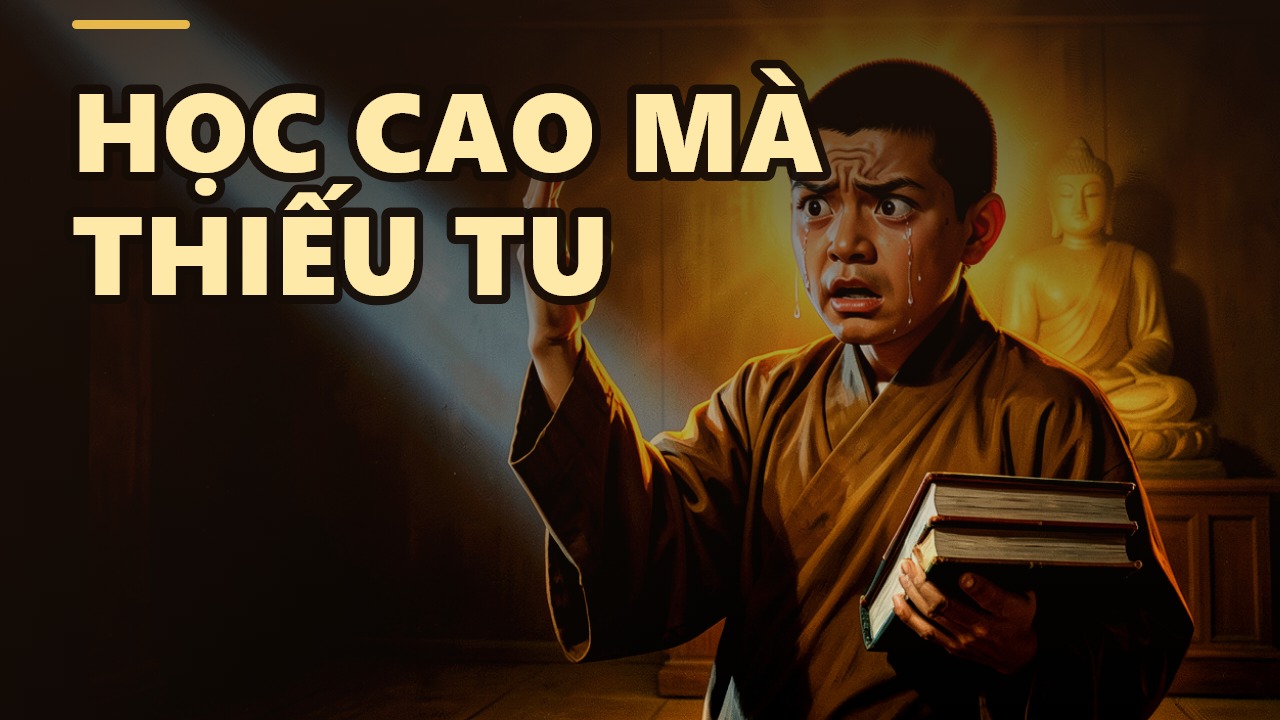
Do you remember the last time you came to the temple simply to pay homage to the Buddha with full reverence, rather than rushing off to hear a dharma talk or debate the teachings?
I still remember the story Thay Thich Chan Quang told in a short dharma talk on the topic "What Is a Buddhist Disciple?" He began with a simple experience that touched deeply the hearts of those who hold mistaken views about practice.
The Story at the Vegetarian Restaurant
One evening, Thay Chan Quang went into a vegetarian restaurant and met a young monastic with a radiant appearance and fine conduct. The young monastic said he was studying medicine and pharmacy at university. Surprised, Thay Chan Quang asked why he had chosen that field, and the young man replied: "I have seen many who graduate with advanced degrees in Buddhist studies and then have nowhere to use them, unable even to support themselves. So I thought I would learn a trade so that one day I can live and support myself."
Thay Chan Quang responded:
"Your conduct is very good, and your virtue from many past lives is deep, yet if you do not give rise to a spiritual aspiration, it would be such a waste. Why? In this age of highly advanced science and technology, when society is losing its balance and people chase after material things and technical skills, we very much need those who preserve the spiritual dimension to help restore that balance."
The young monastic seemed persuaded: "Then I will try hard with my studies, and one day I will come to you to learn and practice."
This story made Thay Chan Quang feel a crisis in the direction of many Buddhist disciples, including monastics and lay practitioners. We come to the Buddha's path, but we lean far too much toward study and understanding, while lacking practice.
The Buddha's Path Is a Path of Practice
Thay Chan Quang pointed out frankly:
"The Buddha's path is a path of practice. Now suppose we enter this path and study for five years, ten years, twenty years, collecting one degree after another. What does that make us? We become scholars who research Buddhism, observing it from the outside without standing within it to practice, without understanding the Buddha's path through the value of the spiritual life."
Thay recounted that in the time of the Buddha, whatever was taught was put into practice immediately. When the Buddha spoke of impermanence (anicca), people would at once contemplate impermanence, letting go of attachment, and could awaken to enlightenment. When the Buddha taught Rahula about the breath, the sutra emphasized each sensation, each contemplation, to gather the mind into meditative concentration. After hearing the teaching, Rahula set aside his alms meal, returned to sit in meditation, and attained the state of an Arhat.
But today, many people merely memorize, even piling up diplomas and certificates, without practicing. This is a very sad kind of decline.
The Four Essentials of a Buddhist Disciple
When asked "What must a Buddhist disciple do?", many people answer according to their own understanding. Thay Chan Quang restated it simply:
A Buddhist disciple must first of all venerate the Buddha. This is the outward foundation and also the spiritual foundation. Next is to understand the life of the Buddha. Third is to understand his teachings. And fourth, indispensable, is to practice according to the Buddha's words.
Thay told of a schoolteacher who had studied the Buddha's teachings (Dharma) quite deeply, but because he understood one-sidedly that "the five aggregates are empty," he removed the Buddha's altar from his home. Thay reminded him: "All dharmas are like a dream. Yet within that dream, not a single point strays from cause and effect (karmic law)." That person was mistaken in thinking that having seen "emptiness," there was no need to venerate the Buddha. Such people lose sight of cause and effect (karmic law), and lose their reverence, which is the very foundation of a practitioner. Understanding the Buddha's teachings (Dharma) rightly always makes a person balanced, quiet, virtuous, courteous, and gentle.
Paying Homage to the Buddha: The Foundation of All Merit
In his talk, Thay Chan Quang strongly emphasized the role of paying homage to the Buddha. He compared practice to a pyramid: four sides representing virtue, merit, meditative concentration, and one side still hidden, yet all of them rest upon the foundation of reverence for the Buddha.
"We are Buddhist disciples, and if we lack reverence for the Buddha, no merit will ever open up for us. No merit at all."
Thay explained: if someone practices meditation but lacks the merit of paying homage to the Buddha, then when the mind is drawn deep inward, they may easily "collapse," that is, lose their sanity. Therefore, whatever we do, whatever we practice, among the "myriad wholesome deeds" we must always keep the practice of bowing to the Buddha. Thay advised:
"Each day, pay homage to the Buddha at least once, and each time at least ten bows, with a heart full of reverence. You may not yet have the conditions to sit in meditation, but if you do not bow to the Buddha, you will never have the blessings from merit to sit in meditation."
The Wondrous Cause and Effect of Paying Homage
Thay told of a friend who worked as a physician, whose character was somewhat flawed from being tossed about in worldly life. But when he was advised to come to the temple and bow to the Buddha, after some time his character naturally improved. His greed lessened, his speech became proper, and his face grew worthy of respect. It all happened so naturally that even he himself did not expect it.
That is precisely the cause and effect (karmic law) of venerating the Buddha. Those who planted conditions with the Buddha in the past will, upon meeting the path again, find it easy to have faith and will gain great merit. But if we are not yet certain, let us begin planting those conditions right now. The Buddha no longer walks among us, but before a sacred statue, if we see it as the Buddha present before us and offer our complete reverence, the merit is still immense.
Do Not Let Learning Obscure Practice
Today, when you hear a wonderful teaching, do not stop at feeling pleased. Let your soul settle down, kneel before the Buddha's statue, and practice with sincerity. Do not turn the study of the teachings into a race for credentials. Study in order to practice, to let go, to live in peace and joy, and to bring benefit to yourself and to others.
As a Buddhist disciple, what matters most is not how much you understand, but how much you actually practice. Begin with the smallest actions: a smile, a single bow of deep reverence, a gentle gaze in the face of difficulty. Just that, and merit will open up like the flowing stream of a sincere heart.
AI-assisted translation from the Vietnamese original.
Read in Vietnamese →