
Parenting According to Buddhism: From Aspiration to a Virtuous Child
**SUMMARY:** A method of parenting based on Buddhist principles: taking morality as the foundation, understanding the karmic bonds with your children, and teaching from the parents' heartfelt aspiration. Begin today.
Have you ever wondered why some children are naturally obedient and talented, while others are rebellious, causing their parents great suffering? Could this be due to karma and conditions from many lifetimes? And how can we raise our children to become good people in the spirit of the Buddha's teachings? In the dharma talk "Raising Children (Part 1)," Venerable Thich Chan Quang offers profoundly practical and deep teachings. They help us reflect on our approach to nurturing children, so they may become both virtuous and successful.
**Why is morality the foundation?**
In modern society, many parents worry about their children's education, rushing to enroll them in extra classes from morning to night. But the Venerable clearly points out: what determines a child's talent is not force-fed knowledge, but a moral heart. If a child has a foundation of morality, learning naturally becomes easier, and wisdom develops spontaneously. This is a logical truth, not blind faith.
"If a child possesses morality, their talents will naturally flourish. This is an extremely practical, logical matter of cause and effect."
Because morality is the "launchpad" for talent, Buddhists should calmly teach morality first, without hurriedly stuffing in knowledge. A child who knows how to live well and believes in karma will naturally understand lessons faster, learning less but with greater quality.
**Children do not come to us by chance**
Sometimes parents lament: "Why is my child like this? No one in my family is like that!" But in truth, every child is born carrying karma and tendencies from past lives. Parents and children have a debt of conditions with one another; it is this karmic debt that determines their meeting. Some children come to repay their parents, some come as a "karmic debt" forcing parents to endure, and some are enlightened beings reborn into a family blessed with merit.
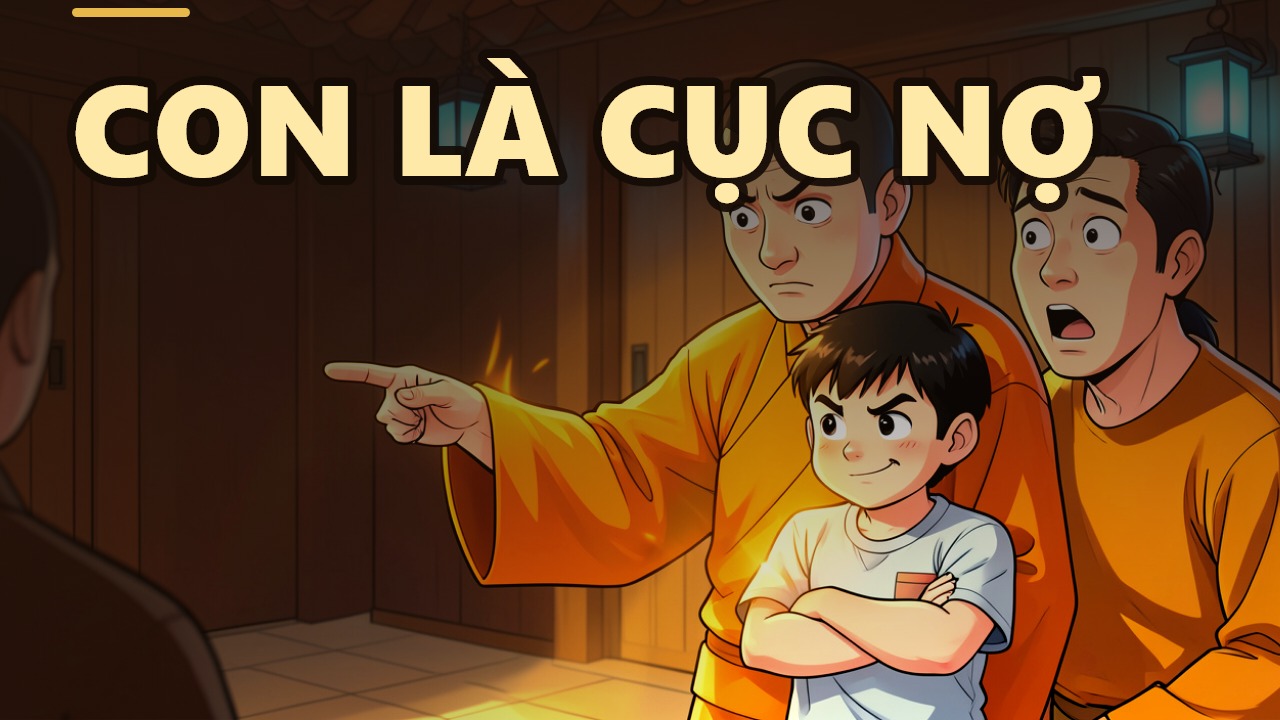
The teacher tells a story about a friend who brought his son to the mountain. Seeing the handsome boy, the Venerable immediately recognized: "This is your debt." The father complained that the child never listened, yet whatever the child said, the father had to comply. This shows that the parent-child relationship is not simply emotional, but one of karma and conditions.
**When should we start teaching children?**
Many say to start teaching children from age three, but the Venerable believes we must begin even earlier:
- From the womb: prenatal influences affect a child's temperament. - From the moment a couple forms a family: the heartfelt aspiration for a virtuous child. - Most fundamentally, from a previous life: living virtuously and helping others.
"Teach children from the initial heartfelt aspiration, from the moment the couple first met."
In truth, the most thorough teaching of a child happens in a previous life. Through virtuous deeds, caring for and helping others, we create the conditions to receive a good child in a future life. But in the present, we can also begin immediately by living morally and teaching the young children around us, to plant good seeds for the future.
**Parents must combine love and discipline**
A common mistake among parents is to lean too far one way: the mother spoils the child excessively, while the father is too strict. The child does not feel the father's love, and the mother cannot teach effectively. The teacher teaches that parents must integrate both: love the child like a mother, but teach with firmness like a father.
"You must love your child like a mother and teach with care and firmness like a father."
The important thing is that children must believe their parents truly love them. When they believe, the parents' teachings will take root. Even between a teacher and a disciple, the disciple needs to feel the teacher's love for the instruction to be effective.
**Be calm and meticulous in raising children**
Recognizing that a child's temperament is a tendency from many lifetimes, we cannot force an overnight change. Therefore, parents need calmness to avoid being hot-tempered, and meticulousness to understand karma, knowing how to plant the right seeds to transform the child's soul. Education is not about forcing a "bad child" to become a "good child"—it is far from simple. But with patience and wisdom, we can help children gradually advance on the path of goodness.
"We must understand this to find calmness and meticulousness in raising our children."
**Conclusion**
Raising children is not just about teaching them letters or a trade; it is a spiritual journey filled with love. Let us begin with a heartfelt aspiration, with living morally, and with helping our children feel our love every day. As the teacher has taught, when a child has morality, talent will develop naturally. Let us plant good seeds, be patient, and trust in cause and effect.
AI-assisted translation from the Vietnamese original.
Read in Vietnamese →