
Does Swatting a Mosquito Break the Precept? A New Perspective on the Precept of Not Killing
A dharma talk by Venerable Thích Chân Quang helps us understand that the precept of not killing does not stop at the action itself, but is also about balancing individual benefit with the global ecology, between plants and animals.
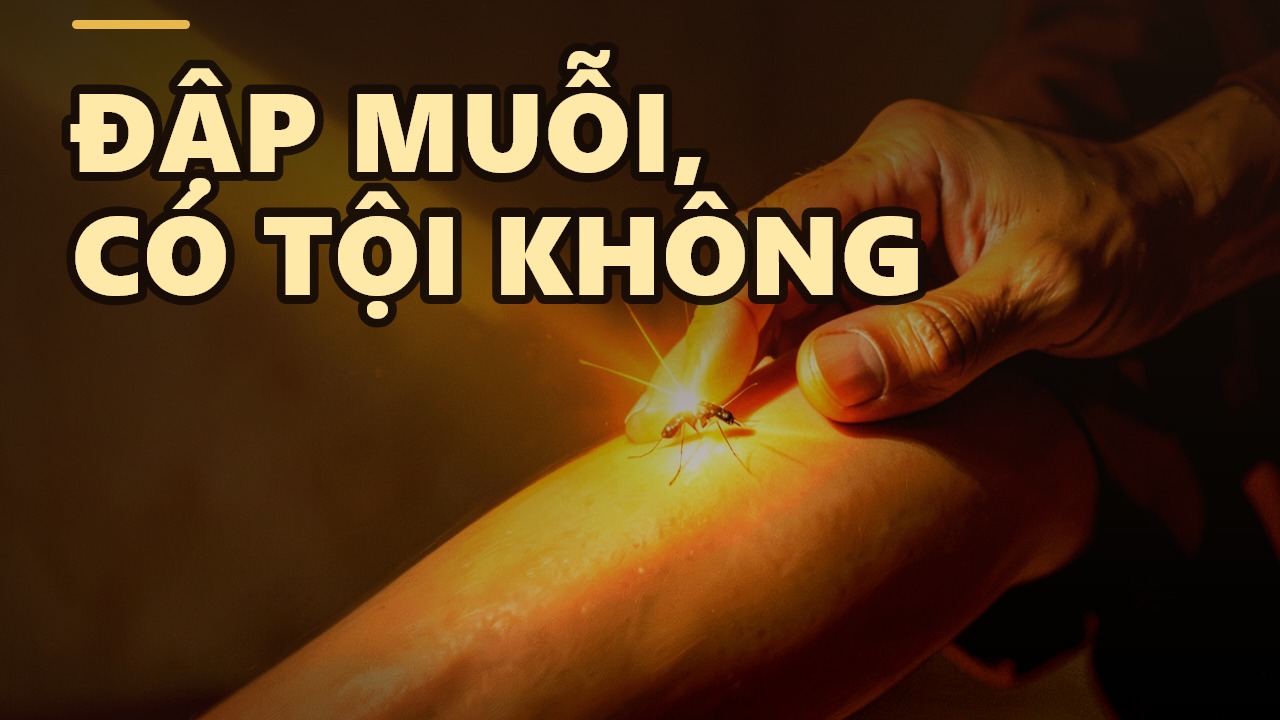
You see a mosquito land on your arm. Do you swat it? If you do, you fear breaking the precept of not killing. If you don't, you worry because it might spread disease to others. This question has probably confused many people. Today, let us listen to Venerable Thích Chân Quang explain a profound perspective on the precept of not killing — one that goes beyond common misunderstandings.
The Precept of Not Killing: More Than Simply Not Killing
Many people think the precept of not killing simply means not killing people or animals. But in truth, this precept carries a far deeper meaning. In his dharma talk on the Vinaya precepts, Venerable Thích Chân Quang opens a new perspective: the precept of not killing is not only about the action, but about the root of a cruel mind and heart, and it is also about the balance between the individual and the global ecology.
"When we speak of the precept against killing, against taking a human life, we usually don't worry much about it. We don't worry because we who practice would never be so cruel as to kill another person."
But if we stop there, we will encounter many difficult dilemmas in our practice of living.
The Cruel Mind Is the Root
The Venerable teaches that the act of killing arises from many states of mind, such as greed, hatred and delusion. But for killing to actually happen, an extreme cruelty is required. A practitioner may still have hatred, may still have greed, but never to that degree. However, from a social standpoint, we must be careful when passing judgment.
"The act of killing, when it truly violates a human life, is something very grave. But we must not condemn completely and absolutely — we must consider each case."
Like a soldier defending the border, or a police officer shooting a robber, they are not precept-breakers in the narrow sense. The Venerable emphasizes that we must have an open view and consider each situation according to its conditions.
The Individual and the Global: A Balance
This leads us to a great lesson: the precept of not killing does not only protect the life of each individual being, but must also maintain ecological balance. For example, if you do not swat the mosquito, you protect its life, but it may transmit malaria to the whole community. On the other hand, if you swat it, you harm one individual being but protect many people.
"We are only stuck — where are we stuck? On the level of individual benefit, and we never think of the benefit on the level of the global ecology."
The Venerable shares that many people keep the precept of not killing by refusing to kill a rat or a fly, yet never think about spraying pesticide on their rice fields. They keep feeling remorseful, wondering whether they have committed a transgression. In truth, if they do not spray, the pests will destroy the entire harvest, and the whole monastery will have no rice to eat. This is the balance between individual benefit and the global ecology.
Plants: The Foundation of Life
The Venerable broadens the topic with an interesting comparison: killing a dog and cutting down a tree — which carries more transgression? By conventional thinking, killing the dog is the heavier act, because an animal feels pain. But the Venerable says we must look further.
"Plants are the foundation of animal life."
Plants appeared first, creating the living environment for animals. When we cut down a tree, we are destroying the foundation of life on earth. Meanwhile, killing an animal only affects one individual being in the present moment. The Venerable says that from the perspective of the global ecology, cutting down a tree is a greater transgression than killing an animal.
"When we cut down a tree, we are cutting at the very root of life on this earth. We are breaking the foundation of life on earth."
The world is sounding the alarm about deforestation, environmental pollution, and climate change. The deep root cause is rapid population growth, leading to the reckless consumption of resources. In a forest, one animal living for every three hundred trees is considered balance. If we destroy the forest without maintaining this ratio, the ecosystem will collapse.
Living, and Living Happily
So the precept of not killing is not merely the prevention of killing, but the elimination of cruelty in the mind and heart. When we protect life, we must also protect the happy life of all species. If we merely let them live in suffering, we still carry a transgression.
"We want all species to live, and we must remember this as well — and let them live happily. If we let all species live but live in suffering, we still have a transgression."
Practitioners need a comprehensive view, not stopping at the letter of the words. Let us cherish plants as we cherish our own lives, because plants are the foundation of all species. Planting forests, retreating into the forest to practice — this is the ideal: it creates merit and supports practice at the same time.
The precept of not killing is a great lesson in compassion and responsibility. Do not let limited understanding trap us in difficult decisions. Let us broaden our vision, love all beings, and at the same time know how to weigh the common good, so that the life of all beings may truly be happy.
AI-assisted translation from the Vietnamese original.
Read in Vietnamese →