
The Mind of the Path, the Conduct of the Path, the Power of the Path, the Fruit of the Path: Four Stages of a Buddhist Practitioner's Life
A dharma talk by Thầy Thích Chân Quang reveals four words of "Path" following a strict logic: from love of the path, to practice, to influence, and to the realization of the fruit. Where are you on this journey?
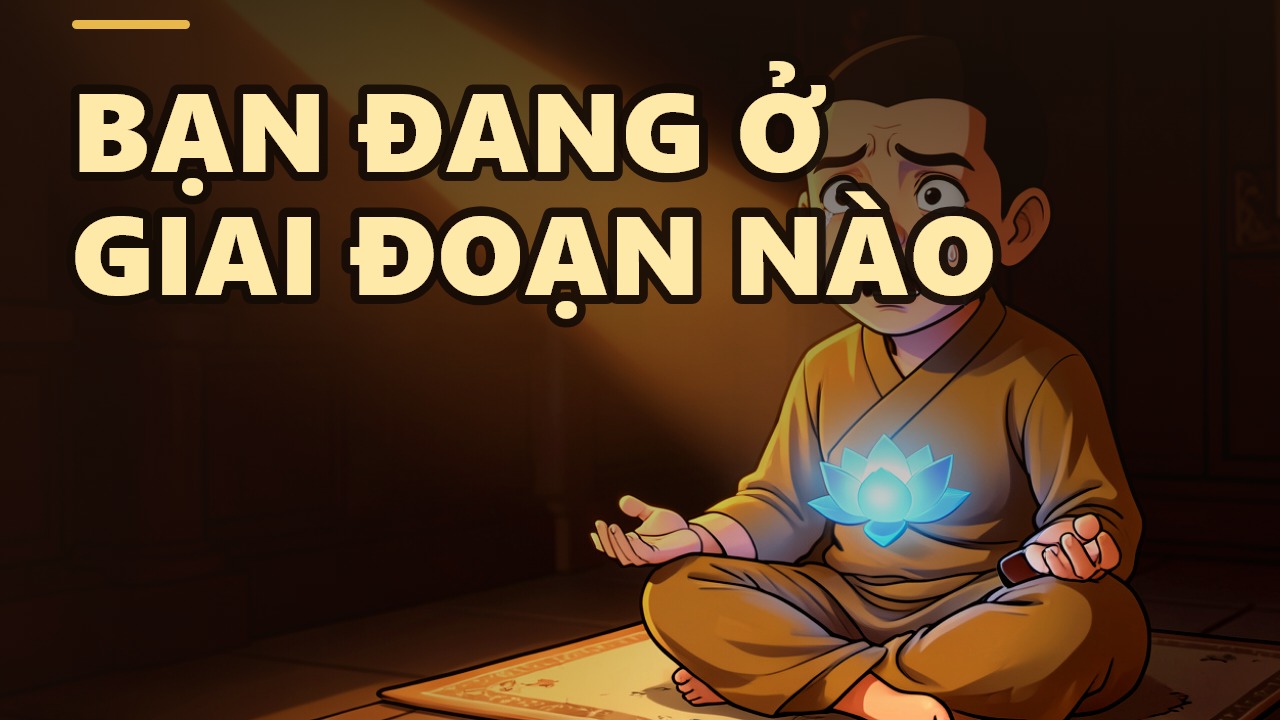
Have you ever wondered which stage of the spiritual path you are on? Is going to the temple, reciting the Buddha's name, and doing charity enough? Or is there a deeper truth waiting behind it all? Today, Thầy Thích Chân Quang opens up for us four familiar yet profoundly meaningful words: the Mind of the Path, the Conduct of the Path, the Power of the Path, and the Fruit of the Path. These four are not separate concepts, but a continuous logical chain that illuminates every step of a practitioner's journey.
The Four Words of "Path" — A Logical Sequence, Not a Coincidence
At first hearing, these may seem like dry terms. But Thầy Chân Quang reminds us: this is a necessary sequence that cannot be reversed.
"The order of the mind of the path, the conduct of the path, the power of the path, and the fruit of the path is a logical sequence, not a coincidence."
The Mind of the Path gives rise to the Conduct of the Path. The Conduct of the Path gives rise to the Power of the Path. And the Power of the Path leads to the Fruit of the Path. It is like a seed that must sprout, a tree that must grow, and then bear fruit. Each stage is the foundation for the next.
The Mind of the Path: The Flame of Love for the Dharma
What is the Mind of the Path? Thầy defines it very simply: it is love for the path, a caring concern for the path, dedicating the greater part of one's life to it. It belongs to the realm of feeling, but not the shallow emotion one has when first encountering the path.
"The mind of the path is love for the path, feeling for the path, caring for the path, dedicating the greater part of one's life to the path. It belongs to the realm of feeling."
So how do we know if we have enough of the Mind of the Path? Thầy poses a crucial question: When can it be said to be complete? His answer startles many: when one naturally begins to think of ordination.
"When the mind of the path is complete, the answer is that the person naturally thinks of becoming a monastic."
Merely thinking of it is enough — one need not actually ordain. Because of family obligations, or because blessings from merit are not yet sufficient, some people cannot ordain. But if the heart constantly turns toward a pure, monastic life, that itself is the Mind of the Path brought to fullness. Those who ordain already possess it, but for lay practitioners, this word "mind of the path" is a precious measure.
The Conduct of the Path: Practice Brought to Ripeness
When the Mind of the Path is complete, we naturally enter the stage of practice. But practice alone does not make Conduct of the Path. The Conduct of the Path arises when that practice has ripened fully and radiates outward.
"The conduct of the path is the practice of the teachings and principles of the path, ripened to the point that it begins to radiate outwardly. Others can see it and recognize it as conduct of the path."
Like a farmer planting trees, not every tree bears fruit immediately. Practitioners are the same: they may practice much, but if it is not yet ripe, others cannot yet see the change. Only when one's speech, actions, gaze, and smile radiate a natural serenity and gentleness do people say that one "has conduct of the path."
The Power of the Path: A Strength That Spreads
When the Conduct of the Path ripens to the point of influencing others, we naturally come to the Power of the Path. This power is not some supernatural energy, but the influence of an awakened life upon those around us, and even upon unseen realms.
"The power of the path begins when the conduct of the path has ripened to the point that it influences others, influences the community, and influences even the devas and the spirits."
The image of a practitioner who transforms an entire family, village, or community — that is the Power of the Path. No supernatural powers are needed. With compassion and clear wisdom, one naturally has a spiritual magnetism that draws others to take refuge in that presence.
The Fruit of the Path: The Blossom of the Spiritual Life
Finally, when the Power of the Path grows great enough, the practitioner realizes realization step by step. The Fruit of the Path means beginning to enter the four noble fruits, from Stream-Entry to Arhatship. This is the ultimate goal of a Buddhist.
"The fruit of the path is when we begin to realize one of the four noble fruits, gradually entering the four fruits of nobility according to the standard the Buddha taught us."
But on this journey, do not forget one thing: a practitioner is not a dry, lifeless person. Thầy Chân Quang emphasizes that the longer one practices, the deeper one's feelings become — feelings for the path, for sentient beings, for the beauty of the Dharma. It is a love guided by reason.
Loving the Path Through Reason and Beauty
Thầy offers a simple example: when we like a motorcycle, we like it for two reasons — it is good (reason) and it is beautiful (aesthetics). With the Buddha's path it is the same. We love the path for two reasons:
Reason: The teachings on cause and effect (karmic law), dependent origination, and non-self (anatta) are as rigorous as mathematics, convincing every intellectual mind.
Beauty: The compassion of the teachings, the serenity of the temples, the gentle smiles of the monastics, the rhythm of the sutras.
Thầy sincerely hopes that teachers and Buddhist practitioners will spread the Dharma through both: wrapping reason in a beautiful form, so that all who hear it find it "both reasonable and touching," and truly lovely.
Now ask yourself: Do I yet have the Mind of the Path? Am I practicing so that my Conduct of the Path may ripen? Have I created positive influence for my community? Do not be discouraged. Simply begin with a love for the Dharma — a sincere, passionate love — and all the later stages will come naturally, like fruit ripening on the branch.
Please begin today — begin with one wholesome thought, one line of scripture, one contemplation of non-self (anatta). The path of practice is not far away; you need only walk it with the Mind of the Path and the Conduct of the Path.
AI-assisted translation from the Vietnamese original.
Read in Vietnamese →