
Buddhism in the New Era: Upholding Truth, Renewing Transmission
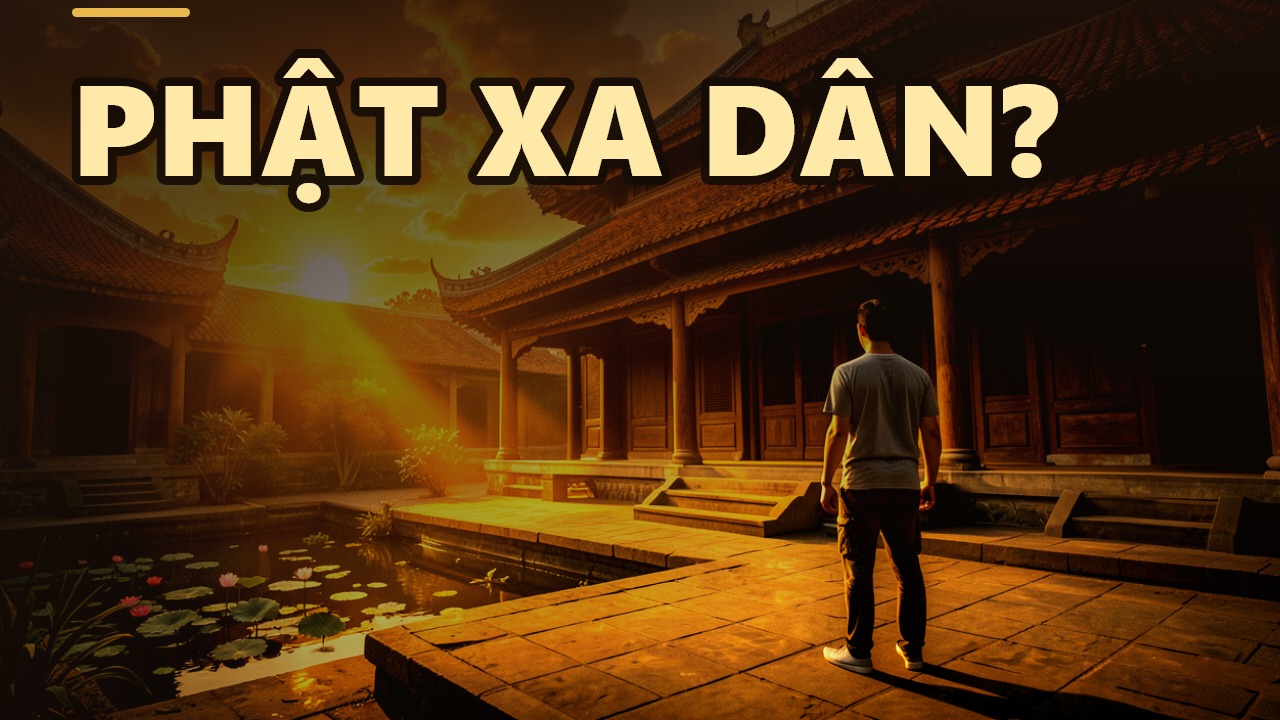
Have you ever passed by an ancient temple, seeing its grand gates and majestic Buddha statues, yet finding the courtyard strangely empty? Venerable Thich Chan Quang candidly observed this phenomenon in a recent dharma talk. He noted that as temples grow larger, the number of practitioners often dwindles. Is Buddhism drifting away from the people, or has the method of transmitting the Buddha's teachings failed to touch modern life?
### The Temple Bell: A Sacred Space is Defined by Spiritual Continuity
The teaching begins with a story of lineage. Since the time of the Buddha, the spiritual current has been transmitted without interruption. When we visit a temple, we are not merely seeking a place of worship; we are connecting with a stream of enlightenment that has flowed through countless generations. The teacher spoke of temples where this lineage was broken, and of the rebirth of Cambodian Buddhism after genocide, illustrating that the continuity of the Dharma is vital for survival.
In Buddhism, this spiritual current has flowed from the time of the Buddha until today without ever being severed.
Even Pho Quang Temple in the village once lacked a resident monk. Yet when the teacher arrived, he felt the sacredness remained. It is no accident, he said, that things are arranged by higher grace. This reminds us that the sanctity of a meditation hall lies not in material wealth, but in the connection to holy wisdom and the sincere heart of those who care for the temple.
### Why Visit a Temple? To Cultivate Filial Piety and Virtue
If asked what should be taught first to those visiting a temple, Venerable Thich Chan Quang answers: filial piety. This is the fundamental virtue of human character. From this root, love expands outward to one’s homeland, country, and all humanity.
Filial piety is the basic moral foundation of a person. No matter how skilled, good, or wealthy someone may be, if they do not know how to honor their grandparents and parents, they are still considered lacking in true morality.
A person may be famous or rich, but without filial devotion, their virtue remains incomplete. In modern life, the temple must be a place that nurtures this foundational merit while also equipping people with knowledge to walk alongside their times.
### Two Keys to Bringing the Dharma to Young People
Over thirty years of teaching, the master recognized a crucial shift. Today’s Buddhists are highly educated; they reject vague or circular lectures. They need principles presented clearly, in harmony with contemporary global knowledge.
He explained that his approach succeeds because it meets two conditions. First, he presents the Buddha’s teachings in simple, accessible language rather than obscure terminology. Second, the ethical viewpoints he teaches run parallel to, and keep pace with, the knowledge of our era.
Therefore, he does not hesitate to set sutras to modern music for children to chant, nor to take youth to movies to learn scriptwriting, even offering them bubble tea. As long as young people expand their wisdom and understand the world, they will love their country more deeply. The Dharma flowing within the nation, and the world embraced in patriotic love—this is the motto he shares.
### Changing Forms, Keeping the Truth
However, renewal does not mean discarding everything old. There are immutable truths, such as cause and effect (karmic law) and karma. These cannot be burned away. Customs, expressions, chanting styles, and dress codes are human constructs that require adjustment to fit the times. The teacher reminds us: those who live kindly must meet goodness; those who live decently must receive luck.
Whoever lives with kindness must encounter goodness; whoever lives with integrity must receive fortune; whoever performs many acts of merit must attain glory. This is truth; it cannot be spoken otherwise.
In daily life, we must learn to distinguish between the essence of the Buddha's teachings (Dharma) and the thick layers of cultural habit. If we cling to outdated customs at the expense of new values, we impoverish Buddhism itself.
### Return to Yourself, Let the Dharma Live in Your Heart
The most powerful message from Venerable Thich Chan Quang’s talk is the determination to harmonize the ancient and the modern. Do not hastily judge Buddhism as irrelevant to the past, nor forget the Buddha’s words in the digital age. Visit the temple not just to pray for peace, but to learn how to love, how to understand others, and how to live with mindfulness amidst a hurried life. Let every step be a breath, and every word an expression of compassion.
As the teacher says: let the Dharma flow within the nation, and let the world be held in patriotic love. Carry this spirit so that the Buddha's teachings do not remain confined within temple walls, but radiate throughout all of life.
AI-assisted translation from the Vietnamese original.
Read in Vietnamese →