
When Morality Vanishes, Where Will Humanity Go?
Venerable Thích Chân Quang affirms that morality is the vital foundation of humanity. While morality endures, the world is at peace; when morality is lost, all things crumble. Let us explore why this is so, and how to nurture morality in daily life.
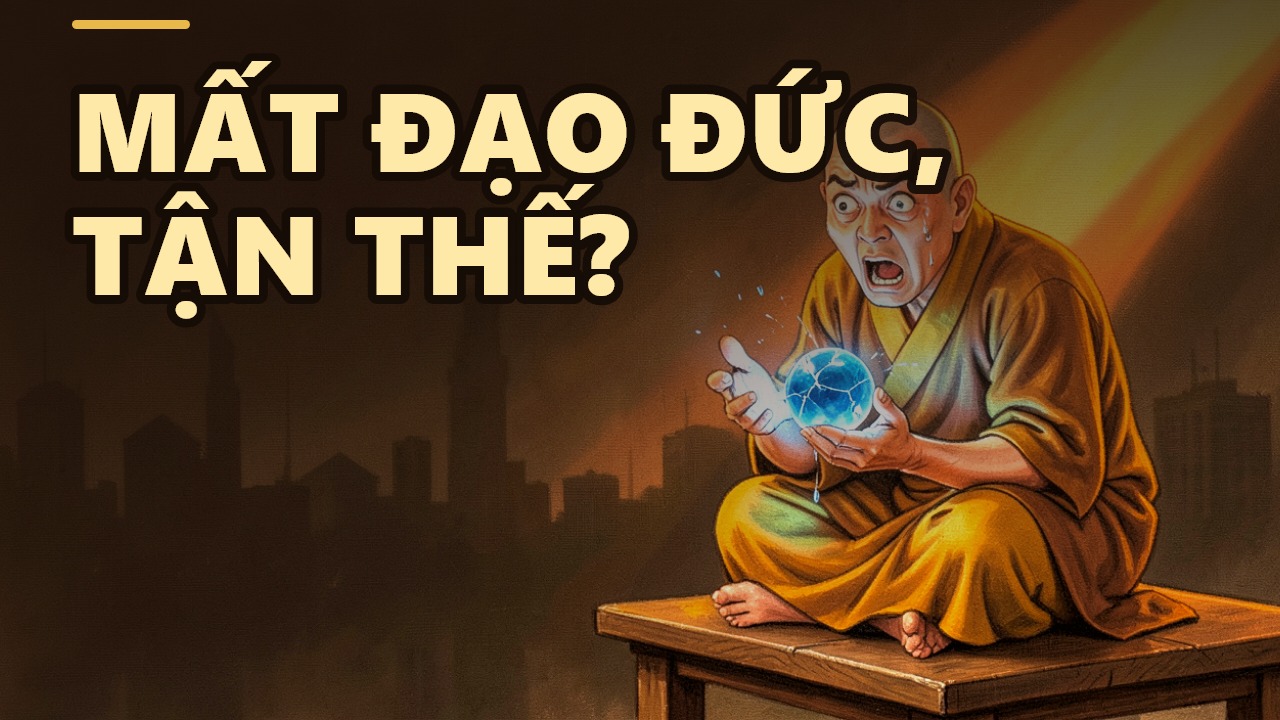
Have you ever wondered: if one day everyone in the world lost their morality, what would happen? In a dharma talk on the evening before the Vu Lan festival, Venerable Thích Chân Quang offered an answer that is simple, yet profoundly deep.
Morality Is the Vital Foundation of Humanity
The Venerable said that morality is not merely an abstract concept; it determines the survival or extinction of all humanity. He affirmed: "If morality remains, humanity survives. If morality disappears, humanity vanishes."
Listening to this, we suddenly understand why the world still exists despite wars and conflicts. It is because within people there remains a seed of morality. There are still those who care for the people, who trade honestly, who strive to protect animal species, who come to the aid of those struck by disaster. Even the great powers that possess nuclear weapons dare not press the button, because they are aware that if they did, the whole world would perish together. That itself is morality.
But try to imagine a day when morality vanishes from the human heart. Immediately, restlessness and suffering (dukkha) would flood over life.
Humans Have No Morality Gene
Interestingly, morality is not a natural instinct of human beings. While animals can be pre-programmed through their genes, like a dog that is loyal to its master, humans do not have such built-in behavior. The Venerable explained: "Humans are more intelligent than every species, but humans lack that instinctive behavior — we have no genetically programmed morality."
The human heart is remarkably free. If it is taught morality, it will know loyalty; if it is not taught, it can easily turn to deceit. That is why morality is a great demand, a great challenge for humanity. And it is thanks to the sages and philosophers who passed down these teachings that people heard and accepted them, choosing morality as a way of life — and thereby humanity has been sustained.
Why Do We Do Good Voluntarily?
Morality differs from the law: we do good not out of compulsion, but out of our own willingness. The Venerable named four reasons why people willingly do good:
Believing in cause and effect (karmic law): We know that doing evil will bring its retribution, and so we choose to do good in order to receive good fruit.
Being moved by a good example: People who live exemplarily, who sacrifice and dedicate themselves, touch our hearts, and we imitate them with both awareness and feeling.
Loving goodness unconditionally: This is the loftiest level, as taught by Confucianism or embodied in the bodhisattva spirit of Mahayana Buddhism. No expectations, no conditions — we simply do what is right, naturally.
Believing in divine reward and punishment: Many people fear that the gods will punish them, and so they dare not do evil, striving instead to do good. Though not yet perfect, this still helps to build a better society.
Thanks to these four reasons, morality spreads from one person to another, from one generation to the next, forming an invisible current that sustains human life.
Each of Us Is a Teacher of Morality
We often think that only teachers can teach morality, but in truth, every one of us can become a transmitter of morality through our own actions. The Venerable told the story of Mr. Phạm Xuân Thệ, a commander during the war. Standing before the graves of his comrades, he said: "I ask forgiveness of my brothers, only because I did not command well, and so I pushed you to your deaths."
These are words full of morality, full of humility and responsibility. They teach us that in all things we should consider carefully, and never look down on the pain, the honor, or the life of another. And as the Venerable emphasized: "Do not belittle the suffering of others."
Each of us, at some point in life, has advised a friend toward what is right, or reminded a loved one to live kindly. Those small acts are themselves the transmission of morality. Be aware that we are contributing to the survival of humanity, and do it with a whole heart.
Conclusion
Morality is not a distant concept; it is the very breath of life. Each day, each decision, from the smallest to the greatest, can carry morality within it. When we choose to do good, we are contributing to the peace of the world. Let us nurture morality in our own heart, so that happiness may spread forth like endless ripples upon the water.
AI-assisted translation from the Vietnamese original.
Read in Vietnamese →