
Giving Without Attachment: Lessons from the Diamond Sutra
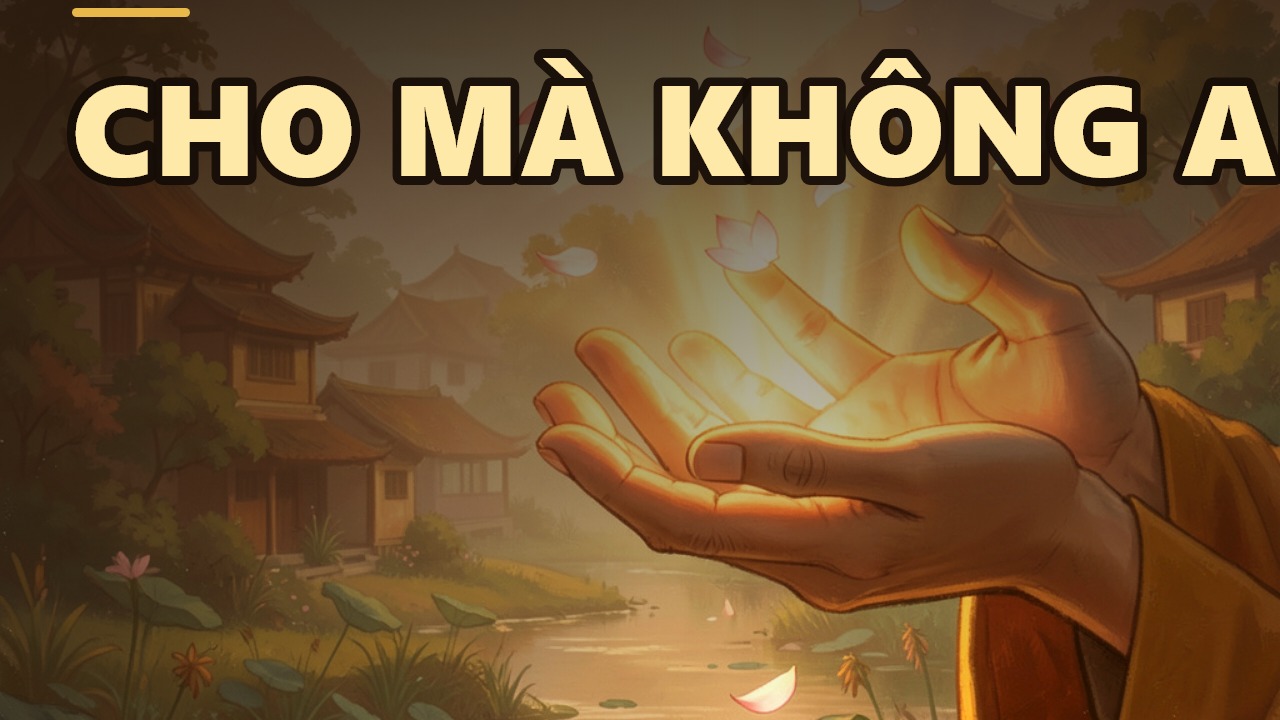
In a dharma talk on the Diamond Sutra, a question troubled many: Why does my heart remain uneasy, despite giving generously, contributing to every temple, and helping everyone in need? In life, we often think of giving as a matter of money or quantity. But through the teachings of Venerable Thich Chan Quang, we see that true giving is a matter of the heart.
**When Giving Becomes a Hidden Transaction**
The Buddha calls non-genuine motivations "dwelling on appearances." This is when we give because someone is attractive, because they flatter us, because they are family, or to seek blessings, praise, to display power, or to gain influence. The action may seem virtuous, but the mind is not. Someone might donate millions for fame, another gives gifts to the wealthy for an autograph, another does charity only to be noticed. All are dwelling on appearances.
We see this discusses the four appearances... giving because someone is attractive, these easy-to-remember points. Giving because someone flatters us... These are the motivations the Buddha calls non-genuine. The action appears moral, a virtuous act of giving, but the mind is not virtuous.
**The Two Genuine Motivations of a Bodhisattva**
Master Chan Quang points out that we must still give, but with two genuine motivations. First, because we see someone in difficulty, troubled, unable to resolve it themselves, we naturally help them with compassion. Second, and more profoundly, to form a wholesome connection with them, so that when the conditions ripen, they may one day encounter and learn the teachings. The second motivation explains why a bodhisattva can give a gift to someone who is well-fed and healthy—not to bribe them, but to plant a wholesome seed.
With these two reasons, it is called "not dwelling on appearances." The first reason is helping someone overcome a certain difficulty... The second reason is to form a wholesome connection for future spiritual guidance.
**The Diamond Sutra Speaks of Morality, Not Emptiness**
There is a truth few notice: the entire Prajnaparamita system, especially the Diamond Sutra, uses many words like "no," "non-," and "not." Many hastily conclude it teaches about voidness or emptiness. But through four lectures, Master Chan Quang turned the idea around. The Buddha uses "no" to eliminate subtle faults in the mind—a morality refined to the level of perfection. Thus, the Diamond Sutra speaks of morality, not merely of emptiness.
The Diamond Sutra speaks of morality. Because this morality is so profound, it must use many words like "no" to support its moral meaning.
We must not think the Prajnaparamita system of wisdom stops at "no." In fact, it uses that "no" to build for a bodhisattva a morality that soars to the absolute peak.
**To Subdue the Mind, Learn to Give**
The Diamond Sutra opens with the question: How can the mind be subdued? The Buddha answers with a broad lesson—He teaches about giving, the four appearances, and non-attachment. Why? Because for our own mind to be at peace and joyful, we must bring peace and joy to the minds of others. Giving is the foremost way to help others find joy. When we give with a mind free of attachment, we let go of the ego. The more we let go, the lighter, calmer, and more subdued the mind becomes.
For our own mind to be at peace and joyful, we must bring peace and joy to the minds of others.
Giving is the foremost practice, the gateway to guiding all beings.
**Why Does Giving Without Attachment Yield Merit Vast as Space?**
According to the law of cause and effect, merit is like an arrow shot upwards—it loses momentum and falls back down. But the Buddha says the merit of giving without attachment is vast as space. In truth, that person enjoys less merit, exercises restraint, and does not seek to consume merit in pleasures or fame. They do not hoard wealth to satisfy the ego. A bodhisattva has no clenched hands—meaning they are not attached to possessions. If they hold money, it is only to care for the Buddha's teachings and all beings, not to satisfy the self.
The merit of a bodhisattva who gives without dwelling on appearances is likewise inconceivable, vast like space in all directions.
A bodhisattva has no clenched hands.
**The Lesson of Letting Go**
The lesson from the Diamond Sutra is not to encourage us to discard all our money. The important thing is to practice giving with compassion, without keeping score, without expectation. Each day, try to help someone, offer a small gift, or simply listen. But do not fall into attachment. As the mind grows less attached, we will feel a lightness as vast as space—and our mind will gradually be subdued. This is the path we walk together.
AI-assisted translation from the Vietnamese original.
Read in Vietnamese →