
The Greatest Victory: Conquering Yourself
A girl who fell in love with a bandit, nearly lost her life, and discovered the supreme victory of conquering oneself.
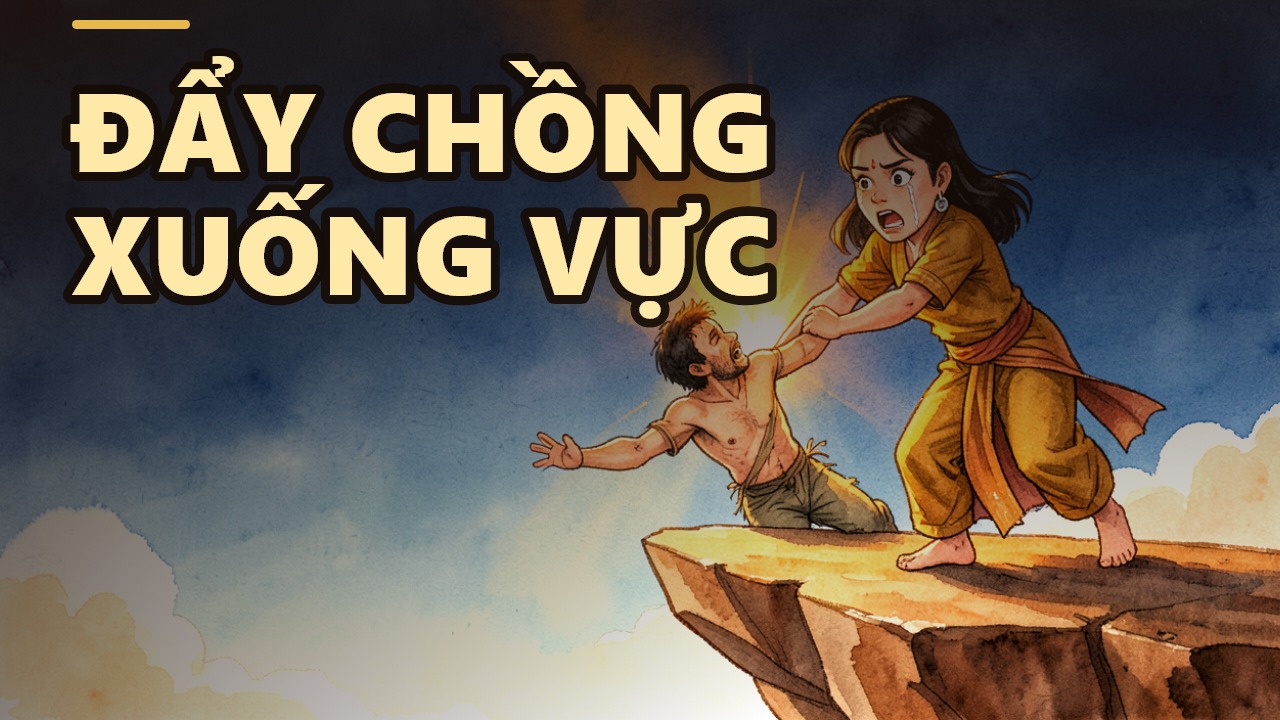
Have you ever loved someone whom everyone said was bad? Have you known clearly that they were bad, yet been unable to let go of your feelings? Today's story of a young girl, recorded in the Dhammapada, will show you a painful truth: the heart does not always follow reason, and the greatest victory is not defeating others, but defeating yourself.
The Most Foolish Love in the World
Kundalakesi, the daughter of a wealthy merchant, once stood on a high terrace looking down when she caught sight of a bandit being led away in custody. In that single moment, a bolt of love's lightning struck her:
"Suddenly, in that one instant, a lightning bolt of love struck her neck, leaving her numb and frozen, her whole body trembling no more—she fell in love with the bandit being captured down on the street."
She demanded to marry the bandit at any cost, and her parents had to substitute a corpse to bring him to her. But the bandit did not love her at all; he only wanted to steal the family fortune and run away. He coldly waited for the day to strike.
The Cruel Truth and the Sudden Turn
One day, the bandit led her to the edge of a cliff and coldly demanded that she remove all her jewelry, declaring he would kill her. At that very moment, she realized:
"The person I loved, whose life I saved, never loved me at all, felt no gratitude toward me, and was in essence nothing but a heartless bandit."
In an instant, she pretended to embrace him affectionately and then pushed him off the cliff. She escaped, but she could not return home. She cast off her jewelry, fled, and became a nun with the Nirgranthas, an ascetic sect of that time.
From Sorrow to Wisdom
In that sect, thanks to her natural wisdom, she became a brilliant debater, traveling everywhere to challenge others. She came to Savatthi, the wealthy capital city, and raised a branch of a tree, declaring that anyone in the whole city could debate her. Sariputta, known as the foremost in wisdom in Buddhism, accepted the challenge. The debate lasted from morning until evening. She asked many questions, and he answered them all. When she had no questions left, he asked her just one:
"What is the one?"
She stood stunned, completely exposed. He answered:
"Nirvana is the one—the supreme peak of liberation, a peace and freedom beyond all comparison."
She knelt down and asked to take refuge, and later, upon meeting the Buddha, she attained the fruit of an Arhat.
The Supreme Victory
After she recounted the story of pushing her husband off the cliff, the Buddha taught:
"Though one may conquer a thousand enemies on the battlefield, that is nothing compared to conquering oneself—the supreme victory."
Her story is a journey from blind love to awakening. She defeated the bandit, but that was not a victory worth being proud of. The true victory was conquering her own delusion of passion, overcoming her afflictions (kleshas) and her ego. The Buddha also said:
"Though one may recite a hundred verses that bring no benefit, it is better to hear just one verse that brings peace after hearing it."
The lesson for us is this: every day, we fight on our own battlefield. We battle bad habits, fits of anger, greed, and unreasonable loves and hates. Instead of trying to conquer others, let us begin with our own mind/heart. Only when we conquer ourselves are we truly free.
Living with Tolerance and Respect for Conditions (Dependent Origination)
One detail worth reflecting on: before encountering the true Dharma, she had followed other paths. Teacher Chan Quang reminds us that "conditions (dependent origination) are simply that"—every stage is a preparation. We should refrain from attacking those who walk a different path, for who knows—that path may be the stepping stone that leads them to the truth.
Remember: the hardest thing in this world is not pushing an enemy off a cliff, but facing yourself in silence. If you today are struggling with a habit or a negative emotion, have the courage to look it straight in the eye and say: "I will win." Because once you have conquered yourself, that victory is complete and more lasting than any brilliant triumph in the world.
AI-assisted translation from the Vietnamese original.
Read in Vietnamese →