
Only One Word Is Enough to Change a Lifetime
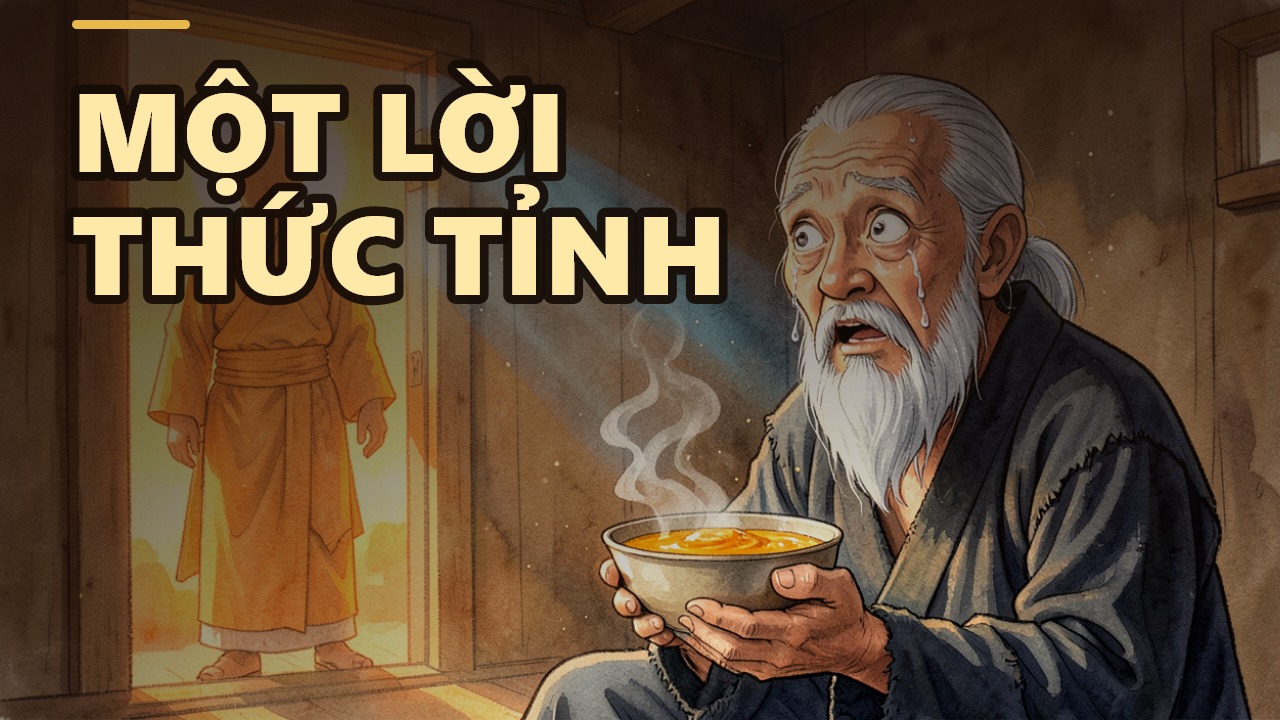
Have you ever spoken thousands of words, yet found that no one valued them? But then, a simple word from someone else awakened you and changed your entire life? The story from the Dhammapada today will show us this clearly.
## Why Can One Word Be Greater Than a Thousand?
In the Dhammapada, the Buddha taught: "Even if one speaks a thousand empty and useless words, it is not as good as speaking just one word full of meaningful peace." This teaching is illustrated by a vivid lesson about a notorious executioner known for his cruelty.
## The Executioner with Blood-Stained Hands
The story goes that long ago, there was a famous robber who was extremely violent. He commanded hundreds of followers and spent his whole life killing and stealing. When captured by the royal court, all hundred men were sentenced to death. No one dared to carry out the beheadings, so the king proposed a deal: if the leader could execute all his own subordinates, he would be pardoned. With his cruel nature, he did not hesitate. He killed nearly three hundred people without changing his expression. Afterwards, he was appointed chief executioner. For many years, he performed his duty with a heart undisturbed by any ripple of emotion.
Only in his old age, when he had to strike three times to sever one head, did the family of the condemned sue him before the king. He was allowed to retire with a decent sum of money, but throughout his life, no woman dared to marry him. On his first day of retirement, he was eating a fragrant bowl of honey porridge when Venerable Sariputta appeared at his door.
## One Awakening Word, A Great Turning Point
Seeing the dignified appearance of the monk, the executioner naturally felt deep respect. He had never made offerings to anyone before, but following proper etiquette, he offered his bowl of honey porridge to Venerable Sariputta. The elder accepted it. After eating, he gave a dharma talk on cause and effect (karmic law), purity, and faith in the Triple Gem. These brief but profound words shook the man’s entire body. When Venerable Sariputta spoke once more, the executioner calmed down and attained the fruit of Stream-Entry right there on the spot.
Often, we speak many words, but they are not timely, do not align with conditions (dependent origination), and lack complete meaning. It is better to say one word that is fully meaningful, aligned with conditions, and timely, bringing pure joy and peace to the listener.
This is how Teacher Thich Chan Quang explained this passage from the sutra. He showed us that the teachings of the Tathagata are not measured by the quantity of lectures, but by truths that arise at the right time and touch the root of the listener's mind/heart.
## Profession and Karma: A Mysterious Connection
An interesting aspect of this story is why such a person was born into the profession of an executioner. Teacher Chan Quang explains that there is a tight relationship between profession and karma. Profession creates karma, and karma creates profession. A noodle seller can create good or bad karma depending on the quality of their food and how they treat customers. A dedicated teacher increases their blessings from merit. Conversely, past thoughts and curses can lead us into professions we never expected.
Teacher Chan Quang shared: "Have you ever been angry at someone and cursed them exactly according to their fault? We always exaggerate, cursing more than the crime committed. For example, when a child drops a cake, we might shout, 'You thief!' In the next life, we may find ourselves among thieves." Furthermore, if a person spends their life swearing, "I will kill all robbers," they may be pushed into that very profession in a future life to pay off karmic debts.
## Punishing Evil Can Be a Good Deed
There is a paradox that Teacher Chan Quang emphasized: In algebra, a negative multiplied by a negative becomes positive. In cause and effect (karmic law), it is similar. Being firm against evil can be a virtuous act. An executioner kills criminals; soldiers kill enemies to protect the country. Generals like Tran Hung Dao and Pham Ngu Lao had blood-stained hands, yet why are they revered? Because when we punish evil, we are planting a wholesome seed.
We must learn this to understand more about social education and raising children. The West has made mistakes in educating youth. They excel in mathematics but forget how to apply mathematical logic to the moral laws of cause and effect in life.
Teacher Chan Quang also mentioned a French executioner who lived into his seventies, sleeping and eating well, untroubled by his executions. This was because the act of punishing evil kept his soul peaceful.
## Lessons for Us Today
Today, in a society filled with empty speech, glorifying violence and hatred, we must remember this lesson: Every word we speak plants a seed. Do not waste words on meaningless things. Use every word to offer others peace and wisdom. And do not fear being firm against evil, for that may be an act of true compassion.
Ultimately, just one truthful word, spoken at the right time to the right person, can transform a blood-stained hand into a holy soul. Begin with your words today.
AI-assisted translation from the Vietnamese original.
Read in Vietnamese →