
Is Death the End, or Is the Soul Immortal? What Did the Buddha Say About Annihilationism and Eternalism?
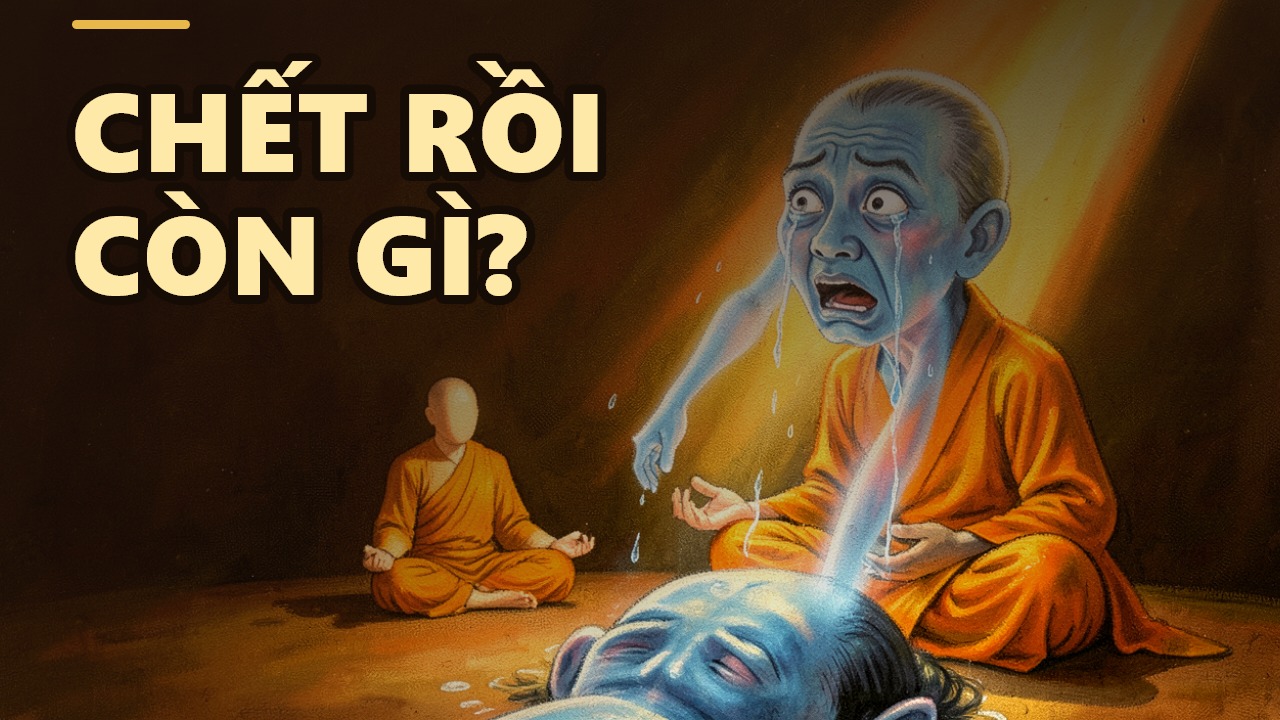
Do you believe that humans continue to exist after death? If someone asked you, "Is death the end, or is there something more?" how would you answer? This question has sparked debate among humanity for thousands of years. In the Buddha's teachings (Dharma), these two extreme views are known as annihilationism and eternalism. Today, let us listen to their profound meaning through a dharma talk by Venerable Thich Chan Quang.
### What Are Annihilationism and Eternalism?
In Buddhism, annihilationism is the view that when we die, everything ends and nothing remains. Eternalism is the belief that after death, the soul exists forever. Venerable Thich Chan Quang begins his teaching with this distinction:
"Annihilationism claims that death is the absolute end. Eternalism claims that death is not the end, asserting that the soul persists eternally thereafter."
These two concepts seem opposite, yet they both fall into the same trap. Consider your deceased loved ones. Some people believe their grandparents have passed away completely, so they only remember their kindness and hold annual memorial services. This is a form of "respectful" annihilationism. Others are less grateful, believing the dead have no connection to them, thus denying any debt of gratitude. Meanwhile, those who hold eternalist views imagine souls wandering in invisible realms, living forever in some unchanging state.
In reality, neither view reflects the truth. If everyone born as human simply died and their souls remained forever in hell or heaven, the populations of those realms would become impossibly crowded! Venerable Chan Quang humorously points out this absurdity of eternalism. Conversely, annihilationism denies the continuity of karma, rendering cause and effect (karmic law) meaningless.
### What Did the Buddha Teach About These Views?
The Buddha rejected both extremes. He did not say death is the end, nor did he claim an eternal soul exists. He taught about rebirth and samsara (cycle of rebirth), which differs from eternalism. Venerable Chan Quang explains:
"Death is not the end, but it is also not the existence of a permanent soul. Why is death not the end? Because your karma remains."
When we die, the body disintegrates, but karma—the actions and intentions we created—persists. Karma carries us into a new existence. Importantly, karma does not always ripen immediately. Some good deeds may take ten or twenty lifetimes to bear fruit. As the teacher illustrates, a person might accumulate great merit but be reborn merely as a village teacher because conditions were not yet ripe for greater results. Sometimes we wonder why good people face misfortune, because cause and effect (karmic law) operates with complex subtlety. Viewing just one or two lifetimes is insufficient to see the whole picture.
### The Subtlety: Self and Non-Self (Anatta)
This is the key to escaping both extremes. Upon death, the consciousness retains its identity during the intermediate state. People may recognize deceased loved ones through dreams or intuition, leading many to mistakenly believe the soul is permanent. However, upon rebirth into a new body, all physical forms, memories, and old identities vanish. Only karma follows. So, is the "self" one entity or two?
Venerable Chan Quang shares: "The self is no longer the self." Saying it is "one" leads to eternalism; saying it is "two" leads to annihilationism. Both are wrong. The truth lies in the Middle Way: between continuity and change. Imagine a beggar in a past life who becomes a monk in this life. Back then, he stood on the street begging; now, he preaches the Dharma. Is he still that same beggar? No. Yet he carries the karmic imprint of his past begging, transforming into a "monk who receives alms" under different conditions. The truth is not found in "one" or "two," but in that flowing stream of impermanence (anicca).
### Beware of Misleading Teachings
Within the Buddha's teachings (Dharma), some practitioners attain deep meditative concentration and recall many past lives. However, if their concentration is not sufficiently profound, they may only see human rebirths and miss other realms. Consequently, they conclude there is no hell or heaven, only one body transitioning to another. Their words sound confident because they rely on personal experience. But the teacher warns:
"The sole duty of future patriarchs, masters, lecturers, and teachers is to clarify the Buddha's teachings for our era. Do not foolishly invent new doctrines that the Buddha never spoke, lest you fall into wrong view."
The Buddha fully understood the three realms and six paths. Even Arhats witnessed these truths directly. Therefore, when hearing claims that "there are no spirits, heavens, or hells," we must remain mindful. Such individuals may have achieved calmness, but their wisdom eye was limited. Do not let narrow interpretations lead you away from the Buddha's words.
### Living the Middle Way
Between the extremes of annihilationism and eternalism, the Buddha shows us a true path: the Middle Way. It involves understanding cause and effect (karmic law), karma, and rebirth without clinging to a fixed "self." Venerable Chan Quang notes:
"Buddhism often uses tentative answers. They are tentative because they reflect the ultimate truth."
This does not mean being vague. Rather, we refuse to settle on any extreme assertion. When practicing the Dharma, we clearly see all phenomena as impermanent (anicca) and lacking inherent self-nature. We live virtuously, doing good and avoiding harm, with compassion and wisdom. This allows wholesome karma to grow and helps us end the suffering (dukkha) of samsara (cycle of rebirth).
By understanding the subtleties of annihilationism and eternalism, we learn a great lesson: do not cling to death, nor grasp at life. Each present moment is an opportunity to plant good causes, to practice letting go of the ego, and to walk the Middle Way. Practice mindfulness of the Buddha, engage in contemplation, and live a life guided by wisdom. Thank you for reading.
AI-assisted translation from the Vietnamese original.
Read in Vietnamese →