
The Balance of Talent and Virtue: The Secret Behind Lasting Success
A dharma talk by Venerable Thích Chân Quang on the balance between talent and virtue, helping us understand that moral character is the solid foundation for every achievement.
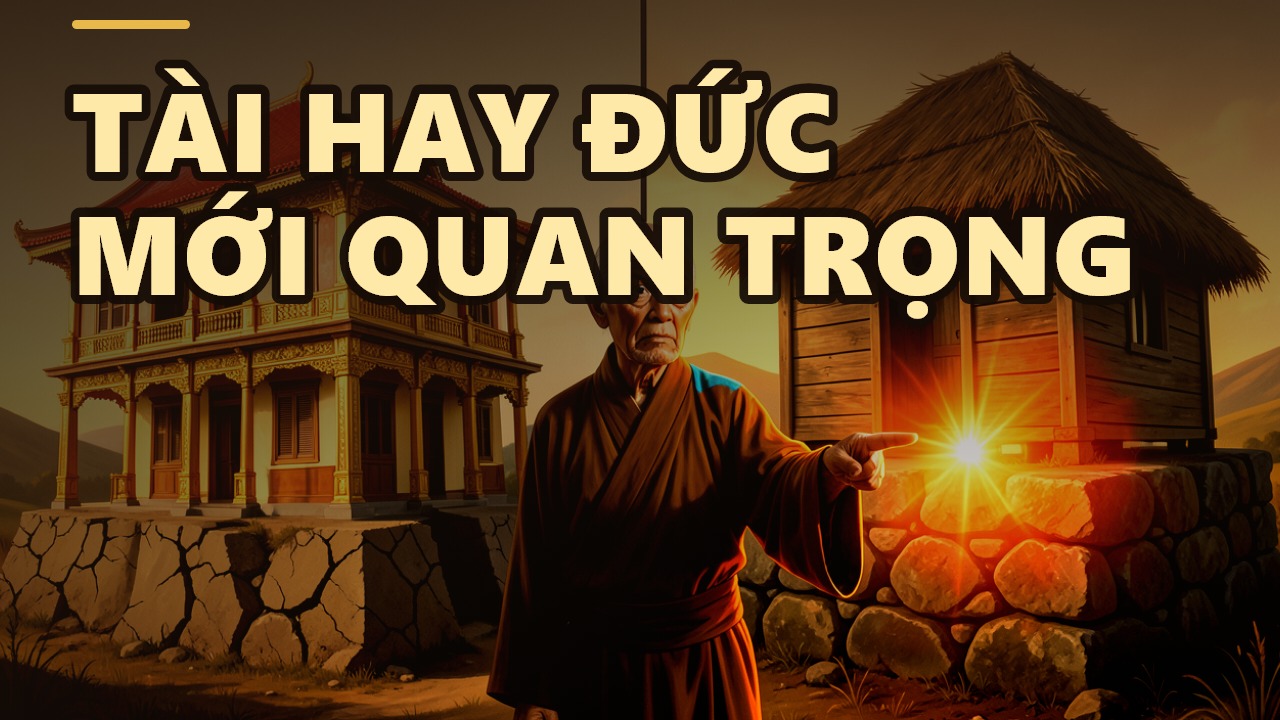
Have you ever wondered why some people are exceptionally gifted and brilliantly successful, yet eventually collapse with no one able to save them? Meanwhile, others live quietly and speak little, yet their lives are remarkably stable and peaceful. Could there be a secret that we often overlook?
The House and Its Foundation
Imagine your life as a house. Talent, career, fame — everything the world sees and admires — is the splendid house above ground. But virtue, character, and inner cultivation — the invisible, hard-to-see things — are the foundation buried beneath the earth. People often marvel at a beautiful house and forget that without a solid foundation, it could collapse at any moment.
"Virtue is like the foundation of a house. Talent is like the house built on top of it. When we walk into a house, no one sees the foundation; people only see the house itself... But truly, if there is no foundation underneath, the house will collapse immediately."
We often chase after what is easy to see and measure: grades, degrees, money, reputation. But few are willing to invest in the "invisible" part — nurturing the soul, cultivating character, living with integrity, and knowing how to sacrifice. This is precisely why some young people achieve early success but quickly wither in their careers, while others go the long distance.
Virtue Gives Rise to Talent
Many people mistakenly believe that talent comes naturally, or that cultivating wisdom alone is enough. But if we look deeply, we will see that behind every great talent lies a solid moral foundation. The scientist Einstein, after his monumental achievements, still devoted great passion to studying religion and spirituality. He once spoke of Buddhism as a religion that could guide the science of the future. This shows that he possessed not only wisdom but also depth of soul, a rich inner life.
Professor Ngô Bảo Châu, the pride of Vietnam, is the same. Everyone who meets him notices how simply and humbly he lives, with philosophical depth. That is the "virtue" supporting his "talent." Without virtue, talent becomes a tool for ambition, easily causing harm to oneself and to society.
"We see that a person's success actually springs from some hidden virtue behind it, inside something we cannot see."
Virtue Without Talent — Harmless or Useless?
Some people worry: "I have no special talent; I only know how to live well. What use am I to the world?" Thầy Chân Quang reassures us: a person with virtue but without talent is harmless — it is even a good thing. They may not have accomplished anything great yet, but their very presence is a blessing to those around them. And when virtue is present, talent will arrive at the right time, in the right way.
"What if one has virtue but no talent? ... It doesn't matter. There is still money to keep building, but it will not collapse. ... But a person with talent and no virtue is a great calamity for this life."
Conversely, a person with talent but lacking virtue is like building a house on sand. The higher you build, the more easily it collapses. History has proven how many talented but immoral people have caused terrible disasters. So do not rush after talent; cultivate virtue first. That is the most solid foundation for all success.
Practicing Within Daily Life — Working and Cultivating at the Same Time
Many people think they must finish their practice before working, or must leave the world to enter a monastery. But in reality, spiritual practice is not escape. We can work and cultivate virtue at the same time, right within our jobs and daily lives. Lay Buddhists still go to work, still care for their families, but always keep their hearts turned toward goodness, knowing how to stop before temptations, and knowing how to sacrifice for others.
"Dear Buddhist friends, you say you must go to work, but if the teacher says to sit and cultivate virtue, when will it ever be finished? ... So keep going to work, keep going into factories and offices, keep doing business, striving, farming, all kinds of things. But work while practicing, while cultivating virtue."
What matters is never neglecting your practice. Each day, set aside a little time to quiet the mind, read sutras, sit in meditation, or simply live mindfully amid the flow of life. Do not assume that practicing on your own at home is enough. Come to the temple, take refuge in the practice community, in the support of the monks and fellow practitioners. That is how to keep the flame of practice burning bright.
Do Not Let the Ego Destroy You
When you accomplish something great, when you are praised, the ego easily awakens. We begin to feel important, to see ourselves as brilliant, and then to look down on others. That is exactly when virtue erodes, and the danger of collapse draws near. Thầy Chân Quang reminds us: "The greater the Buddhist work, the more we must practice — five times, seven times harder." This applies to each of us as well. The more successful we become, the more humble we must be, and the more we must cultivate ourselves.
"Whenever we accomplish something, arrogance arises. And once arrogance arises, we begin to make trouble — blaming this person, criticizing that one, elevating ourselves, praising ourselves and disparaging others — and then all kinds of afflictions (kleshas) flare up everywhere."
Learn to accept being wronged and misunderstood. That is an opportunity to train patience, to test how far our practice has come. Do not rush into sadness or anger when unfairly accused; see it as a precious lesson. As the teacher says: "Being scolded unjustly is such a joy!" — because that is when we are tested, when our souls are polished and refined.
Conclusion
Life is a long journey, and what matters is not running fast but walking steadily. Always remember: virtue is the root, talent is the branch. Nurture your virtue every day, even through a small deed, a kind word, a positive thought. When the foundation is solid, your house will endure through time, and you will taste true happiness — not the superficial happiness of the outside world, but the peace and joy arising from the depths of your soul.
AI-assisted translation from the Vietnamese original.
Read in Vietnamese →