
Neither Shore Exists: The Buddha's Teaching on Liberation in the Midst of the World
The Buddha declared: "There is no this shore, no other shore; neither shore exists, free of suffering and all bondage." This dharma talk by Thay Chan Quang helps us understand that liberation lies not in some distant place, but right here in letting go of all attachments, transcending the "other shore" of consciousness.
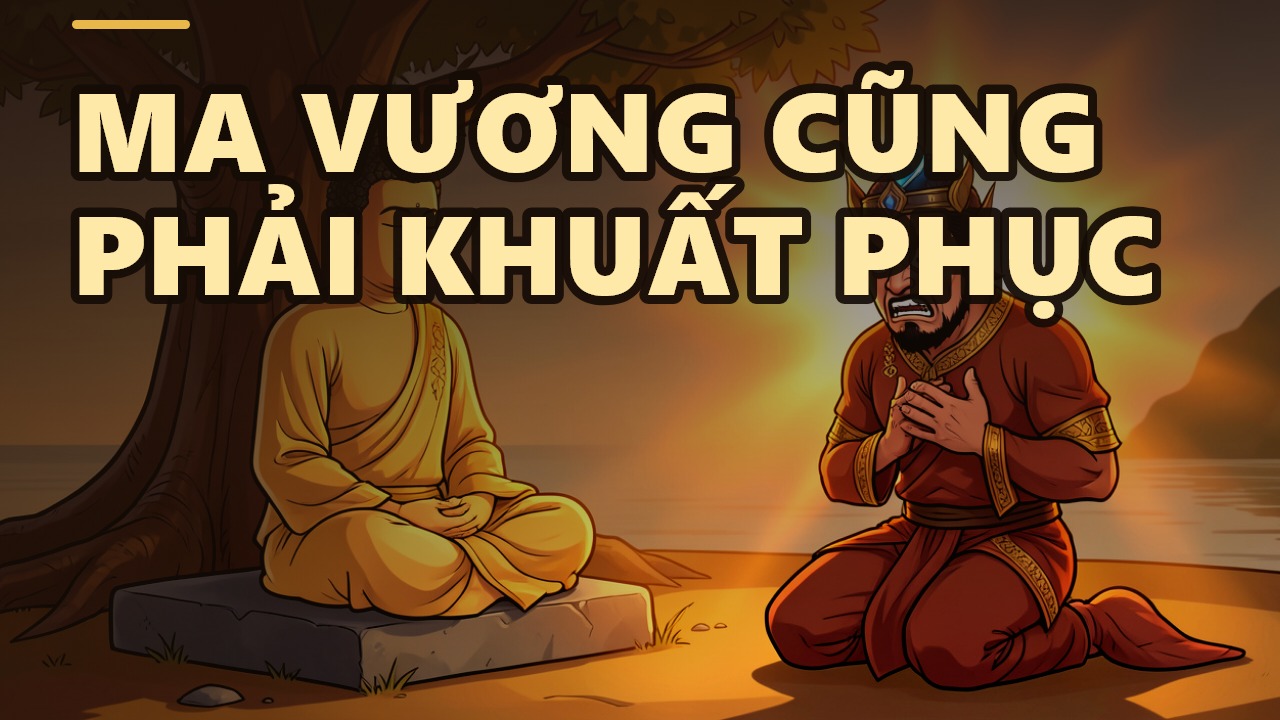
In ancient times, those who wished to cross the Ganges River had to lash together a raft of bamboo and laboriously pole their way to the other side. Whoever made it across would shout out in triumph. And yet the Buddha taught: "There is no this shore, no other shore; neither shore exists." So what does the other shore mean? Why would the wise one deny both shores? The story of the encounter between the Buddha and Mara in the Dhammapada opens a wonderful doorway onto the path of liberation for each of us.
The Other Shore — An Idiom of River Crossers
Thay Thich Chan Quang explains: "In the old days, Indians often used the phrase 'the other shore' to symbolize the arduous completion of some difficult task. The Ganges flows swift and strong, and crossing it was extremely hard. For anyone to reach the other shore was a remarkable feat." From this, the idiom "the other shore" became a symbol of accomplishment, of the ultimate goal. In the Mahayana sutras, it became the word "paramita" — absolute perfection.
"Neither shore exists, no this shore, no other shore, free of suffering and all bondage — such a one I call a Brahmin."
When Mara came to ask the Buddha about "the other shore," the Buddha rejected it outright. For if we cling to a shore, we remain trapped in concepts. Liberation is not about arriving somewhere; it is letting go of all attachment.
Mara Appears: Beautiful, Blessed, and Cunning
Mara did not come to the Buddha looking fearsome as we might imagine. Thay Chan Quang recounts: "Mara is extremely beautiful. Beauty comes from blessings from merit. Mara has great merit. They were people in past lives who accumulated much merit, yet in their hearts remained ambition, rivalry, cunning, and jealousy."
We tend to think of demons as wild-eyed and blood-dripping. In reality, a demon can appear as an ordinary person, even one with charm, power, and wealth. Thay reminds us: "Many people do good deeds and create merit, but if they still crave fame and use cunning schemes, they are a future Mara."
"Deep within Mara there lies a seed of holiness. And within us, even those of us practicing, there still remains a seed of Mara."
So each of us must look back at our own mind/heart. Do not assume that being gentle means being free of Mara. Sometimes jealousy, pettiness, or the desire to control others still lingers within — that is the seed of Mara hidden deep inside.
The Perfection of Generosity: Giving with Wisdom
Many people think the perfection of generosity means giving everything away without regret. But Thay Chan Quang points out: "Generosity reaches absolute perfection when the heart regrets nothing — but one must give to the right person who knows how to use it, for the benefit of many who come after."
Thay gives an example: "Suppose we meet a beggar and feel such pity that we give him a laptop. He does not know how to turn it on and uses it as a cushion to sit on — it gets ruined. It is like giving a poor neighbor three billion dong; he immediately takes a second wife, because his level only allows him to spend fifty thousand a day."
"The perfection of generosity means giving without regret, but with wisdom. Give to the right person, at the right time, in the right place, so that the benefit spreads across many generations."
Generosity is not merely about giving much, but about giving wisely. This is a profound lesson in practice within everyday life.
The Perfection of Patience: Not Weakness
Patience means not being angry. But must we always endure? Thay Chan Quang teaches: "The perfection of patience means the heart holds no anger, but the way we deal with the wicked must be to educate and restrain them, so they cannot harm others."
The wicked may be emboldened by our very silence. Thay gives an example: "If someone strikes me and I run away, that is not patience — that is fear. I could throw him down and pin him, reason with him, and then let him go — all without a trace of anger in my heart."
It is like the state imprisoning someone so they cannot kill again. That is compassion — patience with oneself, but firmness against evil.
Patience is not passivity. It is the fire of virtue that melts away all resentment, while still maintaining the humility to act in accordance with the Dharma.
Language Is Only a Pointer
Why did the Buddha reject both shores? Because language can never fully express the truth. Thay Chan Quang tells the story of four monks observing silence: sitting in meditation, the lamp went out, one reminded another "don't speak," and in the end all four had spoken. Thay teaches: "Language is only a pointer. Do not rely on words and get stuck in them. Use one saying to dispel another, until the mind grows bright and no longer needs words at all."
"Language can never fully express the profound truth. Language is only a pointer. We must use language to see the truth, but never cling to language."
In practice, we first use words and teachings to untangle our confusion. Each saying dispels one wandering thought. Gradually, our mind/heart grows bright, we let go of all language, and arrive at mindfulness and awakened awareness.
Free of Suffering, Free of Bondage — Living Freely Between the Two Shores
The verse of the Dhammapada is a welcome to the path of non-self (anatta). There is no this shore nor other shore — only a mind/heart free of attachment. When the heart is free of all suffering (dukkha) and all bonds are released, that person is a true spiritual guide. Let us abandon prejudice and jealousy, and conquer the demon within our own soul.
Each day, with one minute of meditative concentration, one minute of contemplation, we can gently cross the river of greed, hatred and delusion. And the destination is not "some place over there," but the peace of a soul set free. It is precisely in the absence of every shore that we touch nirvana.
AI-assisted translation from the Vietnamese original.
Read in Vietnamese →