
The Perfection of Generosity: Giving Without Limits
The perfection of generosity is not merely giving away material things; it is giving to the point of perfection, going beyond every limit of the self. Learn to give from a heartfelt aspiration, without boasting, so that step by step we may reach the other shore.
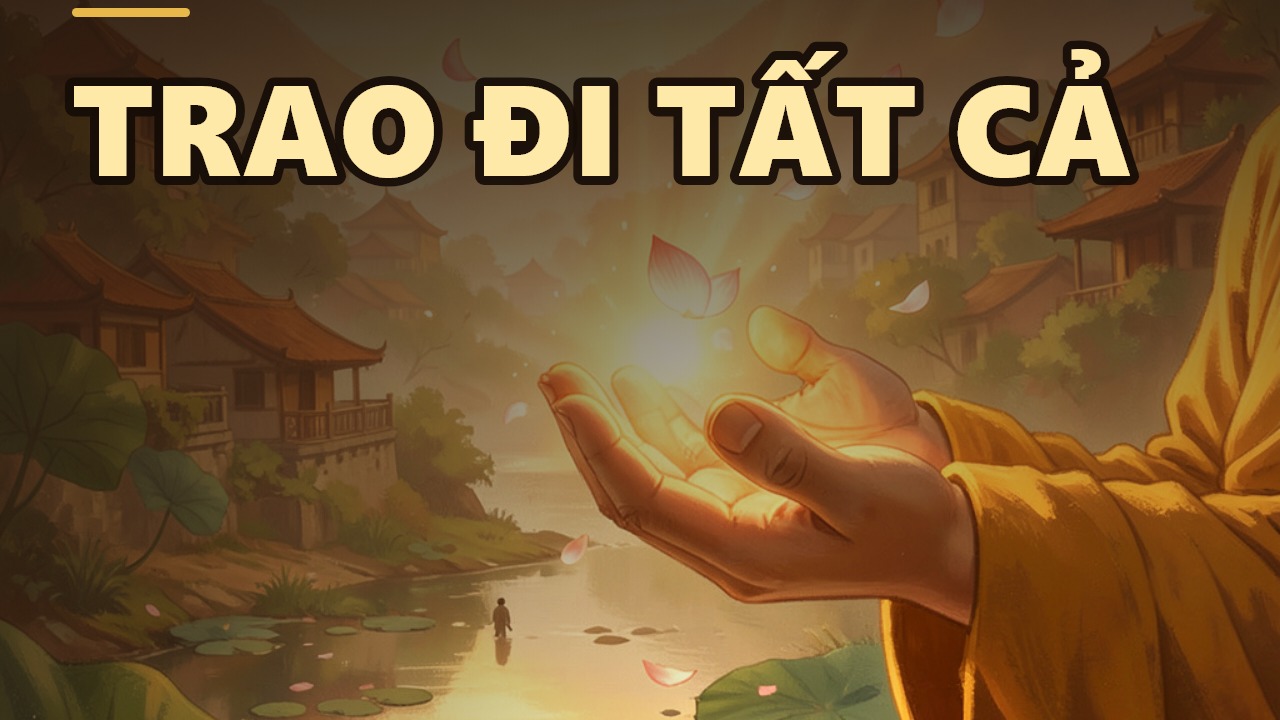
Have you ever given until there was nothing left to give? When people hear about the perfection of generosity, many think it means giving away everything, even sacrificing one's own life. But hidden deep within it is an even greater ideal: absolute perfection of the heart's aspiration.
Paramita — Not Just Crossing a River
In his dharma talk, Master Thích Chân Quang explains that the term "paramita" comes from Sanskrit, literally meaning "to arrive at the other shore." Yet its true meaning is not about wading across a river. It is about completing something fully, to the point of absolute perfection.
"The word paramita describes the very quality of practice within the Buddha's teachings (Dharma)... it means that whatever we do, we do it with a meaning, a quality, and a heart's aspiration that is absolutely perfect. That is called doing something in the way of paramita."
The Master offers an example: when we walk, we may walk leisurely or hurriedly. That attitude is the quality of the action. In the same way, when we practice generosity, it is a resolute, thoroughgoing attitude — free of all hesitation — that makes it paramita.
The Story of the Prince and the Hungry Tigers
To illustrate the spirit of the perfection of generosity, the Master tells a story from the Buddha's former lives:
Long ago, the Buddha was the youngest prince of a kingdom. Walking in the forest with his older brothers, he looked down into a ravine and saw a family of tigers starving. The mother had no milk left for her cubs, and they were all waiting for death. The brothers could only walk away, but the youngest prince turned back, took off his robe, and leapt into the ravine to offer himself to the tigers. The mother was too weak to tear the flesh, so he cut his own throat and let his blood flow, so that she could lick the blood, regain her strength, and only then eat.
"This story is often told to illustrate what is called the perfection of generosity. It means someone who dares to give to sentient beings without discrimination... no longer counting the value of his own life. Whenever he sees sentient beings in need, he saves them."
The story is beautiful, yet deeply challenging. It shows that the perfection of generosity is not only about giving away our possessions. It is about giving away our very selves, without hesitation and without calculation.
Without Hesitation — For the Body, the Mind, and the Self
In daily life, we find it easy to give away what we no longer need, yet we hesitate when asked to give what we truly cherish. The Master points out:
"We may dare to give in great matters, yet in small things we still hesitate. So the difference between a practice that is paramita and one that is not lies precisely in where we hesitate."
That hesitation springs from attachment to the self. We cling to the body, cling to our opinions, and even cling to beautiful states of meditative concentration. If we wish to give perfectly, we must practice letting go of the self, little by little — what the Master calls moving beyond the three levels of self-grasping.
The first level is grasping at the coarse body as self. We take this body to be "me," and we feel discomfort whenever anyone touches it. The second is grasping at our thoughts and intellect as self. We hold our own ideas to be right, which leads to arguments and conflict. The third is grasping at formless states as self. When meditation brings us to a state of vast emptiness, if we still cling to that experience, we have not yet attained the fruit of the path.
The Master recounts how the Buddha once asked the spiritual teachers of his day: "Does this meditative concentration still contain a self?" They could not answer. If a self remained, there was no liberation. But if there were no self at all, then who would be the one knowing he had attained realization? It was precisely because the Buddha could move beyond every level of self-grasping that he achieved the fruit of the path. Thus the perfection of generosity is not only about giving material things. It is about letting go of the ego — the most precious giving of all.
The Heart's Aspiration, Not Boastfulness
The Master emphasizes that the teaching of paramita is a great ideal, but we should never claim to have already achieved it. This is an easy mistake to make.
"We study these teachings of paramita in order to dream, in order to aspire. With that aspiration, whether in this life or in the lives to come, we will steadily strive toward it... It does not mean we have already achieved it."
The Master gives a warning: never take the paramita teachings out to show off, and never turn the teachings into a source of pride that makes us forget actual practice. The sight of people who exalt the Buddha's teachings (Dharma) yet live ordinary, untransformed lives is a heartbreaking paradox. Keep the mind/heart always humble. Listen to the teachings in order to nurture the aspiration to practice — not to become someone who understands the path but does not walk it.
Step by Step to the Other Shore
So how do we practice the perfection of generosity in modern life? We need not leap into a ravine of hungry tigers. We can begin training ourselves to give in small ways: giving our time, giving our care, giving a word of encouragement. Most important is to give without expecting anything in return, to give without clinging.
When we can relinquish the self, the world around us gradually becomes more harmonious. Each act of generosity becomes a step forward on the road to the other shore — the place where there are no more afflictions (kleshas), no more suffering (dukkha). Let us begin today, with a diligent aspiration and a heart full of compassion.
We may not yet have reached paramita, but we have dreamed, and we have aspired. That aspiration is the very seed of enlightenment. Rely on it, practice with patience and perseverance, and let every day of living be a day of giving completely.
AI-assisted translation from the Vietnamese original.
Read in Vietnamese →