
Where One Bank Erodes and Another Grows: Watching the River to Understand Cause and Effect and Live in Peace
As the river keeps building up one bank and washing away the other, so it is with life: the strong grow richer, while the weak suffer on. Understanding this phenomenon of one bank eroding and another growing opens the door to cause and effect (karmic law) and to enlightenment.
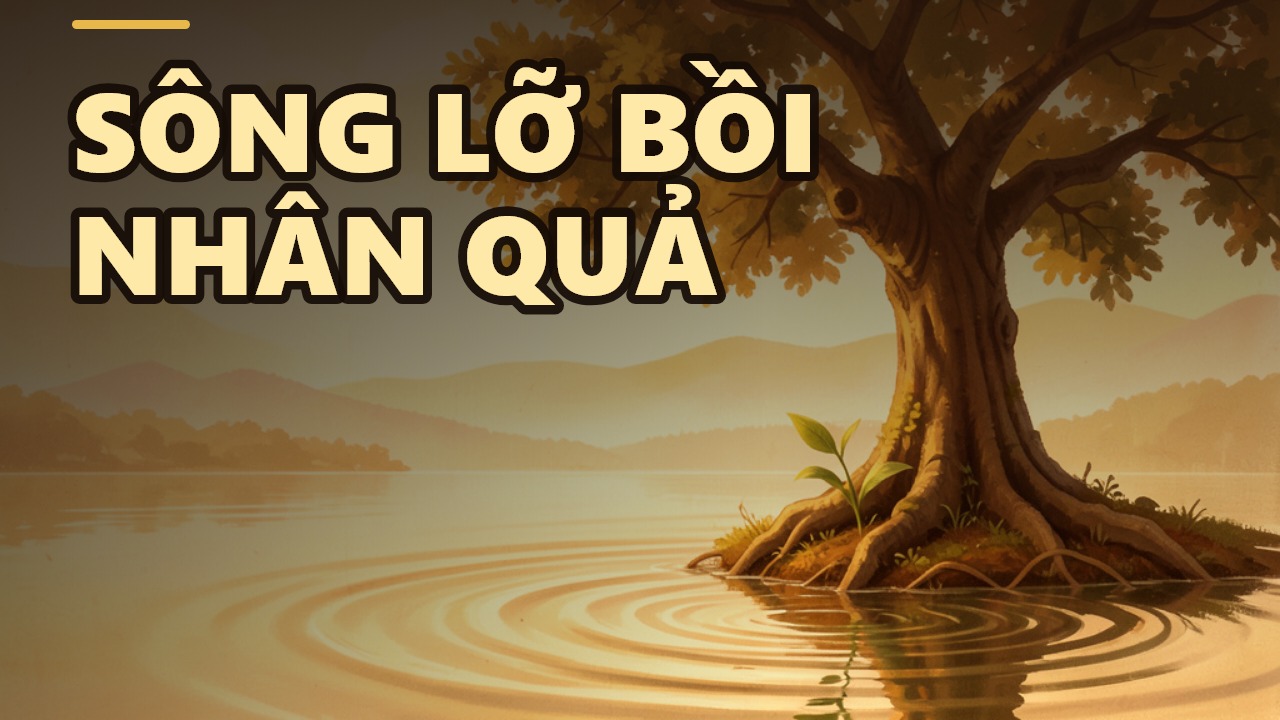
Have you ever stood by a riverbank and wondered why one side keeps crumbling away while the other side keeps growing? It seems the water is always carving out one side and filling in the opposite side, creating winding bends before finally sweeping them all aside to flow straight. This is not merely a matter of geology; it is also a story of cause and effect (karmic law) and of human life.
The river where one bank erodes and another grows – A metaphor for cause and effect and injustice
Thầy Thích Chân Quang opens his year-end dharma talk with a folk verse: "The river erodes one bank and builds up the other; the eroded bank erodes further, the growing bank grows more." From this natural phenomenon, the Thầy guides us into a social law: those with blessings from merit from past lives become wealthy and powerful, as if they were the growing bank; those with less merit are poor and weak, like the eroding bank.
"In life, there are these phenomena where some people, due to merit from past lives, now hold advantages over others. Naturally we are richer than others, stronger, more influential, with more power than others. And some people, due to less merit, are poorer in this life, more alone. Those who lack advantage are like the eroding bank. And so it goes, the growing bank keeps growing, the eroding bank keeps eroding."
And so the river becomes ever more winding: the growing bank is piled higher, the eroding bank is carved deeper. Wealth and poverty are the same – those with capital have opportunities to invest, to study, and to grow richer; those with empty hands must work for hire, are exploited, and their health slowly fades. This injustice seems like an inescapable law.
When the strong overpower the weak – Greed and collapse
Yet this unjust river does not flow forever. Thầy Chân Quang points out that when a river winds for too long, one day it will cut a straight path through its own course, abandoning its bends and leaving behind old ponds. That is when cause and effect (karmic law) takes its course – "the final days of the tyrant." Those who abuse power to plunder and exploit will be overthrown, their fortunes squandered, their descendants corrupted.
"That is what is called the growing bank growing more. Until the day the river flows straight – when is that day? Just recently, December twelfth, it was all swept away. That is the day when cause and effect (karmic law) settles its accounts, and the river flows straight."
Looking more broadly, history shows that many mighty empires, through invasion and expansion of influence, became enormous. But in the end, all of them crumbled. Greed and injustice create the eroding and growing banks, yet they also invite collapse. This is a lesson in the impermanence (anicca) of life and of all power.
Enjoying blessings from merit while still carrying wrongdoing? Why liberation is needed
There is something that sounds paradoxical: a person does good deeds and enjoys blessings from merit, yet alongside this, seeds of wrongdoing are sprouting. Because when a wealthy person calmly enjoys their comforts while others suffer in poverty, even without intending to exploit anyone, they are still creating some form of injustice. Thầy Chân Quang explains:
"When we do good deeds and enjoy blessings from merit, the seeds of injustice and cruelty begin to appear even as we enjoy those blessings. This two-sided nature of merit and wrongdoing constantly intertwines in this way."
Therefore, the ultimate ideal of Buddhism is not to enjoy blessings from merit forever, but liberation. The Buddha did not labor to teach us merely to do good deeds so we could enjoy pleasures throughout samsara (cycle of rebirth), for even within enjoying blessings lies the danger of injustice. Those who practice the Buddha's teachings (Dharma) must remember that nirvana is the final goal – even a bodhisattva must ultimately enter nirvana, leaving the work of teaching to those who come after.
Two core lessons: Experiencing karma and learning the Way
So what are we here in this life to do? Thầy Chân Quang makes it clear: each of us is here to experience the karma from our past and to learn the lessons of life. If we refuse to experience our karma (such as living in poverty yet resorting to stealing and deception), and if we draw no lessons from what we witness, then we will remain forever swept along in samsara (cycle of rebirth).
"We are here, and we should remember two things. One is to experience our karma; two is to learn the lessons from this life. If these two things are not complete, we will never escape samsara (cycle of rebirth)."
What lessons do we learn? When we meet someone who is suffering (dukkha), we learn compassion and readiness to help. When we meet someone successful, we learn sympathetic joy and avoid envy. When we meet someone with a disability, we reflect on cause and effect (karmic law). Everything before our eyes is an opportunity to awaken and look deeply into the truth.
From cause and effect to peace: Living awake amid the flow of life
A practitioner of the Buddha's teachings (Dharma) should be neither indifferent nor careless, yet neither should they be swept into rivalry and greed. In the face of adversity, keep the mind/heart at peace, for that is when karma is being repaid. In the face of good fortune, stay mindful, for blessings from merit can lead to indulgence. The Thầy emphasizes:
"We live in this world and keep our mind/heart at peace in the face of adversity, because that is us experiencing our karma. But second, we should have deep insight into every matter in life, so we can draw out a lesson, a truth for ourselves."
To gain such insight, we rely on the Buddha's teachings (Dharma): taking refuge in the Three Jewels, listening to dharma talks, reading sutras, and then examining our own lives. Buddhism is precisely a way to live well and to escape samsara (cycle of rebirth). It is not a faith of petitioning, but a path of wisdom and practice.
The road to liberation, without abandoning the world
Thầy Chân Quang warns that if we speak of liberation too soon, we will fall into passivity and negativity, benefiting no one. On the path toward liberation, we must live truly actively, selflessly, sacrificing for sentient beings. Do good deeds, plant wholesome seeds, but do not cling to their fruits. Be like that river – eroding here, growing there – yet always keeping your mind/heart straight like the original current, flowing toward the vast ocean of wisdom.
May each of us, through this dharma talk on the eroding and growing banks, realize that injustice is temporary, while cause and effect (karmic law) is real. And then, we can live in peace amid the flow of life, learning each small lesson, gathering each grain of wholesome merit, so that we never fall into being the eroding bank or the growing bank.
AI-assisted translation from the Vietnamese original.
Read in Vietnamese →