
Instinct or Reason: The Silent Battle Shaping Your Destiny
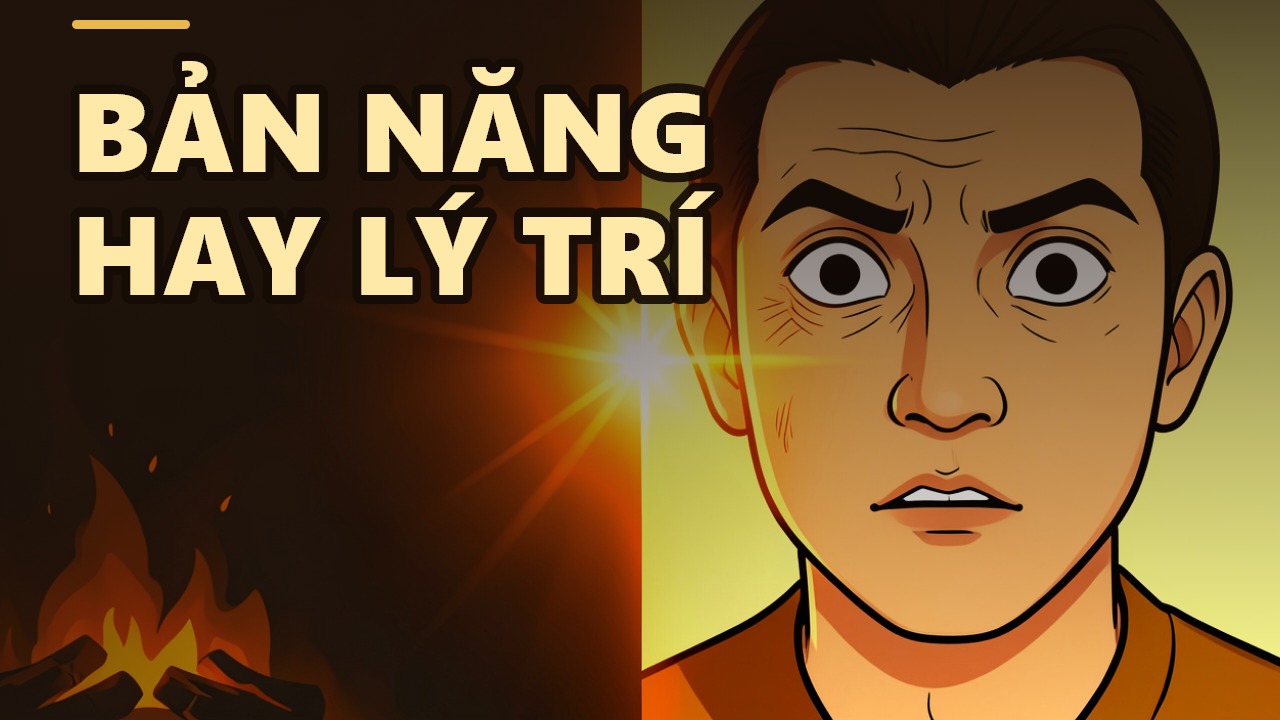
**Summary:** A dharma talk by Venerable Thích Chân Quang helps us recognize the struggle between instinct and reason, thereby learning to transform our karma, live in peace, and grow in the truest sense.
Have you ever wondered why, even when you clearly know what is right and what is wrong, you still follow old habits and momentary emotions? This is the silent battle between instinct and reason taking place within each of us. Today, let us listen to the profound sharing of Venerable Thích Chân Quang on this topic, to better understand ourselves and find the right path amidst the temptations of life.
**Instinct and Reason: Two Opposing Forces**
Instinct consists of inherent tendencies that require no learning, operating automatically like a pre-installed program in every species. Animals live entirely by instinct, without thought. Humans, however, possess reason, the ability to think and deliberate, which allows them to rise above instinct. Yet reason does not arise naturally; it must be cultivated and trained. This is why we need teachers, fellow practitioners, and education.
“Instinct is these natural, inherent tendencies that you don’t need to learn, that are simply there. Reason, however, must be learned, requires effort to be applied. Instinct needs no effort – it knows and acts on its own.”
**Parental Love: Instinct or Reason?**
When parents love their children, it is both natural instinct and reason. Instinct drives the automatic love, while reason guides them on how to raise and nurture their children to become good people. Conversely, a child's love for their parents leans more towards reason. When young, children depend on their parents, but as they grow older, if not educated in filial piety, they can easily forget the debt of gratitude for their birth. Therefore, the word "path" in filial piety reminds us that we must cultivate and train ourselves daily.
“Humans are similar, but because humans have reason, the ability to think and reflect, we compel ourselves to love our parents. That is called filial piety. Whenever the word 'path' is used, it signifies that we must cultivate and train with difficulty; what comes naturally requires no path.”
**Romantic Love: The Pull of Instinct**
When in love, we are often swept away by intense emotions—this is instinct. But behind this lies the factor of karmic conditions from the past. It is not that anyone we meet inspires love, but only a specific person who moves our heart. This is the operation of cause and effect. If we only follow instinct, we easily make misguided decisions. Here, reason plays a crucial role, helping us perceive things objectively and wisely.
“Instinct also has the governing influence of karmic conditions. So if we speak from the perspective of biologists or psychologists, they would define instinct as a biological programming. But from the view of Buddhism, instinct is programming that comes from both biology and karmic conditions from the past.”
**The Consequences of Living by Instinct**
Living by instinct brings momentary pleasure and delight, but the consequences are unpredictable. It is like riding a bicycle downhill—it feels exhilarating at first, but you might end up with broken bones. In contrast, living by reason, though it may feel exhausting and uncomfortable, leads to good and proud results. This struggle lasts a lifetime, and whoever wins will ascend, while whoever loses will decline.
“Living by instinct, we feel joy for a moment, but the consequences are dreadful. Living by reason, we restrain our instinct, which makes us weary, but the results are truly something to be proud of.”
**Reason is Not Dry, It is Wisdom**
Many people think that living by reason is dry and rigid. In truth, reason helps us have measured emotions and handle things skillfully and justly. A father who stops his child from going out with bad friends is not being dry; he is being wise, thinking ahead. Reason helps us balance emotion with righteousness, instinct with moral truth.
“Reason is wisdom. So do not think that what belongs to moral truth is dry; it is full of both compassion and wisdom.”
**Growing Up: Conquering Instinct**
Growing up is not about turning eighteen; it is when we learn to use reason to govern instinct. Some people at fifty still live by instinct, having not yet grown up. Others at fifteen or sixteen surpass this stage through spiritual practice. Those who genuinely practice as monastics often mature earlier than laypeople, because they are trained in an environment of the Dharma. Therefore, do not measure maturity by age, but by the degree to which you have conquered your own instinct.
“There are people who at fifty have not yet conquered this. But there are people who at fifteen or sixteen already have. We call them early bloomers. So maturity is not about age.”
The battle between instinct and reason is the most arduous battle in human life. But do not be discouraged, for each time you conquer instinct, you gain more merit, more blessings from merit. Remember, no one can help you overcome this except yourself. Listen to the Buddha's teachings, take refuge in the Three Jewels, and persevere in your practice. The results will come, not only in this life but in many lives to come. Start from today, from the smallest things: restraining a burst of anger, refusing an enticing invitation, or simply waking early to chant sutras. Each small victory is a step forward on the path to enlightenment.
AI-assisted translation from the Vietnamese original.
Read in Vietnamese →