
Love and Desire: Instinct or Trap? A Warning for Those Committed to Practice
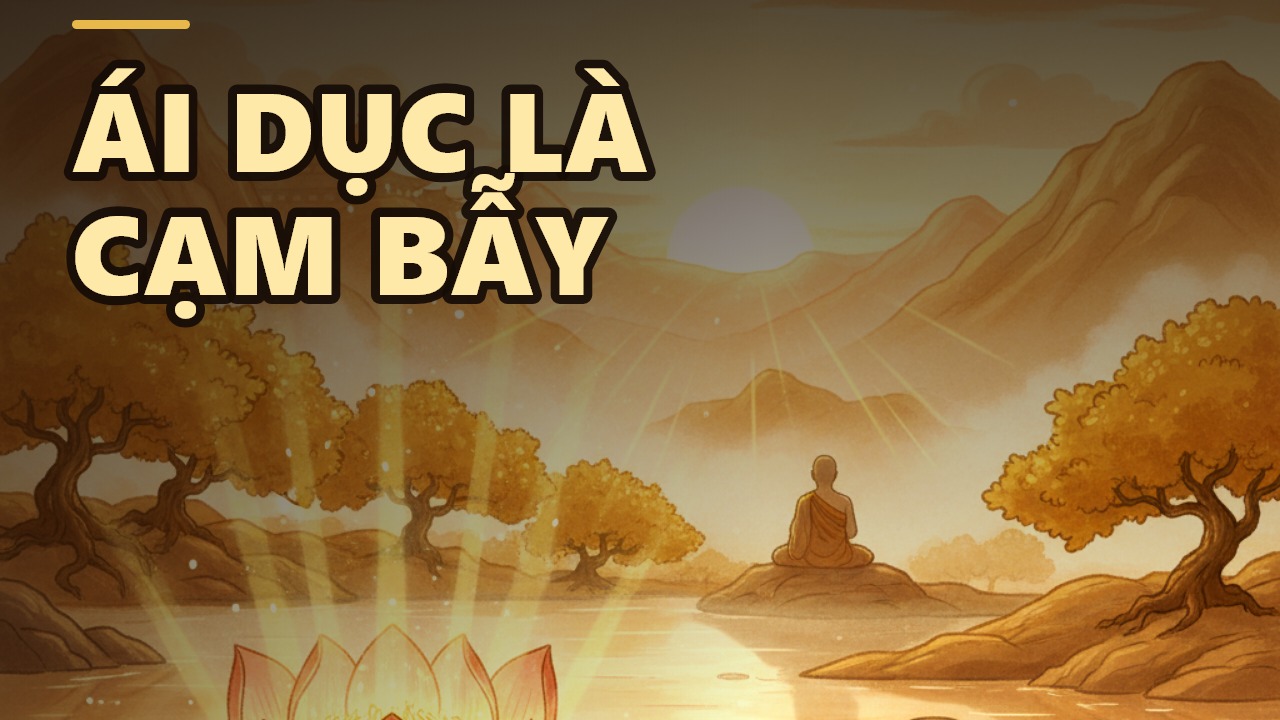
Have you ever wondered why some practitioners spend their entire lives unable to escape the bondage of emotional attachment? Or why, even within the monastery gates, so-called "love and desire" silently creep in, shaking one’s resolve for liberation? Today, Venerable Thich Chan Quang examines this issue with frankness, offering guidance for those truly determined on the path of practice.
### The Three Realms of Samsara and the Trap of the Desire Realm
The Buddha taught that the universe consists of three realms: the Desire Realm, the Form Realm, and the Formless Realm. We currently live in the Desire Realm, a place where sentient beings still engage in sexual conduct, including certain lower heavens. Ascending to the heavens of the Form Realm, devas no longer possess sensual desires but still retain physical forms. In the Formless Realm, only subtle consciousness remains. This reveals how formidable love and desire are; they mark the boundary between the human realm and the sacred realm.
"In the three realms and six paths, the Desire Realm encompasses beings from the lower heavens down to hell, because they still engage in sexual conduct."
### Love and Desire: Two Sides of the Same Coin
Many mistakenly believe that love and desire are identical. In reality, love refers to romantic affection, manifested through preferences for privacy, longing, jealousy, the desire for touch, and the wish to marry. Desire, however, is sexual conduct itself, rooted in genital pleasure. Love serves as a stepping stone that gradually leads to desire. As the teacher recounts, when asked how to distinguish love from friendship, a pigeon replied: "Friendship becomes more joyful with many people, while love becomes more joyful with fewer."
"The fundamental principle of love is the preference for privacy. It is this very privacy that gives rise to terrible selfishness, creating countless afflictions (kleshas)."
### Instinct or Not an Instinct?
Society often views desire as a natural instinct that everyone must possess. But if it were a vital survival instinct, why did the Buddha forbid it? And why have some individuals overcome it to attain enlightenment? The truth is, it is merely an intense craving, not a life-or-death instinct. It can be abandoned if we possess sufficient determination.
"If it were an instinct, forbidding it would mean death. But the Buddha forbade it, and those who overcome it attain the Way. Therefore, it is not a life-and-death instinct; it is simply too strong."
### The Modern Era: Pervasive Temptations
We live in an era saturated with Western lifestyles: obscene films, suggestive advertisements, and revealing clothing. These elements act as kindling for the fire of love and desire. Monastics who lack firm mental stability may become infected daily without realizing it. Laypeople, if they do not maintain discipline, also contribute to the weakening of the Buddha's teachings (Dharma).
"In today’s era, practicing pure celibacy is extremely difficult. Because Western lifestyles are pervasive, indulgence in love and desire is encouraged."
### How to Recognize Your Spiritual Capacity
The teacher offers a practical criterion: If you view love and desire as normal, you belong to the category of "human." However, if you find them uncomfortable, strange, or undesirable, you are moving toward the status of a "saint." This serves as a measure of each person’s spiritual roots.
"Those who see love and desire as normal are humans. Those who see love and desire as something unpleasant and undesirable are preparing to become saints."
### A Call to Action: Preserve Purity
It is time for us to sound the alarm. Whether monastic or layperson, every disciple of the Buddha should strive to maintain unblemished purity. As the teacher states, "A disciple of the Buddha who lives in pure, unblemished integrity, regardless of who they are, contributes to strengthening the Dharma and making the world more holy."
"A disciple of the Buddha who lives in pure, unblemished integrity, whether monastic or layperson, contributes to strengthening the Dharma and making this world more holy."
Let us begin today. Look inward and assess where you stand on the path to liberation. Do not let love and desire bind you; boldly step toward the light of purity. This is the only path that leads us to the shore of enlightenment.
AI-assisted translation from the Vietnamese original.
Read in Vietnamese →