
Demons Are Not Ugly at All: A Wake-Up Call from the Mara Samyutta Sutta
A dharma talk on the Mara Samyutta Sutta, revealing the connection between two worlds, warning of the subtle signs of Mara right within our own mind/heart, and teaching how to guard the mind so we do not become a "lesser demon."
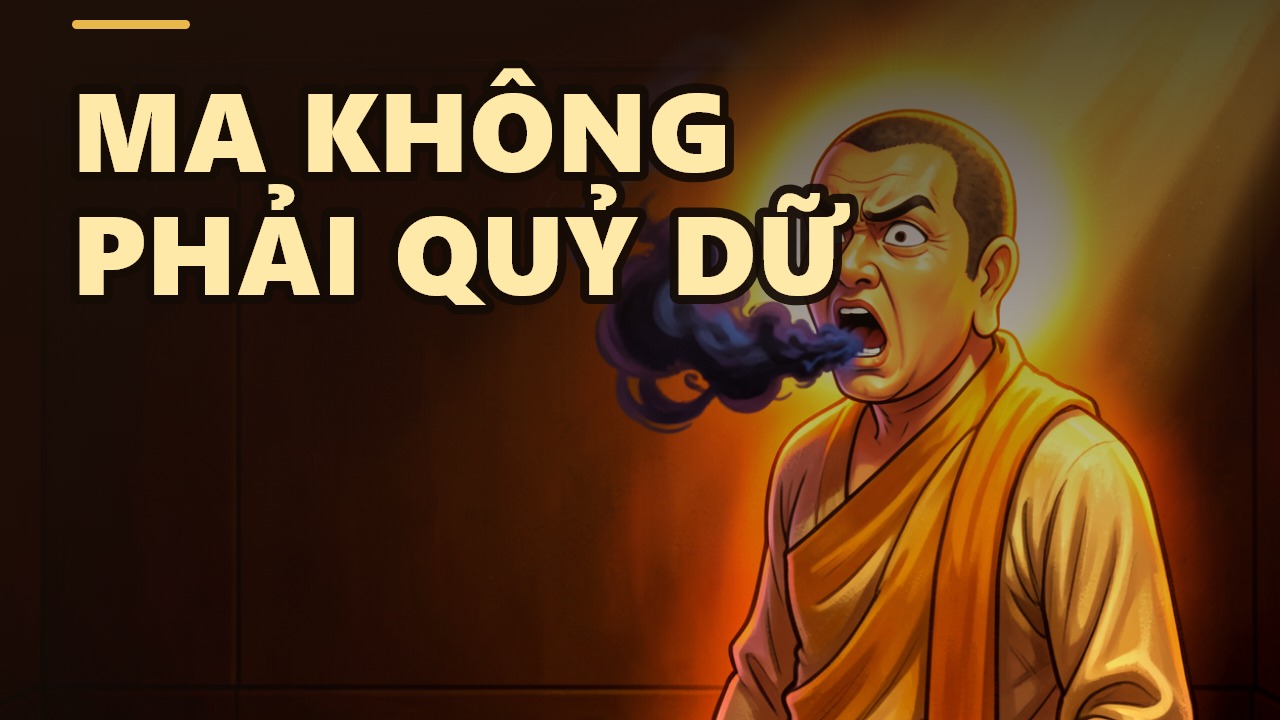
People often imagine demons as terrifying giants with sharp horns, but the Mara Samyutta Sutta reveals a different truth: a demon can be anyone, even ourselves.
The Mara Samyutta Sutta – The Story of the Monk with a Demon in His Belly
This sutra is the final one in the Majjhima Nikaya. It tells of the Venerable Maha Moggallana, who, while walking in meditation, felt a heaviness in his belly. It turned out that a demon had entered his body. The Venerable One rebuked it:
Come out, demon! Do not trouble the Tathagata or the Tathagata's disciples. Do not bring upon yourself misfortune and long suffering.
What is striking is that the demon at first did not believe the Venerable One knew of its presence. But when he said, "Do not think that I do not know you," the demon stepped out from his mouth. The name "Subduing Mara" is, in essence, a rebuke of demons – a rebuke of those who destroy the Dharma. Through this, the Mara Samyutta Sutta opens a window onto an unseen world that ordinary eyes cannot perceive.
The Supramundane World – Real Though Unseen
In this dharma talk, Master Thich Chan Quang reminds us to avoid two extremes: either becoming absorbed in mythology and living in fantasy, or denying the supramundane world entirely. The Buddha's teachings (Dharma) are a path of truth as it is:
Indeed, the Buddha's teachings are a very practical path, teaching people each aspect of life and speaking the truth as it is. And within that truth, whatever exists and whatever is real, the Buddha pointed out, because it affects our lives, our human existence, and our practice.
The supramundane world is not emptiness. Consider electricity – we cannot see the current, yet touching it gives us a sharp shock. Or consider a colorless, odorless poison that can kill. The unseen world likewise affects us every day, every hour, more powerfully than we imagine.
Who Is a Demon? The Most Dangerous One Needs No Horns
Here lies a paradox: no one admits to being a demon. When called a demon, they reply, "I am not a demon; I am a divine being." This is because demons also believe in cause and effect (karmic law); they too once made merit and practiced meditative concentration. Master Chan Quang warns:
The things we are doing now, demons once did as well – and with great skill, with great success... So be careful: we too may be becoming demons.
Dangerously, a person who is jealous, who cannot bear anyone surpassing them, and who seeks to sabotage the practice of others – that is the very cause of becoming a demon. Even Buddhists who make merit, but with a mind craving greater blessings from merit and with a heart of arrogance, may become demons in the future.
Signs of a "Lesser Demon" in Daily Life
You may encounter lesser demons around you: a student who secretly ruins the work of classmates, or someone who claims to be a saint yet harbors hatred for others. The Master teaches:
When you see someone more capable than yourself and instead of admiring and praising them, you feel resentment, no longer wish them well, and seek to sabotage their practice – that behavior is the behavior of a demon.
Another sign is a practitioner who sees the Buddha come to pat their head and say, "My child, you have entered deep meditative concentration." According to the Master, this is an illusion created by Mara for those with arrogant minds. Therefore:
The best practice is to see nothing at all. Many practitioners who see the Buddha or see saints – be careful, for that may not be the true Buddha or true saints, but demons appearing in disguise.
The Lesson from Maha Moggallana – The Courage to Face One's Past
In the sutra, Maha Moggallana recalls that in a former life he himself was a demon. Yet he spoke of it calmly, without concealment or shame. This courage to acknowledge past wrongs is the lesson for us all. Do not fear looking into the hidden corners of your soul in order to awaken, because:
Only the courageous can see their own faults.
The Mara Samyutta Sutta is not about confronting demons outside, but about a silent battle with our own mind/heart – so that each day we may keep it pure and full of compassion.
As the Master taught, let us live with a heart of compassion, observe ourselves, and never let ego and jealousy turn us into lesser demons. Be courageous enough to look at yourself honestly, so that on the path of practice, every step is light and mindful.
AI-assisted translation from the Vietnamese original.
Read in Vietnamese →